

Topics in Current Chemistry (2019) 377:23
1 3
1 Introduction
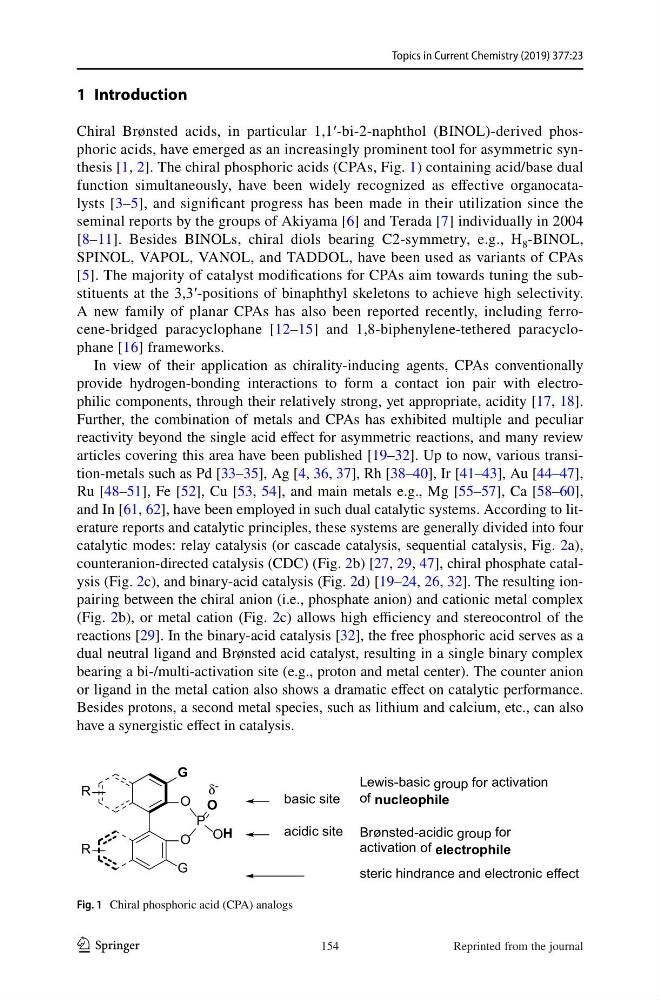
Chiral Brønsted acids, in particular 1,1′-bi-2-naphthol (BINOL)-derived phosphoric acids, have emerged as an increasingly prominent tool for asymmetric synthesis [1, 2]. The chiral phosphoric acids (CPAs, Fig. 1) containing acid/base dual
function simultaneously, have been widely recognized as effective organocatalysts [3–5], and significant progress has been made in their utilization since the
seminal reports by the groups of Akiyama [6] and Terada [7] individually in 2004
[8–11]. Besides BINOLs, chiral diols bearing C2-symmetry, e.g., H 8 -BINOL,
SPINOL, VAPOL, VANOL, and TADDOL, have been used as variants of CPAs
[5]. The majority of catalyst modifications for CPAs aim towards tuning the substituents at the 3,3′-positions of binaphthyl skeletons to achieve high selectivity.
A new family of planar CPAs has also been reported recently, including ferrocene-bridged paracyclophane [12–15] and 1,8-biphenylene-tethered paracyclophane [16] frameworks.
In view of their application as chirality-inducing agents, CPAs conventionally
provide hydrogen-bonding interactions to form a contact ion pair with electrophilic components, through their relatively strong, yet appropriate, acidity [17, 18].
Further, the combination of metals and CPAs has exhibited multiple and peculiar
reactivity beyond the single acid effect for asymmetric reactions, and many review
articles covering this area have been published [19–32]. Up to now, various transition-metals such as Pd [33–35], Ag [4, 36, 37], Rh [38–40], Ir [41–43], Au [44–47],
Ru [48–51], Fe [52], Cu [53, 54], and main metals e.g., Mg [55–57], Ca [58–60],
and In [61, 62], have been employed in such dual catalytic systems. According to literature reports and catalytic principles, these systems are generally divided into four
catalytic modes: relay catalysis (or cascade catalysis, sequential catalysis, Fig. 2a),
counteranion-directed catalysis (CDC) (Fig. 2b) [27, 29, 47], chiral phosphate catalysis (Fig. 2c), and binary-acid catalysis (Fig. 2d) [19–24, 26, 32]. The resulting ionpairing between the chiral anion (i.e., phosphate anion) and cationic metal complex
(Fig. 2b), or metal cation (Fig. 2c) allows high efficiency and stereocontrol of the
reactions [29]. In the binary-acid catalysis [32], the free phosphoric acid serves as a
dual neutral ligand and Brønsted acid catalyst, resulting in a single binary complex
bearing a bi-/multi-activation site (e.g., proton and metal center). The counter anion
or ligand in the metal cation also shows a dramatic effect on catalytic performance.
Besides protons, a second metal species, such as lithium and calcium, etc., can also
have a synergistic effect in catalysis.
acidic site
O
O
P
O
OH
G
G
R
R
basic site
Lewis-basic group for activation
of nucleophile
δ -
steric hindrance and electronic effect
Brønsted-acidic group for
activation of electrophile
Fig. 1 Chiral phosphoric acid (CPA) analogs
Reprinted from the journal
154
1 3
1 Introduction
Chiral Brønsted acids, in particular 1,1′-bi-2-naphthol (BINOL)-derived phosphoric acids, have emerged as an increasingly prominent tool for asymmetric synthesis [1, 2]. The chiral phosphoric acids (CPAs, Fig. 1) containing acid/base dual
function simultaneously, have been widely recognized as effective organocatalysts [3–5], and significant progress has been made in their utilization since the
seminal reports by the groups of Akiyama [6] and Terada [7] individually in 2004
[8–11]. Besides BINOLs, chiral diols bearing C2-symmetry, e.g., H 8 -BINOL,
SPINOL, VAPOL, VANOL, and TADDOL, have been used as variants of CPAs
[5]. The majority of catalyst modifications for CPAs aim towards tuning the substituents at the 3,3′-positions of binaphthyl skeletons to achieve high selectivity.
A new family of planar CPAs has also been reported recently, including ferrocene-bridged paracyclophane [12–15] and 1,8-biphenylene-tethered paracyclophane [16] frameworks.
In view of their application as chirality-inducing agents, CPAs conventionally
provide hydrogen-bonding interactions to form a contact ion pair with electrophilic components, through their relatively strong, yet appropriate, acidity [17, 18].
Further, the combination of metals and CPAs has exhibited multiple and peculiar
reactivity beyond the single acid effect for asymmetric reactions, and many review
articles covering this area have been published [19–32]. Up to now, various transition-metals such as Pd [33–35], Ag [4, 36, 37], Rh [38–40], Ir [41–43], Au [44–47],
Ru [48–51], Fe [52], Cu [53, 54], and main metals e.g., Mg [55–57], Ca [58–60],
and In [61, 62], have been employed in such dual catalytic systems. According to literature reports and catalytic principles, these systems are generally divided into four
catalytic modes: relay catalysis (or cascade catalysis, sequential catalysis, Fig. 2a),
counteranion-directed catalysis (CDC) (Fig. 2b) [27, 29, 47], chiral phosphate catalysis (Fig. 2c), and binary-acid catalysis (Fig. 2d) [19–24, 26, 32]. The resulting ionpairing between the chiral anion (i.e., phosphate anion) and cationic metal complex
(Fig. 2b), or metal cation (Fig. 2c) allows high efficiency and stereocontrol of the
reactions [29]. In the binary-acid catalysis [32], the free phosphoric acid serves as a
dual neutral ligand and Brønsted acid catalyst, resulting in a single binary complex
bearing a bi-/multi-activation site (e.g., proton and metal center). The counter anion
or ligand in the metal cation also shows a dramatic effect on catalytic performance.
Besides protons, a second metal species, such as lithium and calcium, etc., can also
have a synergistic effect in catalysis.
acidic site
O
O
P
O
OH
G
G
R
R
basic site
Lewis-basic group for activation
of nucleophile
δ -
steric hindrance and electronic effect
Brønsted-acidic group for
activation of electrophile
Fig. 1 Chiral phosphoric acid (CPA) analogs
Reprinted from the journal
154