

Topics in Current Chemistry (2019) 377:31
1 3
ammonium–phosphine 38 as a ligand in combination with BINOL derivative 52
under otherwise identical conditions led to the formation of racemic 55. These
results strongly suggest that ion-pairing between the ammonium–phosphine hybrid
achiral ligand and the chiral binaphtholate anion is a prerequisite for enabling this
asymmetric induction. It is important to note that the use of phosphine components
containing ammonium cation moieties at slightly different positions resulted in total
loss of enantioselectivity. Optimization of reaction conditions as well as the structures of the ligand components rendered this process highly enantioselective.
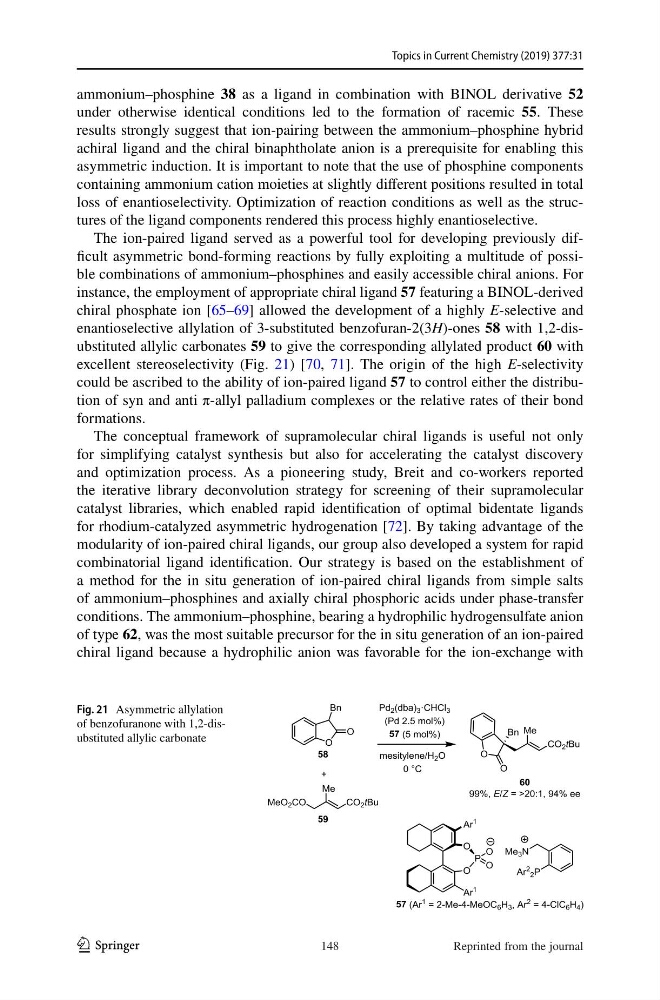
The ion-paired ligand served as a powerful tool for developing previously difficult asymmetric bond-forming reactions by fully exploiting a multitude of possible combinations of ammonium–phosphines and easily accessible chiral anions. For
instance, the employment of appropriate chiral ligand 57 featuring a BINOL-derived
chiral phosphate ion [65–69] allowed the development of a highly E-selective and
enantioselective allylation of 3-substituted benzofuran-2(3H)-ones 58 with 1,2-disubstituted allylic carbonates 59 to give the corresponding allylated product 60 with
excellent stereoselectivity (Fig. 21) [70, 71]. The origin of the high E-selectivity
could be ascribed to the ability of ion-paired ligand 57 to control either the distribution of syn and anti π-allyl palladium complexes or the relative rates of their bond
formations.
The conceptual framework of supramolecular chiral ligands is useful not only
for simplifying catalyst synthesis but also for accelerating the catalyst discovery
and optimization process. As a pioneering study, Breit and co-workers reported
the iterative library deconvolution strategy for screening of their supramolecular
catalyst libraries, which enabled rapid identification of optimal bidentate ligands
for rhodium-catalyzed asymmetric hydrogenation [72]. By taking advantage of the
modularity of ion-paired chiral ligands, our group also developed a system for rapid
combinatorial ligand identification. Our strategy is based on the establishment of
a method for the in situ generation of ion-paired chiral ligands from simple salts
of ammonium–phosphines and axially chiral phosphoric acids under phase-transfer
conditions. The ammonium–phosphine, bearing a hydrophilic hydrogensulfate anion
of type 62, was the most suitable precursor for the in situ generation of an ion-paired
chiral ligand because a hydrophilic anion was favorable for the ion-exchange with
Fig. 21 Asymmetric allylation
of benzofuranone with 1,2-disubstituted allylic carbonate
Reprinted from the journal
148
1 3
ammonium–phosphine 38 as a ligand in combination with BINOL derivative 52
under otherwise identical conditions led to the formation of racemic 55. These
results strongly suggest that ion-pairing between the ammonium–phosphine hybrid
achiral ligand and the chiral binaphtholate anion is a prerequisite for enabling this
asymmetric induction. It is important to note that the use of phosphine components
containing ammonium cation moieties at slightly different positions resulted in total
loss of enantioselectivity. Optimization of reaction conditions as well as the structures of the ligand components rendered this process highly enantioselective.
The ion-paired ligand served as a powerful tool for developing previously difficult asymmetric bond-forming reactions by fully exploiting a multitude of possible combinations of ammonium–phosphines and easily accessible chiral anions. For
instance, the employment of appropriate chiral ligand 57 featuring a BINOL-derived
chiral phosphate ion [65–69] allowed the development of a highly E-selective and
enantioselective allylation of 3-substituted benzofuran-2(3H)-ones 58 with 1,2-disubstituted allylic carbonates 59 to give the corresponding allylated product 60 with
excellent stereoselectivity (Fig. 21) [70, 71]. The origin of the high E-selectivity
could be ascribed to the ability of ion-paired ligand 57 to control either the distribution of syn and anti π-allyl palladium complexes or the relative rates of their bond
formations.
The conceptual framework of supramolecular chiral ligands is useful not only
for simplifying catalyst synthesis but also for accelerating the catalyst discovery
and optimization process. As a pioneering study, Breit and co-workers reported
the iterative library deconvolution strategy for screening of their supramolecular
catalyst libraries, which enabled rapid identification of optimal bidentate ligands
for rhodium-catalyzed asymmetric hydrogenation [72]. By taking advantage of the
modularity of ion-paired chiral ligands, our group also developed a system for rapid
combinatorial ligand identification. Our strategy is based on the establishment of
a method for the in situ generation of ion-paired chiral ligands from simple salts
of ammonium–phosphines and axially chiral phosphoric acids under phase-transfer
conditions. The ammonium–phosphine, bearing a hydrophilic hydrogensulfate anion
of type 62, was the most suitable precursor for the in situ generation of an ion-paired
chiral ligand because a hydrophilic anion was favorable for the ion-exchange with
Fig. 21 Asymmetric allylation
of benzofuranone with 1,2-disubstituted allylic carbonate
Reprinted from the journal
148