

1 3
Topics in Current Chemistry (2019) 377:31
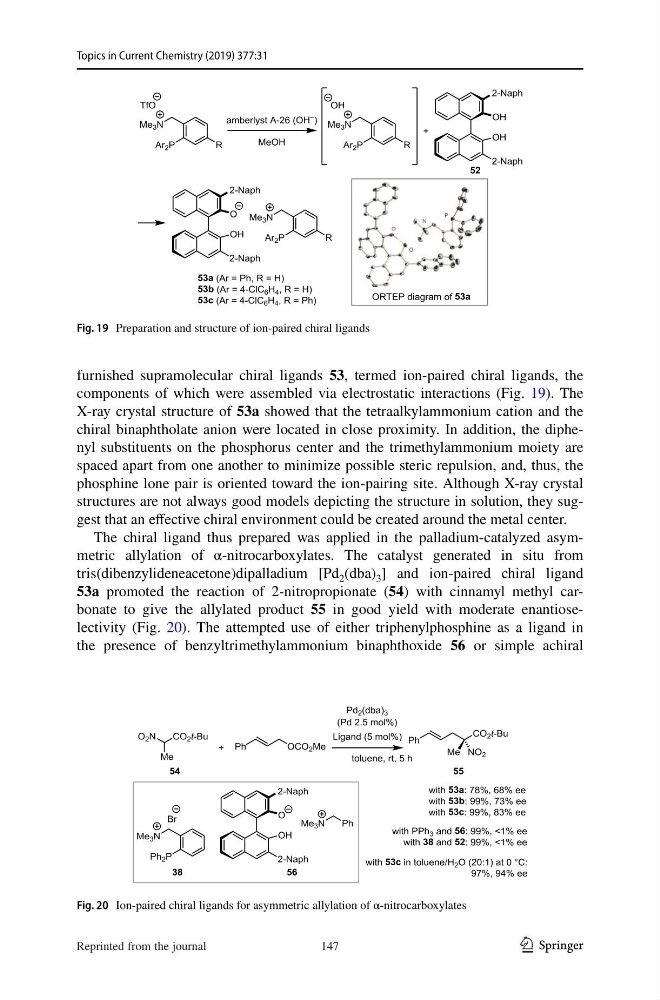
furnished supramolecular chiral ligands 53, termed ion-paired chiral ligands, the
components of which were assembled via electrostatic interactions (Fig. 19). The
X-ray crystal structure of 53a showed that the tetraalkylammonium cation and the
chiral binaphtholate anion were located in close proximity. In addition, the diphenyl substituents on the phosphorus center and the trimethylammonium moiety are
spaced apart from one another to minimize possible steric repulsion, and, thus, the
phosphine lone pair is oriented toward the ion-pairing site. Although X-ray crystal
structures are not always good models depicting the structure in solution, they suggest that an effective chiral environment could be created around the metal center.
The chiral ligand thus prepared was applied in the palladium-catalyzed asymmetric allylation of α-nitrocarboxylates. The catalyst generated in situ from
tris(dibenzylideneacetone)dipalladium [Pd 2 (dba) 3 ] and ion-paired chiral ligand
53a promoted the reaction of 2-nitropropionate (54) with cinnamyl methyl carbonate to give the allylated product 55 in good yield with moderate enantioselectivity (Fig. 20). The attempted use of either triphenylphosphine as a ligand in
the presence of benzyltrimethylammonium binaphthoxide 56 or simple achiral
Fig. 19 Preparation and structure of ion-paired chiral ligands
Fig. 20 Ion-paired chiral ligands for asymmetric allylation of α-nitrocarboxylates
Reprinted from the journal
147
Topics in Current Chemistry (2019) 377:31
furnished supramolecular chiral ligands 53, termed ion-paired chiral ligands, the
components of which were assembled via electrostatic interactions (Fig. 19). The
X-ray crystal structure of 53a showed that the tetraalkylammonium cation and the
chiral binaphtholate anion were located in close proximity. In addition, the diphenyl substituents on the phosphorus center and the trimethylammonium moiety are
spaced apart from one another to minimize possible steric repulsion, and, thus, the
phosphine lone pair is oriented toward the ion-pairing site. Although X-ray crystal
structures are not always good models depicting the structure in solution, they suggest that an effective chiral environment could be created around the metal center.
The chiral ligand thus prepared was applied in the palladium-catalyzed asymmetric allylation of α-nitrocarboxylates. The catalyst generated in situ from
tris(dibenzylideneacetone)dipalladium [Pd 2 (dba) 3 ] and ion-paired chiral ligand
53a promoted the reaction of 2-nitropropionate (54) with cinnamyl methyl carbonate to give the allylated product 55 in good yield with moderate enantioselectivity (Fig. 20). The attempted use of either triphenylphosphine as a ligand in
the presence of benzyltrimethylammonium binaphthoxide 56 or simple achiral
Fig. 19 Preparation and structure of ion-paired chiral ligands
Fig. 20 Ion-paired chiral ligands for asymmetric allylation of α-nitrocarboxylates
Reprinted from the journal
147