

Topics in Current Chemistry (2019) 377:31
1 3
Chiral ammonium–phosphines of type 39 also allowed for the establishment
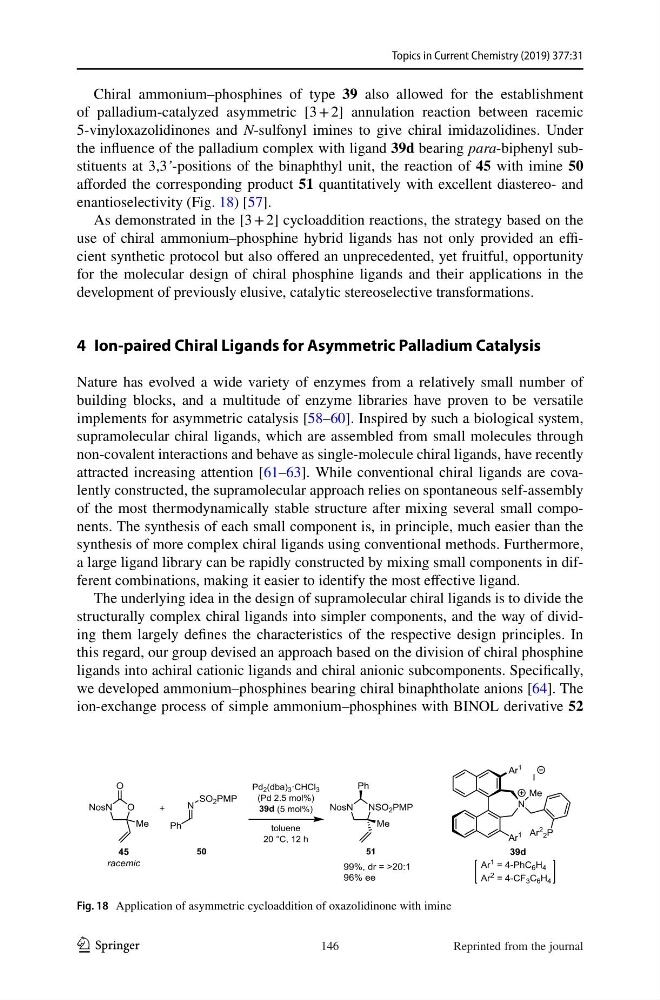
of palladium-catalyzed asymmetric [3 + 2] annulation reaction between racemic
5-vinyloxazolidinones and N-sulfonyl imines to give chiral imidazolidines. Under
the influence of the palladium complex with ligand 39d bearing para-biphenyl substituents at 3,3’-positions of the binaphthyl unit, the reaction of 45 with imine 50
afforded the corresponding product 51 quantitatively with excellent diastereo- and
enantioselectivity (Fig. 18) [57].
As demonstrated in the [3 + 2] cycloaddition reactions, the strategy based on the
use of chiral ammonium–phosphine hybrid ligands has not only provided an efficient synthetic protocol but also offered an unprecedented, yet fruitful, opportunity
for the molecular design of chiral phosphine ligands and their applications in the
development of previously elusive, catalytic stereoselective transformations.
4 Ion‑paired Chiral Ligands for Asymmetric Palladium Catalysis
Nature has evolved a wide variety of enzymes from a relatively small number of
building blocks, and a multitude of enzyme libraries have proven to be versatile
implements for asymmetric catalysis [58–60]. Inspired by such a biological system,
supramolecular chiral ligands, which are assembled from small molecules through
non-covalent interactions and behave as single-molecule chiral ligands, have recently
attracted increasing attention [61–63]. While conventional chiral ligands are covalently constructed, the supramolecular approach relies on spontaneous self-assembly
of the most thermodynamically stable structure after mixing several small components. The synthesis of each small component is, in principle, much easier than the
synthesis of more complex chiral ligands using conventional methods. Furthermore,
a large ligand library can be rapidly constructed by mixing small components in different combinations, making it easier to identify the most effective ligand.
The underlying idea in the design of supramolecular chiral ligands is to divide the
structurally complex chiral ligands into simpler components, and the way of dividing them largely defines the characteristics of the respective design principles. In
this regard, our group devised an approach based on the division of chiral phosphine
ligands into achiral cationic ligands and chiral anionic subcomponents. Specifically,
we developed ammonium–phosphines bearing chiral binaphtholate anions [64]. The
ion-exchange process of simple ammonium–phosphines with BINOL derivative 52
Fig. 18 Application of asymmetric cycloaddition of oxazolidinone with imine
Reprinted from the journal
146
1 3
Chiral ammonium–phosphines of type 39 also allowed for the establishment
of palladium-catalyzed asymmetric [3 + 2] annulation reaction between racemic
5-vinyloxazolidinones and N-sulfonyl imines to give chiral imidazolidines. Under
the influence of the palladium complex with ligand 39d bearing para-biphenyl substituents at 3,3’-positions of the binaphthyl unit, the reaction of 45 with imine 50
afforded the corresponding product 51 quantitatively with excellent diastereo- and
enantioselectivity (Fig. 18) [57].
As demonstrated in the [3 + 2] cycloaddition reactions, the strategy based on the
use of chiral ammonium–phosphine hybrid ligands has not only provided an efficient synthetic protocol but also offered an unprecedented, yet fruitful, opportunity
for the molecular design of chiral phosphine ligands and their applications in the
development of previously elusive, catalytic stereoselective transformations.
4 Ion‑paired Chiral Ligands for Asymmetric Palladium Catalysis
Nature has evolved a wide variety of enzymes from a relatively small number of
building blocks, and a multitude of enzyme libraries have proven to be versatile
implements for asymmetric catalysis [58–60]. Inspired by such a biological system,
supramolecular chiral ligands, which are assembled from small molecules through
non-covalent interactions and behave as single-molecule chiral ligands, have recently
attracted increasing attention [61–63]. While conventional chiral ligands are covalently constructed, the supramolecular approach relies on spontaneous self-assembly
of the most thermodynamically stable structure after mixing several small components. The synthesis of each small component is, in principle, much easier than the
synthesis of more complex chiral ligands using conventional methods. Furthermore,
a large ligand library can be rapidly constructed by mixing small components in different combinations, making it easier to identify the most effective ligand.
The underlying idea in the design of supramolecular chiral ligands is to divide the
structurally complex chiral ligands into simpler components, and the way of dividing them largely defines the characteristics of the respective design principles. In
this regard, our group devised an approach based on the division of chiral phosphine
ligands into achiral cationic ligands and chiral anionic subcomponents. Specifically,
we developed ammonium–phosphines bearing chiral binaphtholate anions [64]. The
ion-exchange process of simple ammonium–phosphines with BINOL derivative 52
Fig. 18 Application of asymmetric cycloaddition of oxazolidinone with imine
Reprinted from the journal
146