

1 3
Topics in Current Chemistry (2019) 377:31
caused a significant decrease in reactivity toward the subsequent nucleophilic
addition of the sulfonamide to 41. Ammonium–phosphine 39c would create an
effective chiral environment through the formation of the doubly ion-paired complex D, where the iodide ion would preferentially associate with the cationic palladium center and thus inhibit the unfavorable coordination between the sulfonamide and palladium.
The unique and remarkable ability of ammonium–phosphine hybrid ligand 39c
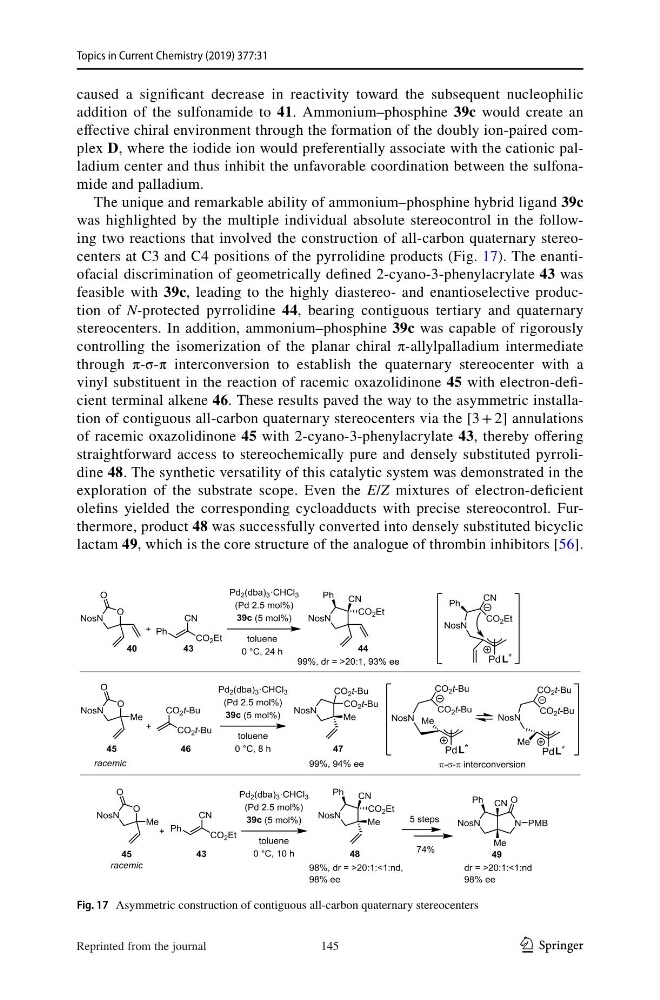
was highlighted by the multiple individual absolute stereocontrol in the following two reactions that involved the construction of all-carbon quaternary stereocenters at C3 and C4 positions of the pyrrolidine products (Fig. 17). The enantiofacial discrimination of geometrically defined 2-cyano-3-phenylacrylate 43 was
feasible with 39c, leading to the highly diastereo- and enantioselective production of N-protected pyrrolidine 44, bearing contiguous tertiary and quaternary
stereocenters. In addition, ammonium–phosphine 39c was capable of rigorously
controlling the isomerization of the planar chiral π-allylpalladium intermediate
through π-σ-π interconversion to establish the quaternary stereocenter with a
vinyl substituent in the reaction of racemic oxazolidinone 45 with electron-deficient terminal alkene 46. These results paved the way to the asymmetric installation of contiguous all-carbon quaternary stereocenters via the [3 + 2] annulations
of racemic oxazolidinone 45 with 2-cyano-3-phenylacrylate 43, thereby offering
straightforward access to stereochemically pure and densely substituted pyrrolidine 48. The synthetic versatility of this catalytic system was demonstrated in the
exploration of the substrate scope. Even the E/Z mixtures of electron-deficient
olefins yielded the corresponding cycloadducts with precise stereocontrol. Furthermore, product 48 was successfully converted into densely substituted bicyclic
lactam 49, which is the core structure of the analogue of thrombin inhibitors [56].
Fig. 17 Asymmetric construction of contiguous all-carbon quaternary stereocenters
Reprinted from the journal
145
Topics in Current Chemistry (2019) 377:31
caused a significant decrease in reactivity toward the subsequent nucleophilic
addition of the sulfonamide to 41. Ammonium–phosphine 39c would create an
effective chiral environment through the formation of the doubly ion-paired complex D, where the iodide ion would preferentially associate with the cationic palladium center and thus inhibit the unfavorable coordination between the sulfonamide and palladium.
The unique and remarkable ability of ammonium–phosphine hybrid ligand 39c
was highlighted by the multiple individual absolute stereocontrol in the following two reactions that involved the construction of all-carbon quaternary stereocenters at C3 and C4 positions of the pyrrolidine products (Fig. 17). The enantiofacial discrimination of geometrically defined 2-cyano-3-phenylacrylate 43 was
feasible with 39c, leading to the highly diastereo- and enantioselective production of N-protected pyrrolidine 44, bearing contiguous tertiary and quaternary
stereocenters. In addition, ammonium–phosphine 39c was capable of rigorously
controlling the isomerization of the planar chiral π-allylpalladium intermediate
through π-σ-π interconversion to establish the quaternary stereocenter with a
vinyl substituent in the reaction of racemic oxazolidinone 45 with electron-deficient terminal alkene 46. These results paved the way to the asymmetric installation of contiguous all-carbon quaternary stereocenters via the [3 + 2] annulations
of racemic oxazolidinone 45 with 2-cyano-3-phenylacrylate 43, thereby offering
straightforward access to stereochemically pure and densely substituted pyrrolidine 48. The synthetic versatility of this catalytic system was demonstrated in the
exploration of the substrate scope. Even the E/Z mixtures of electron-deficient
olefins yielded the corresponding cycloadducts with precise stereocontrol. Furthermore, product 48 was successfully converted into densely substituted bicyclic
lactam 49, which is the core structure of the analogue of thrombin inhibitors [56].
Fig. 17 Asymmetric construction of contiguous all-carbon quaternary stereocenters
Reprinted from the journal
145