

Topics in Current Chemistry (2019) 377:31
1 3
architecture for the precise stereocontrol was also confirmed by the experiments
using structurally similar, yet non-triazolium type, chiral cobalt complexes.
3.2 Chiral Ammonium–Phosphine Hybrid Ligands for Asymmetric Palladium
Catalysis
The incorporation of onium salt functionality into ligands has also been shown
to be a powerful strategy for asymmetric transition-metal catalysis. Our group
developed a triarylphosphine ligand with a pendant axially chiral ammonium salt
of type 39, which imparted preeminent catalytic activity and stereocontrolling
ability to the corresponding palladium complex [55]. The idea of designing this
ligand originated from the substantial enhancement in reactivity observed in the
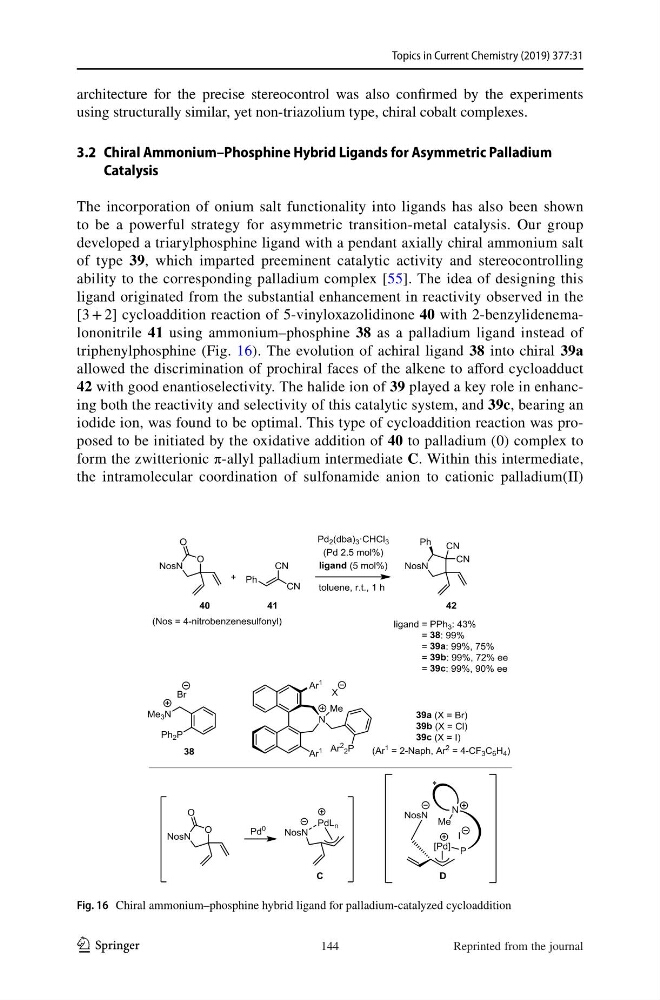
[3 + 2] cycloaddition reaction of 5-vinyloxazolidinone 40 with 2-benzylidenemalononitrile 41 using ammonium–phosphine 38 as a palladium ligand instead of
triphenylphosphine (Fig. 16). The evolution of achiral ligand 38 into chiral 39a
allowed the discrimination of prochiral faces of the alkene to afford cycloadduct
42 with good enantioselectivity. The halide ion of 39 played a key role in enhancing both the reactivity and selectivity of this catalytic system, and 39c, bearing an
iodide ion, was found to be optimal. This type of cycloaddition reaction was proposed to be initiated by the oxidative addition of 40 to palladium (0) complex to
form the zwitterionic π-allyl palladium intermediate C. Within this intermediate,
the intramolecular coordination of sulfonamide anion to cationic palladium(II)
Fig. 16 Chiral ammonium–phosphine hybrid ligand for palladium-catalyzed cycloaddition
Reprinted from the journal
144
1 3
architecture for the precise stereocontrol was also confirmed by the experiments
using structurally similar, yet non-triazolium type, chiral cobalt complexes.
3.2 Chiral Ammonium–Phosphine Hybrid Ligands for Asymmetric Palladium
Catalysis
The incorporation of onium salt functionality into ligands has also been shown
to be a powerful strategy for asymmetric transition-metal catalysis. Our group
developed a triarylphosphine ligand with a pendant axially chiral ammonium salt
of type 39, which imparted preeminent catalytic activity and stereocontrolling
ability to the corresponding palladium complex [55]. The idea of designing this
ligand originated from the substantial enhancement in reactivity observed in the
[3 + 2] cycloaddition reaction of 5-vinyloxazolidinone 40 with 2-benzylidenemalononitrile 41 using ammonium–phosphine 38 as a palladium ligand instead of
triphenylphosphine (Fig. 16). The evolution of achiral ligand 38 into chiral 39a
allowed the discrimination of prochiral faces of the alkene to afford cycloadduct
42 with good enantioselectivity. The halide ion of 39 played a key role in enhancing both the reactivity and selectivity of this catalytic system, and 39c, bearing an
iodide ion, was found to be optimal. This type of cycloaddition reaction was proposed to be initiated by the oxidative addition of 40 to palladium (0) complex to
form the zwitterionic π-allyl palladium intermediate C. Within this intermediate,
the intramolecular coordination of sulfonamide anion to cationic palladium(II)
Fig. 16 Chiral ammonium–phosphine hybrid ligand for palladium-catalyzed cycloaddition
Reprinted from the journal
144