

1 3
Topics in Current Chemistry (2019) 377:31
from (1S,2R)-2-amino-1,2-diphenylethanol to (1R,2S)-2-amino-1-phenylpropanol
led to the reversal of diastereoselectivity; the reaction with nickel complex 31b
under otherwise identical conditions afforded 33b as a major diastereomer with
high enantioselectivity. The analysis of the absolute stereochemistries of 33a and
33b revealed that the stereocenters generated at the C3 position of the oxindole
component had opposite configurations, while those of the nitroalkane side chain
were identical. This information indicated that the orientation of the oxindolederived enolate in the transition state of the bond formation would be dictated by
the nickel–iminoalcohol units and nitrostyrene would interact with the bisimidazolium ions in 31 through electrostatic and hydrogen-bonding interactions. Such
a multiple recognition of substrates by taking advantage of the hybrid catalyst
structure comprising of chiral nickel–iminoalcohol and axially chiral bisimidazolium represents a powerful strategy for achieving the catalyst-controlled diastereodivergence, which remains a formidable challenge in catalytic asymmetric
synthesis [51, 52].
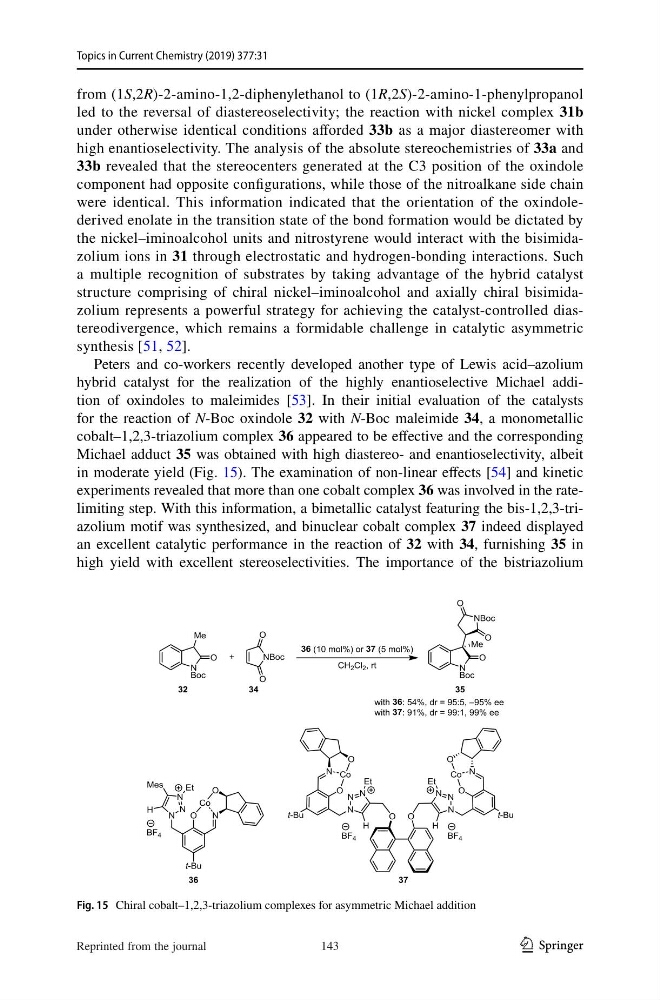
Peters and co-workers recently developed another type of Lewis acid–azolium
hybrid catalyst for the realization of the highly enantioselective Michael addition of oxindoles to maleimides [53]. In their initial evaluation of the catalysts
for the reaction of N-Boc oxindole 32 with N-Boc maleimide 34, a monometallic
cobalt–1,2,3-triazolium complex 36 appeared to be effective and the corresponding
Michael adduct 35 was obtained with high diastereo- and enantioselectivity, albeit
in moderate yield (Fig. 15). The examination of non-linear effects [54] and kinetic
experiments revealed that more than one cobalt complex 36 was involved in the ratelimiting step. With this information, a bimetallic catalyst featuring the bis-1,2,3-triazolium motif was synthesized, and binuclear cobalt complex 37 indeed displayed
an excellent catalytic performance in the reaction of 32 with 34, furnishing 35 in
high yield with excellent stereoselectivities. The importance of the bistriazolium
Fig. 15 Chiral cobalt–1,2,3-triazolium complexes for asymmetric Michael addition
Reprinted from the journal
143
Topics in Current Chemistry (2019) 377:31
from (1S,2R)-2-amino-1,2-diphenylethanol to (1R,2S)-2-amino-1-phenylpropanol
led to the reversal of diastereoselectivity; the reaction with nickel complex 31b
under otherwise identical conditions afforded 33b as a major diastereomer with
high enantioselectivity. The analysis of the absolute stereochemistries of 33a and
33b revealed that the stereocenters generated at the C3 position of the oxindole
component had opposite configurations, while those of the nitroalkane side chain
were identical. This information indicated that the orientation of the oxindolederived enolate in the transition state of the bond formation would be dictated by
the nickel–iminoalcohol units and nitrostyrene would interact with the bisimidazolium ions in 31 through electrostatic and hydrogen-bonding interactions. Such
a multiple recognition of substrates by taking advantage of the hybrid catalyst
structure comprising of chiral nickel–iminoalcohol and axially chiral bisimidazolium represents a powerful strategy for achieving the catalyst-controlled diastereodivergence, which remains a formidable challenge in catalytic asymmetric
synthesis [51, 52].
Peters and co-workers recently developed another type of Lewis acid–azolium
hybrid catalyst for the realization of the highly enantioselective Michael addition of oxindoles to maleimides [53]. In their initial evaluation of the catalysts
for the reaction of N-Boc oxindole 32 with N-Boc maleimide 34, a monometallic
cobalt–1,2,3-triazolium complex 36 appeared to be effective and the corresponding
Michael adduct 35 was obtained with high diastereo- and enantioselectivity, albeit
in moderate yield (Fig. 15). The examination of non-linear effects [54] and kinetic
experiments revealed that more than one cobalt complex 36 was involved in the ratelimiting step. With this information, a bimetallic catalyst featuring the bis-1,2,3-triazolium motif was synthesized, and binuclear cobalt complex 37 indeed displayed
an excellent catalytic performance in the reaction of 32 with 34, furnishing 35 in
high yield with excellent stereoselectivities. The importance of the bistriazolium
Fig. 15 Chiral cobalt–1,2,3-triazolium complexes for asymmetric Michael addition
Reprinted from the journal
143