

Topics in Current Chemistry (2019) 377:31
1 3
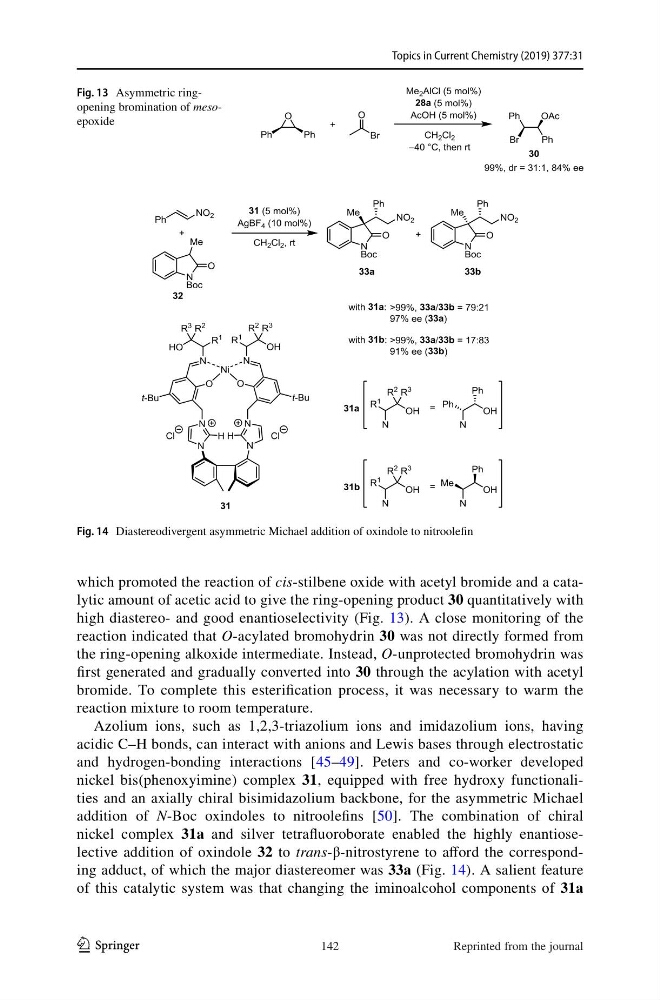
which promoted the reaction of cis-stilbene oxide with acetyl bromide and a catalytic amount of acetic acid to give the ring-opening product 30 quantitatively with
high diastereo- and good enantioselectivity (Fig. 13). A close monitoring of the
reaction indicated that O-acylated bromohydrin 30 was not directly formed from
the ring-opening alkoxide intermediate. Instead, O-unprotected bromohydrin was
first generated and gradually converted into 30 through the acylation with acetyl
bromide. To complete this esterification process, it was necessary to warm the
reaction mixture to room temperature.
Azolium ions, such as 1,2,3-triazolium ions and imidazolium ions, having
acidic C–H bonds, can interact with anions and Lewis bases through electrostatic
and hydrogen-bonding interactions [45–49]. Peters and co-worker developed
nickel bis(phenoxyimine) complex 31, equipped with free hydroxy functionalities and an axially chiral bisimidazolium backbone, for the asymmetric Michael
addition of N-Boc oxindoles to nitroolefins [50]. The combination of chiral
nickel complex 31a and silver tetrafluoroborate enabled the highly enantioselective addition of oxindole 32 to trans-β-nitrostyrene to afford the corresponding adduct, of which the major diastereomer was 33a (Fig. 14). A salient feature
of this catalytic system was that changing the iminoalcohol components of 31a
Fig. 13 Asymmetric ringopening bromination of mesoepoxide
Fig. 14 Diastereodivergent asymmetric Michael addition of oxindole to nitroolefin
Reprinted from the journal
142
1 3
which promoted the reaction of cis-stilbene oxide with acetyl bromide and a catalytic amount of acetic acid to give the ring-opening product 30 quantitatively with
high diastereo- and good enantioselectivity (Fig. 13). A close monitoring of the
reaction indicated that O-acylated bromohydrin 30 was not directly formed from
the ring-opening alkoxide intermediate. Instead, O-unprotected bromohydrin was
first generated and gradually converted into 30 through the acylation with acetyl
bromide. To complete this esterification process, it was necessary to warm the
reaction mixture to room temperature.
Azolium ions, such as 1,2,3-triazolium ions and imidazolium ions, having
acidic C–H bonds, can interact with anions and Lewis bases through electrostatic
and hydrogen-bonding interactions [45–49]. Peters and co-worker developed
nickel bis(phenoxyimine) complex 31, equipped with free hydroxy functionalities and an axially chiral bisimidazolium backbone, for the asymmetric Michael
addition of N-Boc oxindoles to nitroolefins [50]. The combination of chiral
nickel complex 31a and silver tetrafluoroborate enabled the highly enantioselective addition of oxindole 32 to trans-β-nitrostyrene to afford the corresponding adduct, of which the major diastereomer was 33a (Fig. 14). A salient feature
of this catalytic system was that changing the iminoalcohol components of 31a
Fig. 13 Asymmetric ringopening bromination of mesoepoxide
Fig. 14 Diastereodivergent asymmetric Michael addition of oxindole to nitroolefin
Reprinted from the journal
142