

1 3
Topics in Current Chemistry (2019) 377:31
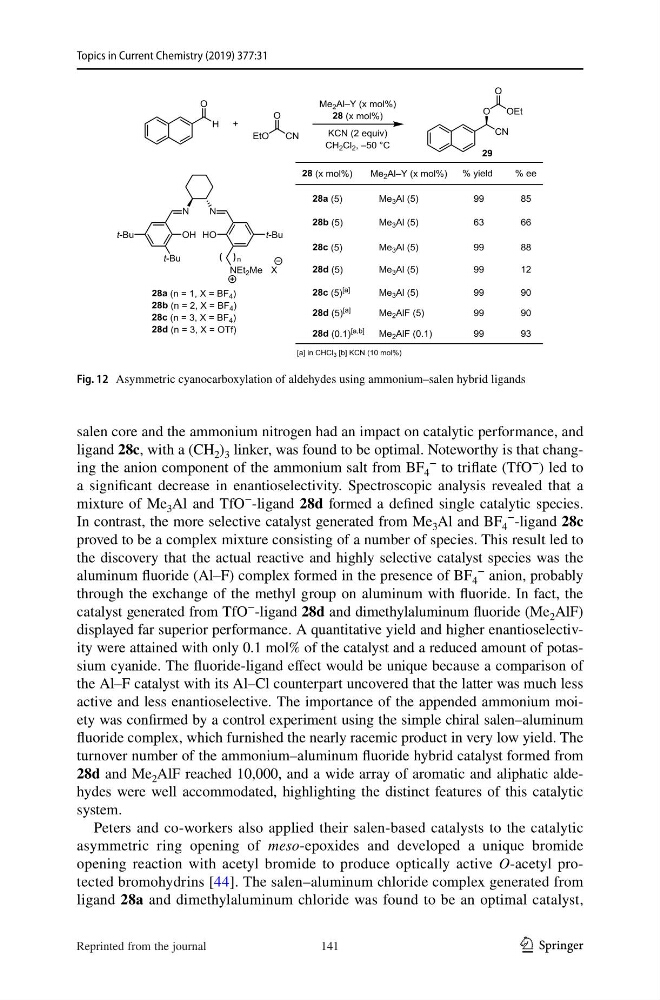
salen core and the ammonium nitrogen had an impact on catalytic performance, and
ligand 28c, with a (CH 2 ) 3 linker, was found to be optimal. Noteworthy is that changing the anion component of the ammonium salt from BF 4
−
to triflate (TfO
−
) led to
a significant decrease in enantioselectivity. Spectroscopic analysis revealed that a
mixture of Me 3 Al and TfO
−
-ligand 28d formed a defined single catalytic species.
In contrast, the more selective catalyst generated from Me 3 Al and BF 4
−
-ligand 28c
proved to be a complex mixture consisting of a number of species. This result led to
the discovery that the actual reactive and highly selective catalyst species was the
aluminum fluoride (Al–F) complex formed in the presence of BF 4
−
anion, probably
through the exchange of the methyl group on aluminum with fluoride. In fact, the
catalyst generated from TfO
−
-ligand 28d and dimethylaluminum fluoride (Me 2 AlF)
displayed far superior performance. A quantitative yield and higher enantioselectivity were attained with only 0.1 mol% of the catalyst and a reduced amount of potassium cyanide. The fluoride-ligand effect would be unique because a comparison of
the Al–F catalyst with its Al–Cl counterpart uncovered that the latter was much less
active and less enantioselective. The importance of the appended ammonium moiety was confirmed by a control experiment using the simple chiral salen–aluminum
fluoride complex, which furnished the nearly racemic product in very low yield. The
turnover number of the ammonium–aluminum fluoride hybrid catalyst formed from
28d and Me 2 AlF reached 10,000, and a wide array of aromatic and aliphatic aldehydes were well accommodated, highlighting the distinct features of this catalytic
system.
Peters and co-workers also applied their salen-based catalysts to the catalytic
asymmetric ring opening of meso-epoxides and developed a unique bromide
opening reaction with acetyl bromide to produce optically active O-acetyl protected bromohydrins [44]. The salen–aluminum chloride complex generated from
ligand 28a and dimethylaluminum chloride was found to be an optimal catalyst,
Fig. 12 Asymmetric cyanocarboxylation of aldehydes using ammonium–salen hybrid ligands
Reprinted from the journal
141
Topics in Current Chemistry (2019) 377:31
salen core and the ammonium nitrogen had an impact on catalytic performance, and
ligand 28c, with a (CH 2 ) 3 linker, was found to be optimal. Noteworthy is that changing the anion component of the ammonium salt from BF 4
−
to triflate (TfO
−
) led to
a significant decrease in enantioselectivity. Spectroscopic analysis revealed that a
mixture of Me 3 Al and TfO
−
-ligand 28d formed a defined single catalytic species.
In contrast, the more selective catalyst generated from Me 3 Al and BF 4
−
-ligand 28c
proved to be a complex mixture consisting of a number of species. This result led to
the discovery that the actual reactive and highly selective catalyst species was the
aluminum fluoride (Al–F) complex formed in the presence of BF 4
−
anion, probably
through the exchange of the methyl group on aluminum with fluoride. In fact, the
catalyst generated from TfO
−
-ligand 28d and dimethylaluminum fluoride (Me 2 AlF)
displayed far superior performance. A quantitative yield and higher enantioselectivity were attained with only 0.1 mol% of the catalyst and a reduced amount of potassium cyanide. The fluoride-ligand effect would be unique because a comparison of
the Al–F catalyst with its Al–Cl counterpart uncovered that the latter was much less
active and less enantioselective. The importance of the appended ammonium moiety was confirmed by a control experiment using the simple chiral salen–aluminum
fluoride complex, which furnished the nearly racemic product in very low yield. The
turnover number of the ammonium–aluminum fluoride hybrid catalyst formed from
28d and Me 2 AlF reached 10,000, and a wide array of aromatic and aliphatic aldehydes were well accommodated, highlighting the distinct features of this catalytic
system.
Peters and co-workers also applied their salen-based catalysts to the catalytic
asymmetric ring opening of meso-epoxides and developed a unique bromide
opening reaction with acetyl bromide to produce optically active O-acetyl protected bromohydrins [44]. The salen–aluminum chloride complex generated from
ligand 28a and dimethylaluminum chloride was found to be an optimal catalyst,
Fig. 12 Asymmetric cyanocarboxylation of aldehydes using ammonium–salen hybrid ligands
Reprinted from the journal
141