

Topics in Current Chemistry (2019) 377:31
1 3
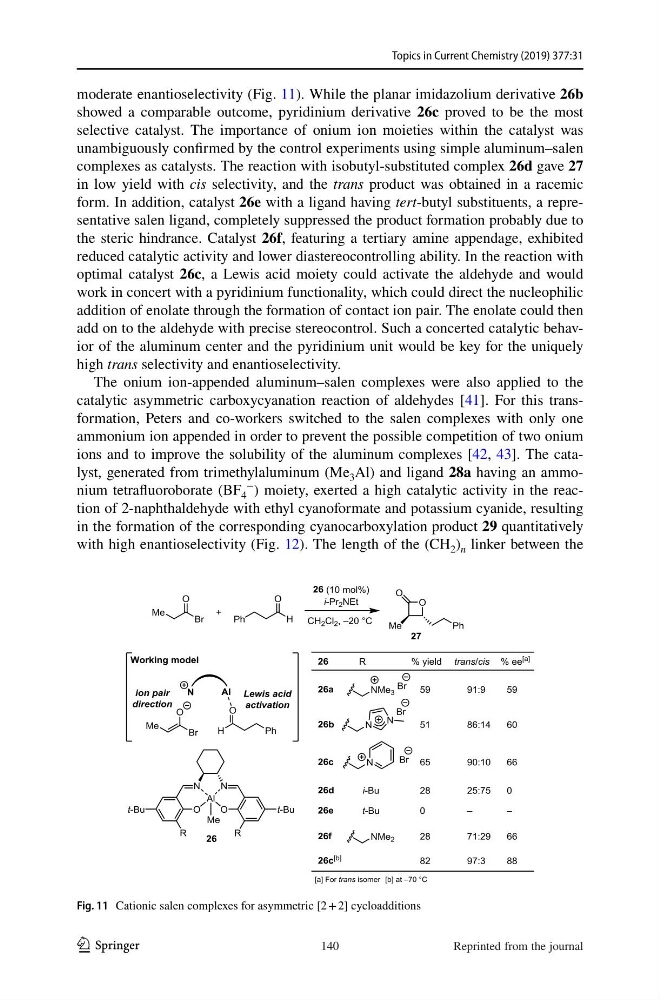
moderate enantioselectivity (Fig. 11). While the planar imidazolium derivative 26b
showed a comparable outcome, pyridinium derivative 26c proved to be the most
selective catalyst. The importance of onium ion moieties within the catalyst was
unambiguously confirmed by the control experiments using simple aluminum–salen
complexes as catalysts. The reaction with isobutyl-substituted complex 26d gave 27
in low yield with cis selectivity, and the trans product was obtained in a racemic
form. In addition, catalyst 26e with a ligand having tert-butyl substituents, a representative salen ligand, completely suppressed the product formation probably due to
the steric hindrance. Catalyst 26f, featuring a tertiary amine appendage, exhibited
reduced catalytic activity and lower diastereocontrolling ability. In the reaction with
optimal catalyst 26c, a Lewis acid moiety could activate the aldehyde and would
work in concert with a pyridinium functionality, which could direct the nucleophilic
addition of enolate through the formation of contact ion pair. The enolate could then
add on to the aldehyde with precise stereocontrol. Such a concerted catalytic behavior of the aluminum center and the pyridinium unit would be key for the uniquely
high trans selectivity and enantioselectivity.
The onium ion-appended aluminum–salen complexes were also applied to the
catalytic asymmetric carboxycyanation reaction of aldehydes [41]. For this transformation, Peters and co-workers switched to the salen complexes with only one
ammonium ion appended in order to prevent the possible competition of two onium
ions and to improve the solubility of the aluminum complexes [42, 43]. The catalyst, generated from trimethylaluminum (Me 3 Al) and ligand 28a having an ammonium tetrafluoroborate (BF 4
−
) moiety, exerted a high catalytic activity in the reaction of 2-naphthaldehyde with ethyl cyanoformate and potassium cyanide, resulting
in the formation of the corresponding cyanocarboxylation product 29 quantitatively
with high enantioselectivity (Fig. 12). The length of the (CH 2 ) n linker between the
Fig. 11 Cationic salen complexes for asymmetric [2 + 2] cycloadditions
Reprinted from the journal
140
1 3
moderate enantioselectivity (Fig. 11). While the planar imidazolium derivative 26b
showed a comparable outcome, pyridinium derivative 26c proved to be the most
selective catalyst. The importance of onium ion moieties within the catalyst was
unambiguously confirmed by the control experiments using simple aluminum–salen
complexes as catalysts. The reaction with isobutyl-substituted complex 26d gave 27
in low yield with cis selectivity, and the trans product was obtained in a racemic
form. In addition, catalyst 26e with a ligand having tert-butyl substituents, a representative salen ligand, completely suppressed the product formation probably due to
the steric hindrance. Catalyst 26f, featuring a tertiary amine appendage, exhibited
reduced catalytic activity and lower diastereocontrolling ability. In the reaction with
optimal catalyst 26c, a Lewis acid moiety could activate the aldehyde and would
work in concert with a pyridinium functionality, which could direct the nucleophilic
addition of enolate through the formation of contact ion pair. The enolate could then
add on to the aldehyde with precise stereocontrol. Such a concerted catalytic behavior of the aluminum center and the pyridinium unit would be key for the uniquely
high trans selectivity and enantioselectivity.
The onium ion-appended aluminum–salen complexes were also applied to the
catalytic asymmetric carboxycyanation reaction of aldehydes [41]. For this transformation, Peters and co-workers switched to the salen complexes with only one
ammonium ion appended in order to prevent the possible competition of two onium
ions and to improve the solubility of the aluminum complexes [42, 43]. The catalyst, generated from trimethylaluminum (Me 3 Al) and ligand 28a having an ammonium tetrafluoroborate (BF 4
−
) moiety, exerted a high catalytic activity in the reaction of 2-naphthaldehyde with ethyl cyanoformate and potassium cyanide, resulting
in the formation of the corresponding cyanocarboxylation product 29 quantitatively
with high enantioselectivity (Fig. 12). The length of the (CH 2 ) n linker between the
Fig. 11 Cationic salen complexes for asymmetric [2 + 2] cycloadditions
Reprinted from the journal
140