

1 3
Topics in Current Chemistry (2019) 377:31
terminal alkynes [33, 34], leads to the catalytic generation of ion pairs consisting of
chiral onium ions and alkynyl metallates. These alkynyl metallic anions would have
an enhanced nucleophilicity and their chiral counter ions have an opportunity to control the absolute stereochemistry in the bond-forming events, thus enabling the catalytic enantioselective alkynylation reactions. For implementing this scenario, copper
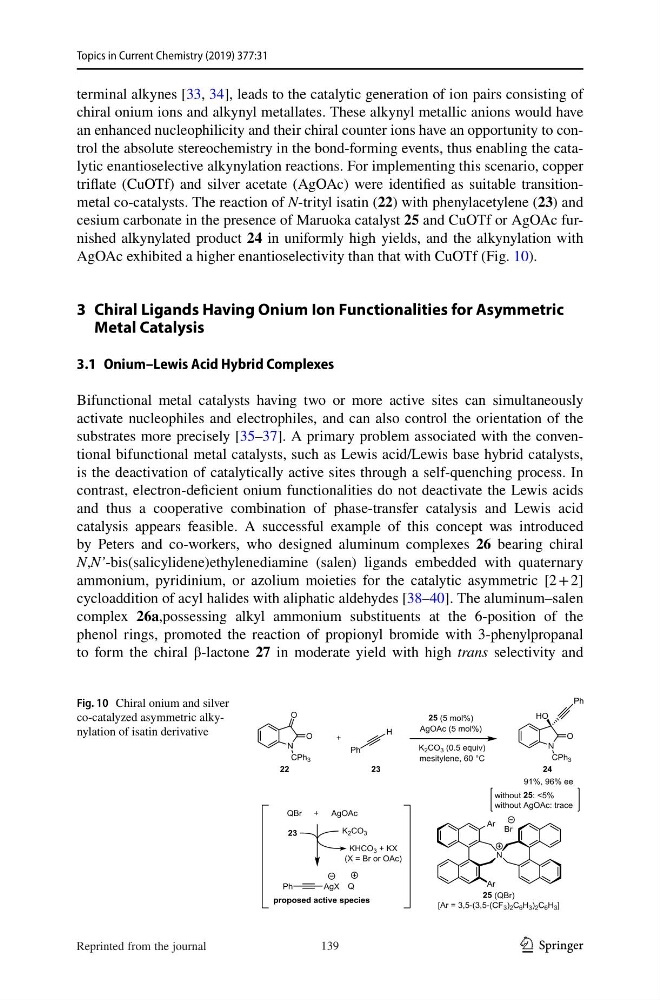
triflate (CuOTf) and silver acetate (AgOAc) were identified as suitable transitionmetal co-catalysts. The reaction of N-trityl isatin (22) with phenylacetylene (23) and
cesium carbonate in the presence of Maruoka catalyst 25 and CuOTf or AgOAc furnished alkynylated product 24 in uniformly high yields, and the alkynylation with
AgOAc exhibited a higher enantioselectivity than that with CuOTf (Fig. 10).
3 Chiral Ligands Having Onium Ion Functionalities for Asymmetric
Metal Catalysis
3.1 Onium–Lewis Acid Hybrid Complexes
Bifunctional metal catalysts having two or more active sites can simultaneously
activate nucleophiles and electrophiles, and can also control the orientation of the
substrates more precisely [35–37]. A primary problem associated with the conventional bifunctional metal catalysts, such as Lewis acid/Lewis base hybrid catalysts,
is the deactivation of catalytically active sites through a self-quenching process. In
contrast, electron-deficient onium functionalities do not deactivate the Lewis acids
and thus a cooperative combination of phase-transfer catalysis and Lewis acid
catalysis appears feasible. A successful example of this concept was introduced
by Peters and co-workers, who designed aluminum complexes 26 bearing chiral
N,N’-bis(salicylidene)ethylenediamine (salen) ligands embedded with quaternary
ammonium, pyridinium, or azolium moieties for the catalytic asymmetric [2 + 2]
cycloaddition of acyl halides with aliphatic aldehydes [38–40]. The aluminum–salen
complex 26a,possessing alkyl ammonium substituents at the 6-position of the
phenol rings, promoted the reaction of propionyl bromide with 3-phenylpropanal
to form the chiral β-lactone 27 in moderate yield with high trans selectivity and
Fig. 10 Chiral onium and silver
co-catalyzed asymmetric alkynylation of isatin derivative
Reprinted from the journal
139
Topics in Current Chemistry (2019) 377:31
terminal alkynes [33, 34], leads to the catalytic generation of ion pairs consisting of
chiral onium ions and alkynyl metallates. These alkynyl metallic anions would have
an enhanced nucleophilicity and their chiral counter ions have an opportunity to control the absolute stereochemistry in the bond-forming events, thus enabling the catalytic enantioselective alkynylation reactions. For implementing this scenario, copper
triflate (CuOTf) and silver acetate (AgOAc) were identified as suitable transitionmetal co-catalysts. The reaction of N-trityl isatin (22) with phenylacetylene (23) and
cesium carbonate in the presence of Maruoka catalyst 25 and CuOTf or AgOAc furnished alkynylated product 24 in uniformly high yields, and the alkynylation with
AgOAc exhibited a higher enantioselectivity than that with CuOTf (Fig. 10).
3 Chiral Ligands Having Onium Ion Functionalities for Asymmetric
Metal Catalysis
3.1 Onium–Lewis Acid Hybrid Complexes
Bifunctional metal catalysts having two or more active sites can simultaneously
activate nucleophiles and electrophiles, and can also control the orientation of the
substrates more precisely [35–37]. A primary problem associated with the conventional bifunctional metal catalysts, such as Lewis acid/Lewis base hybrid catalysts,
is the deactivation of catalytically active sites through a self-quenching process. In
contrast, electron-deficient onium functionalities do not deactivate the Lewis acids
and thus a cooperative combination of phase-transfer catalysis and Lewis acid
catalysis appears feasible. A successful example of this concept was introduced
by Peters and co-workers, who designed aluminum complexes 26 bearing chiral
N,N’-bis(salicylidene)ethylenediamine (salen) ligands embedded with quaternary
ammonium, pyridinium, or azolium moieties for the catalytic asymmetric [2 + 2]
cycloaddition of acyl halides with aliphatic aldehydes [38–40]. The aluminum–salen
complex 26a,possessing alkyl ammonium substituents at the 6-position of the
phenol rings, promoted the reaction of propionyl bromide with 3-phenylpropanal
to form the chiral β-lactone 27 in moderate yield with high trans selectivity and
Fig. 10 Chiral onium and silver
co-catalyzed asymmetric alkynylation of isatin derivative
Reprinted from the journal
139