

Topics in Current Chemistry (2019) 377:31
1 3
aqueous hydrogen peroxide [31]. For instance, under optimized catalytic conditions,
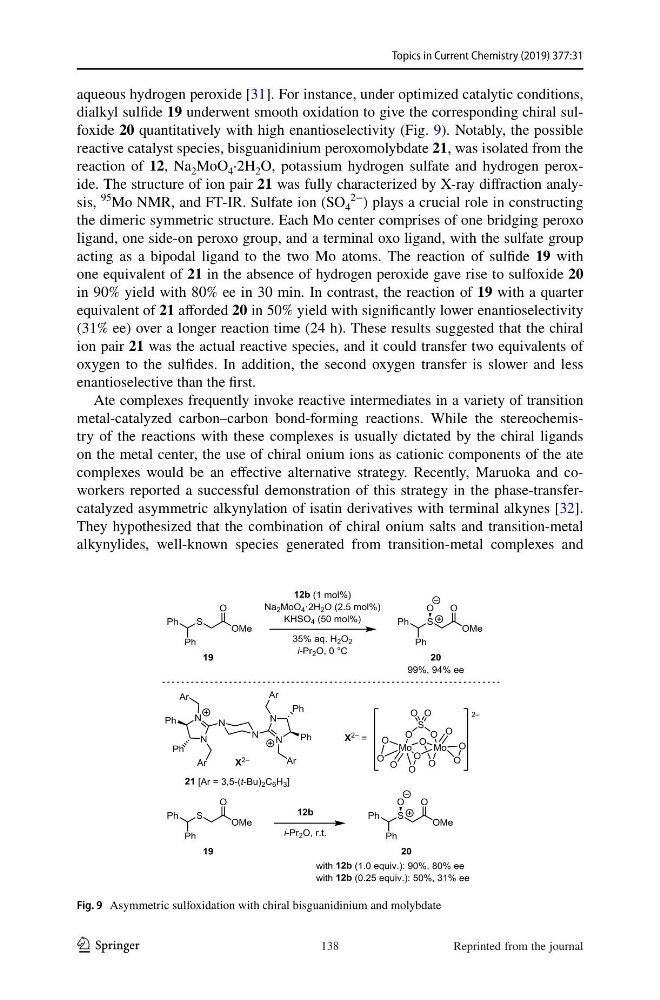
dialkyl sulfide 19 underwent smooth oxidation to give the corresponding chiral sulfoxide 20 quantitatively with high enantioselectivity (Fig. 9). Notably, the possible
reactive catalyst species, bisguanidinium peroxomolybdate 21, was isolated from the
reaction of 12, Na 2 MoO 4 ·2H 2 O, potassium hydrogen sulfate and hydrogen peroxide. The structure of ion pair 21 was fully characterized by X-ray diffraction analysis,
95
Mo NMR, and FT-IR. Sulfate ion (SO 4
2−
) plays a crucial role in constructing
the dimeric symmetric structure. Each Mo center comprises of one bridging peroxo
ligand, one side-on peroxo group, and a terminal oxo ligand, with the sulfate group
acting as a bipodal ligand to the two Mo atoms. The reaction of sulfide 19 with
one equivalent of 21 in the absence of hydrogen peroxide gave rise to sulfoxide 20
in 90% yield with 80% ee in 30 min. In contrast, the reaction of 19 with a quarter
equivalent of 21 afforded 20 in 50% yield with significantly lower enantioselectivity
(31% ee) over a longer reaction time (24 h). These results suggested that the chiral
ion pair 21 was the actual reactive species, and it could transfer two equivalents of
oxygen to the sulfides. In addition, the second oxygen transfer is slower and less
enantioselective than the first.
Ate complexes frequently invoke reactive intermediates in a variety of transition
metal-catalyzed carbon–carbon bond-forming reactions. While the stereochemistry of the reactions with these complexes is usually dictated by the chiral ligands
on the metal center, the use of chiral onium ions as cationic components of the ate
complexes would be an effective alternative strategy. Recently, Maruoka and coworkers reported a successful demonstration of this strategy in the phase-transfercatalyzed asymmetric alkynylation of isatin derivatives with terminal alkynes [32].
They hypothesized that the combination of chiral onium salts and transition-metal
alkynylides, well-known species generated from transition-metal complexes and
Fig. 9 Asymmetric sulfoxidation with chiral bisguanidinium and molybdate
Reprinted from the journal
138
1 3
aqueous hydrogen peroxide [31]. For instance, under optimized catalytic conditions,
dialkyl sulfide 19 underwent smooth oxidation to give the corresponding chiral sulfoxide 20 quantitatively with high enantioselectivity (Fig. 9). Notably, the possible
reactive catalyst species, bisguanidinium peroxomolybdate 21, was isolated from the
reaction of 12, Na 2 MoO 4 ·2H 2 O, potassium hydrogen sulfate and hydrogen peroxide. The structure of ion pair 21 was fully characterized by X-ray diffraction analysis,
95
Mo NMR, and FT-IR. Sulfate ion (SO 4
2−
) plays a crucial role in constructing
the dimeric symmetric structure. Each Mo center comprises of one bridging peroxo
ligand, one side-on peroxo group, and a terminal oxo ligand, with the sulfate group
acting as a bipodal ligand to the two Mo atoms. The reaction of sulfide 19 with
one equivalent of 21 in the absence of hydrogen peroxide gave rise to sulfoxide 20
in 90% yield with 80% ee in 30 min. In contrast, the reaction of 19 with a quarter
equivalent of 21 afforded 20 in 50% yield with significantly lower enantioselectivity
(31% ee) over a longer reaction time (24 h). These results suggested that the chiral
ion pair 21 was the actual reactive species, and it could transfer two equivalents of
oxygen to the sulfides. In addition, the second oxygen transfer is slower and less
enantioselective than the first.
Ate complexes frequently invoke reactive intermediates in a variety of transition
metal-catalyzed carbon–carbon bond-forming reactions. While the stereochemistry of the reactions with these complexes is usually dictated by the chiral ligands
on the metal center, the use of chiral onium ions as cationic components of the ate
complexes would be an effective alternative strategy. Recently, Maruoka and coworkers reported a successful demonstration of this strategy in the phase-transfercatalyzed asymmetric alkynylation of isatin derivatives with terminal alkynes [32].
They hypothesized that the combination of chiral onium salts and transition-metal
alkynylides, well-known species generated from transition-metal complexes and
Fig. 9 Asymmetric sulfoxidation with chiral bisguanidinium and molybdate
Reprinted from the journal
138