

1 3
Topics in Current Chemistry (2019) 377:31
by the coordination of permanganate ion to phenyl acrylate. The catalytic process
was relayed by the stepwise two carbon–oxygen bond formations, the latter of which
would be the stereo-determining step and could be accelerated by the chiral guanidinium ion.
Tan and co-workers subsequently established the synergistic asymmetric catalysis
of cationic organic catalysts and anionic metal oxide catalysts. [25] Specifically, they
developed the asymmetric oxidation of alkyl aryl sulfides employing chiral bisguanidinium in combination with tungstate (WO 4
2−
), a well-known anionic catalyst for
oxidation reactions such as epoxidation and sulfoxidation [26, 27]. The reaction of
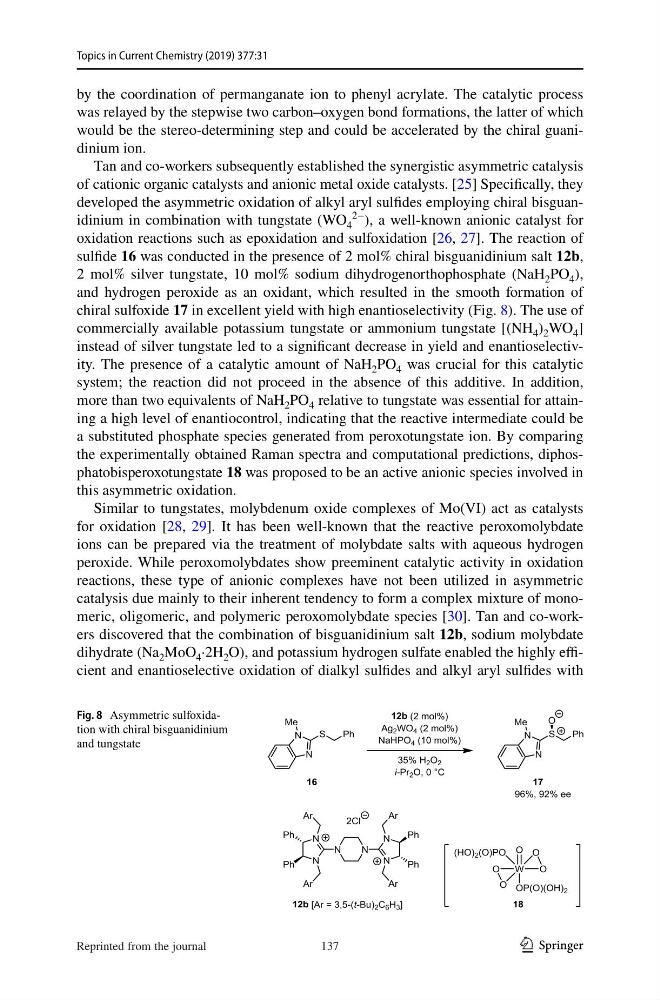
sulfide 16 was conducted in the presence of 2 mol% chiral bisguanidinium salt 12b,
2 mol% silver tungstate, 10 mol% sodium dihydrogenorthophosphate (NaH 2 PO 4 ),
and hydrogen peroxide as an oxidant, which resulted in the smooth formation of
chiral sulfoxide 17 in excellent yield with high enantioselectivity (Fig. 8). The use of
commercially available potassium tungstate or ammonium tungstate [(NH 4 ) 2 WO 4 ]
instead of silver tungstate led to a significant decrease in yield and enantioselectivity. The presence of a catalytic amount of NaH 2 PO 4 was crucial for this catalytic
system; the reaction did not proceed in the absence of this additive. In addition,
more than two equivalents of NaH 2 PO 4 relative to tungstate was essential for attaining a high level of enantiocontrol, indicating that the reactive intermediate could be
a substituted phosphate species generated from peroxotungstate ion. By comparing
the experimentally obtained Raman spectra and computational predictions, diphosphatobisperoxotungstate 18 was proposed to be an active anionic species involved in
this asymmetric oxidation.
Similar to tungstates, molybdenum oxide complexes of Mo(VI) act as catalysts
for oxidation [28, 29]. It has been well-known that the reactive peroxomolybdate
ions can be prepared via the treatment of molybdate salts with aqueous hydrogen
peroxide. While peroxomolybdates show preeminent catalytic activity in oxidation
reactions, these type of anionic complexes have not been utilized in asymmetric
catalysis due mainly to their inherent tendency to form a complex mixture of monomeric, oligomeric, and polymeric peroxomolybdate species [30]. Tan and co-workers discovered that the combination of bisguanidinium salt 12b, sodium molybdate
dihydrate (Na 2 MoO 4 ·2H 2 O), and potassium hydrogen sulfate enabled the highly efficient and enantioselective oxidation of dialkyl sulfides and alkyl aryl sulfides with
Fig. 8 Asymmetric sulfoxidation with chiral bisguanidinium
and tungstate
Reprinted from the journal
137
Topics in Current Chemistry (2019) 377:31
by the coordination of permanganate ion to phenyl acrylate. The catalytic process
was relayed by the stepwise two carbon–oxygen bond formations, the latter of which
would be the stereo-determining step and could be accelerated by the chiral guanidinium ion.
Tan and co-workers subsequently established the synergistic asymmetric catalysis
of cationic organic catalysts and anionic metal oxide catalysts. [25] Specifically, they
developed the asymmetric oxidation of alkyl aryl sulfides employing chiral bisguanidinium in combination with tungstate (WO 4
2−
), a well-known anionic catalyst for
oxidation reactions such as epoxidation and sulfoxidation [26, 27]. The reaction of
sulfide 16 was conducted in the presence of 2 mol% chiral bisguanidinium salt 12b,
2 mol% silver tungstate, 10 mol% sodium dihydrogenorthophosphate (NaH 2 PO 4 ),
and hydrogen peroxide as an oxidant, which resulted in the smooth formation of
chiral sulfoxide 17 in excellent yield with high enantioselectivity (Fig. 8). The use of
commercially available potassium tungstate or ammonium tungstate [(NH 4 ) 2 WO 4 ]
instead of silver tungstate led to a significant decrease in yield and enantioselectivity. The presence of a catalytic amount of NaH 2 PO 4 was crucial for this catalytic
system; the reaction did not proceed in the absence of this additive. In addition,
more than two equivalents of NaH 2 PO 4 relative to tungstate was essential for attaining a high level of enantiocontrol, indicating that the reactive intermediate could be
a substituted phosphate species generated from peroxotungstate ion. By comparing
the experimentally obtained Raman spectra and computational predictions, diphosphatobisperoxotungstate 18 was proposed to be an active anionic species involved in
this asymmetric oxidation.
Similar to tungstates, molybdenum oxide complexes of Mo(VI) act as catalysts
for oxidation [28, 29]. It has been well-known that the reactive peroxomolybdate
ions can be prepared via the treatment of molybdate salts with aqueous hydrogen
peroxide. While peroxomolybdates show preeminent catalytic activity in oxidation
reactions, these type of anionic complexes have not been utilized in asymmetric
catalysis due mainly to their inherent tendency to form a complex mixture of monomeric, oligomeric, and polymeric peroxomolybdate species [30]. Tan and co-workers discovered that the combination of bisguanidinium salt 12b, sodium molybdate
dihydrate (Na 2 MoO 4 ·2H 2 O), and potassium hydrogen sulfate enabled the highly efficient and enantioselective oxidation of dialkyl sulfides and alkyl aryl sulfides with
Fig. 8 Asymmetric sulfoxidation with chiral bisguanidinium
and tungstate
Reprinted from the journal
137