

Topics in Current Chemistry (2019) 377:31
1 3
2.2 Asymmetric Catalysis of Chiral Onium Ions with Reactive Metallic Anions
In conventional asymmetric phase-transfer catalysis, most transformations are Brønsted base-promoted reactions, where the functional anion is usually a hydroxide or
carbonate. The asymmetric reactions that are facilitated by other functional anions,
such as cyanide (CN
−
), hypochlorite (ClO
−
), and in situ generated hypoiodite (IO
−
),
have also been achieved using designer chiral ammonium ions [20–22]. These reactions clearly demonstrated the potential of asymmetric ion-pair catalysis, in which a
variety of functional inorganic anions could be tamed by pairing with chiral organic
cations. Indeed, the catalysis of chiral onium ions could accommodate reactive
metallic anions such as permanganate (MnO 4
−
).
Permanganate is one of the most explored metallic oxidizing agents and its reactivity and stereochemistry in the oxidative bond formations can be controlled by
chiral onium ions. The first demonstration was reported by Brown and co-workers,
who used a stoichiometric amount of cinchonidinium salt in the permanganatemediated dihydroxylation of α,β-unsaturated ketones to obtain the dihydroxylated
product, albeit in low yields with moderate enantioselectivities [23]. The low reaction efficiency was ascribed to the decomposition of cinchonidinium salts under the
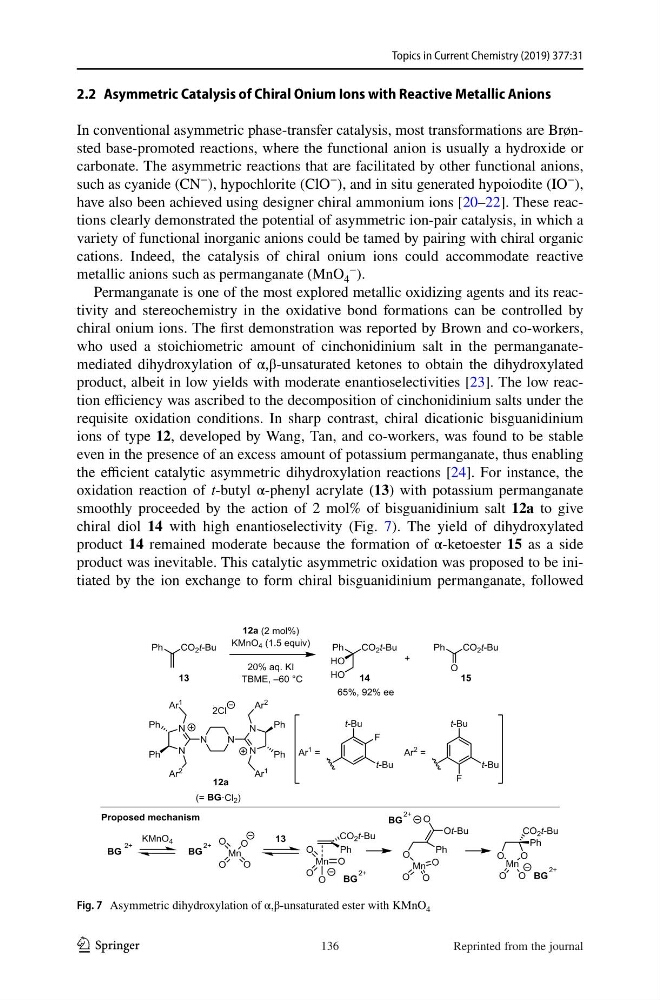
requisite oxidation conditions. In sharp contrast, chiral dicationic bisguanidinium
ions of type 12, developed by Wang, Tan, and co-workers, was found to be stable
even in the presence of an excess amount of potassium permanganate, thus enabling
the efficient catalytic asymmetric dihydroxylation reactions [24]. For instance, the
oxidation reaction of t-butyl α-phenyl acrylate (13) with potassium permanganate
smoothly proceeded by the action of 2 mol% of bisguanidinium salt 12a to give
chiral diol 14 with high enantioselectivity (Fig. 7). The yield of dihydroxylated
product 14 remained moderate because the formation of α-ketoester 15 as a side
product was inevitable. This catalytic asymmetric oxidation was proposed to be initiated by the ion exchange to form chiral bisguanidinium permanganate, followed
Fig. 7 Asymmetric dihydroxylation of α,β-unsaturated ester with KMnO 4
Reprinted from the journal
136
1 3
2.2 Asymmetric Catalysis of Chiral Onium Ions with Reactive Metallic Anions
In conventional asymmetric phase-transfer catalysis, most transformations are Brønsted base-promoted reactions, where the functional anion is usually a hydroxide or
carbonate. The asymmetric reactions that are facilitated by other functional anions,
such as cyanide (CN
−
), hypochlorite (ClO
−
), and in situ generated hypoiodite (IO
−
),
have also been achieved using designer chiral ammonium ions [20–22]. These reactions clearly demonstrated the potential of asymmetric ion-pair catalysis, in which a
variety of functional inorganic anions could be tamed by pairing with chiral organic
cations. Indeed, the catalysis of chiral onium ions could accommodate reactive
metallic anions such as permanganate (MnO 4
−
).
Permanganate is one of the most explored metallic oxidizing agents and its reactivity and stereochemistry in the oxidative bond formations can be controlled by
chiral onium ions. The first demonstration was reported by Brown and co-workers,
who used a stoichiometric amount of cinchonidinium salt in the permanganatemediated dihydroxylation of α,β-unsaturated ketones to obtain the dihydroxylated
product, albeit in low yields with moderate enantioselectivities [23]. The low reaction efficiency was ascribed to the decomposition of cinchonidinium salts under the
requisite oxidation conditions. In sharp contrast, chiral dicationic bisguanidinium
ions of type 12, developed by Wang, Tan, and co-workers, was found to be stable
even in the presence of an excess amount of potassium permanganate, thus enabling
the efficient catalytic asymmetric dihydroxylation reactions [24]. For instance, the
oxidation reaction of t-butyl α-phenyl acrylate (13) with potassium permanganate
smoothly proceeded by the action of 2 mol% of bisguanidinium salt 12a to give
chiral diol 14 with high enantioselectivity (Fig. 7). The yield of dihydroxylated
product 14 remained moderate because the formation of α-ketoester 15 as a side
product was inevitable. This catalytic asymmetric oxidation was proposed to be initiated by the ion exchange to form chiral bisguanidinium permanganate, followed
Fig. 7 Asymmetric dihydroxylation of α,β-unsaturated ester with KMnO 4
Reprinted from the journal
136