

1 3
Topics in Current Chemistry (2019) 377:31
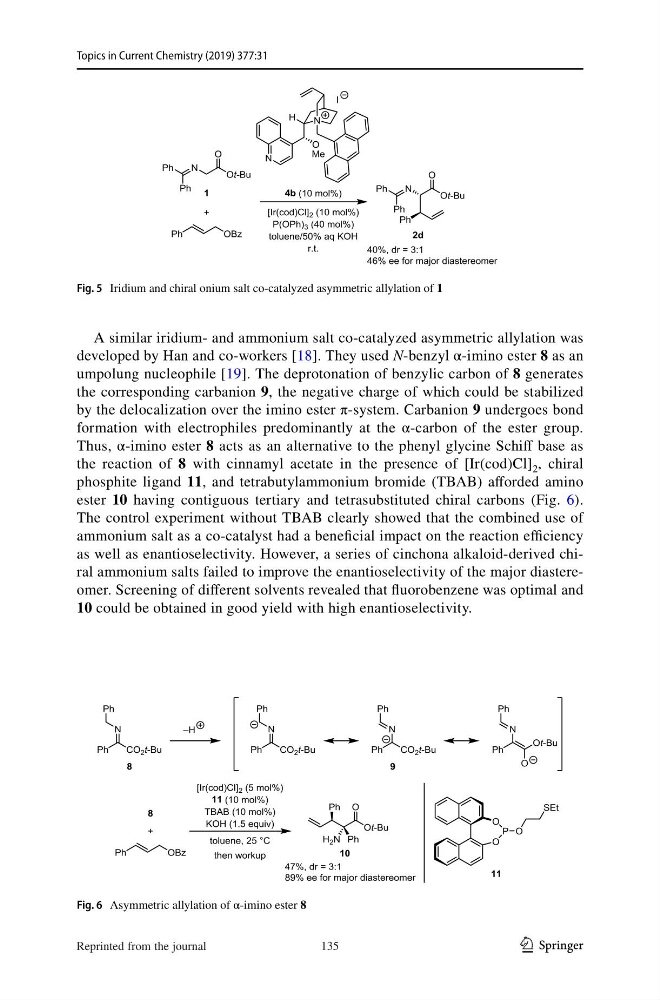
A similar iridium- and ammonium salt co-catalyzed asymmetric allylation was
developed by Han and co-workers [18]. They used N-benzyl α-imino ester 8 as an
umpolung nucleophile [19]. The deprotonation of benzylic carbon of 8 generates
the corresponding carbanion 9, the negative charge of which could be stabilized
by the delocalization over the imino ester π-system. Carbanion 9 undergoes bond
formation with electrophiles predominantly at the α-carbon of the ester group.
Thus, α-imino ester 8 acts as an alternative to the phenyl glycine Schiff base as
the reaction of 8 with cinnamyl acetate in the presence of [Ir(cod)Cl] 2 , chiral
phosphite ligand 11, and tetrabutylammonium bromide (TBAB) afforded amino
ester 10 having contiguous tertiary and tetrasubstituted chiral carbons (Fig. 6).
The control experiment without TBAB clearly showed that the combined use of
ammonium salt as a co-catalyst had a beneficial impact on the reaction efficiency
as well as enantioselectivity. However, a series of cinchona alkaloid-derived chiral ammonium salts failed to improve the enantioselectivity of the major diastereomer. Screening of different solvents revealed that fluorobenzene was optimal and
10 could be obtained in good yield with high enantioselectivity.
Fig. 5 Iridium and chiral onium salt co-catalyzed asymmetric allylation of 1
Fig. 6 Asymmetric allylation of α-imino ester 8
Reprinted from the journal
135
Topics in Current Chemistry (2019) 377:31
A similar iridium- and ammonium salt co-catalyzed asymmetric allylation was
developed by Han and co-workers [18]. They used N-benzyl α-imino ester 8 as an
umpolung nucleophile [19]. The deprotonation of benzylic carbon of 8 generates
the corresponding carbanion 9, the negative charge of which could be stabilized
by the delocalization over the imino ester π-system. Carbanion 9 undergoes bond
formation with electrophiles predominantly at the α-carbon of the ester group.
Thus, α-imino ester 8 acts as an alternative to the phenyl glycine Schiff base as
the reaction of 8 with cinnamyl acetate in the presence of [Ir(cod)Cl] 2 , chiral
phosphite ligand 11, and tetrabutylammonium bromide (TBAB) afforded amino
ester 10 having contiguous tertiary and tetrasubstituted chiral carbons (Fig. 6).
The control experiment without TBAB clearly showed that the combined use of
ammonium salt as a co-catalyst had a beneficial impact on the reaction efficiency
as well as enantioselectivity. However, a series of cinchona alkaloid-derived chiral ammonium salts failed to improve the enantioselectivity of the major diastereomer. Screening of different solvents revealed that fluorobenzene was optimal and
10 could be obtained in good yield with high enantioselectivity.
Fig. 5 Iridium and chiral onium salt co-catalyzed asymmetric allylation of 1
Fig. 6 Asymmetric allylation of α-imino ester 8
Reprinted from the journal
135