

Topics in Current Chemistry (2019) 377:31
1 3
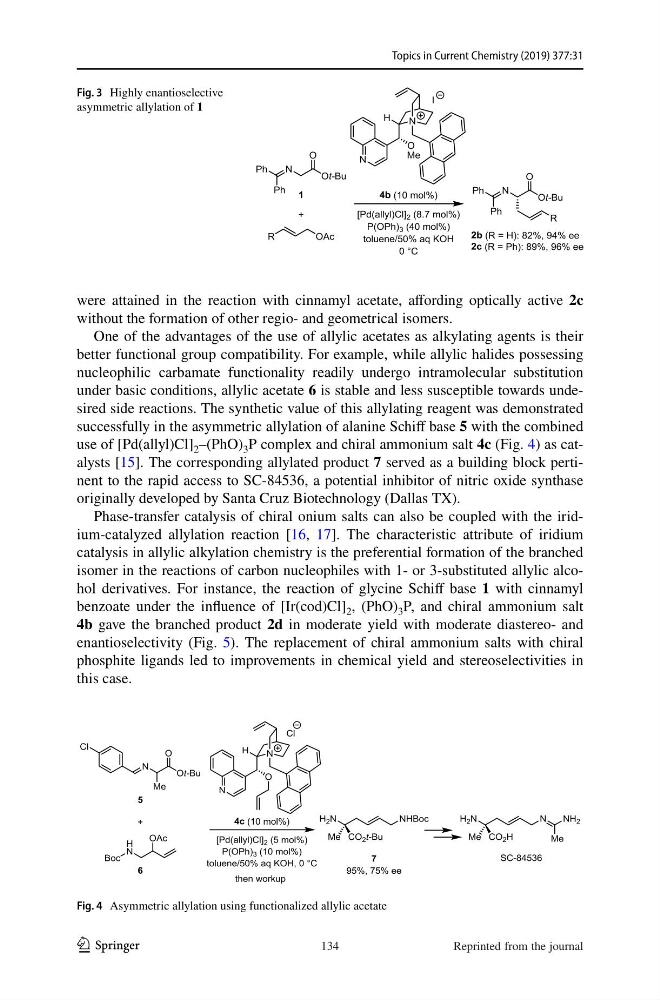
were attained in the reaction with cinnamyl acetate, affording optically active 2c
without the formation of other regio- and geometrical isomers.
One of the advantages of the use of allylic acetates as alkylating agents is their
better functional group compatibility. For example, while allylic halides possessing
nucleophilic carbamate functionality readily undergo intramolecular substitution
under basic conditions, allylic acetate 6 is stable and less susceptible towards undesired side reactions. The synthetic value of this allylating reagent was demonstrated
successfully in the asymmetric allylation of alanine Schiff base 5 with the combined
use of [Pd(allyl)Cl] 2 –(PhO) 3 P complex and chiral ammonium salt 4c (Fig. 4) as catalysts [15]. The corresponding allylated product 7 served as a building block pertinent to the rapid access to SC-84536, a potential inhibitor of nitric oxide synthase
originally developed by Santa Cruz Biotechnology (Dallas TX).
Phase-transfer catalysis of chiral onium salts can also be coupled with the iridium-catalyzed allylation reaction [16, 17]. The characteristic attribute of iridium
catalysis in allylic alkylation chemistry is the preferential formation of the branched
isomer in the reactions of carbon nucleophiles with 1- or 3-substituted allylic alcohol derivatives. For instance, the reaction of glycine Schiff base 1 with cinnamyl
benzoate under the influence of [Ir(cod)Cl] 2 , (PhO) 3 P, and chiral ammonium salt
4b gave the branched product 2d in moderate yield with moderate diastereo- and
enantioselectivity (Fig. 5). The replacement of chiral ammonium salts with chiral
phosphite ligands led to improvements in chemical yield and stereoselectivities in
this case.
Fig. 3 Highly enantioselective
asymmetric allylation of 1
Fig. 4 Asymmetric allylation using functionalized allylic acetate
Reprinted from the journal
134
1 3
were attained in the reaction with cinnamyl acetate, affording optically active 2c
without the formation of other regio- and geometrical isomers.
One of the advantages of the use of allylic acetates as alkylating agents is their
better functional group compatibility. For example, while allylic halides possessing
nucleophilic carbamate functionality readily undergo intramolecular substitution
under basic conditions, allylic acetate 6 is stable and less susceptible towards undesired side reactions. The synthetic value of this allylating reagent was demonstrated
successfully in the asymmetric allylation of alanine Schiff base 5 with the combined
use of [Pd(allyl)Cl] 2 –(PhO) 3 P complex and chiral ammonium salt 4c (Fig. 4) as catalysts [15]. The corresponding allylated product 7 served as a building block pertinent to the rapid access to SC-84536, a potential inhibitor of nitric oxide synthase
originally developed by Santa Cruz Biotechnology (Dallas TX).
Phase-transfer catalysis of chiral onium salts can also be coupled with the iridium-catalyzed allylation reaction [16, 17]. The characteristic attribute of iridium
catalysis in allylic alkylation chemistry is the preferential formation of the branched
isomer in the reactions of carbon nucleophiles with 1- or 3-substituted allylic alcohol derivatives. For instance, the reaction of glycine Schiff base 1 with cinnamyl
benzoate under the influence of [Ir(cod)Cl] 2 , (PhO) 3 P, and chiral ammonium salt
4b gave the branched product 2d in moderate yield with moderate diastereo- and
enantioselectivity (Fig. 5). The replacement of chiral ammonium salts with chiral
phosphite ligands led to improvements in chemical yield and stereoselectivities in
this case.
Fig. 3 Highly enantioselective
asymmetric allylation of 1
Fig. 4 Asymmetric allylation using functionalized allylic acetate
Reprinted from the journal
134