

1 3
Topics in Current Chemistry (2019) 377:31
Maruoka catalysts [9–11], resulted in notable advancement, making it feasible to
conduct the alkylation of 1 with high efficiency and excellent enantioselectivity.
Although the catalysis of chiral onium salts has enabled the efficient asymmetric
alkylation of glycine Schiff bases, this type of reaction requires the use of highly
reactive alkylating reagents, such as benzylic halides. The combined use of metal
complexes for the activation of electrophiles has significantly expanded the scope
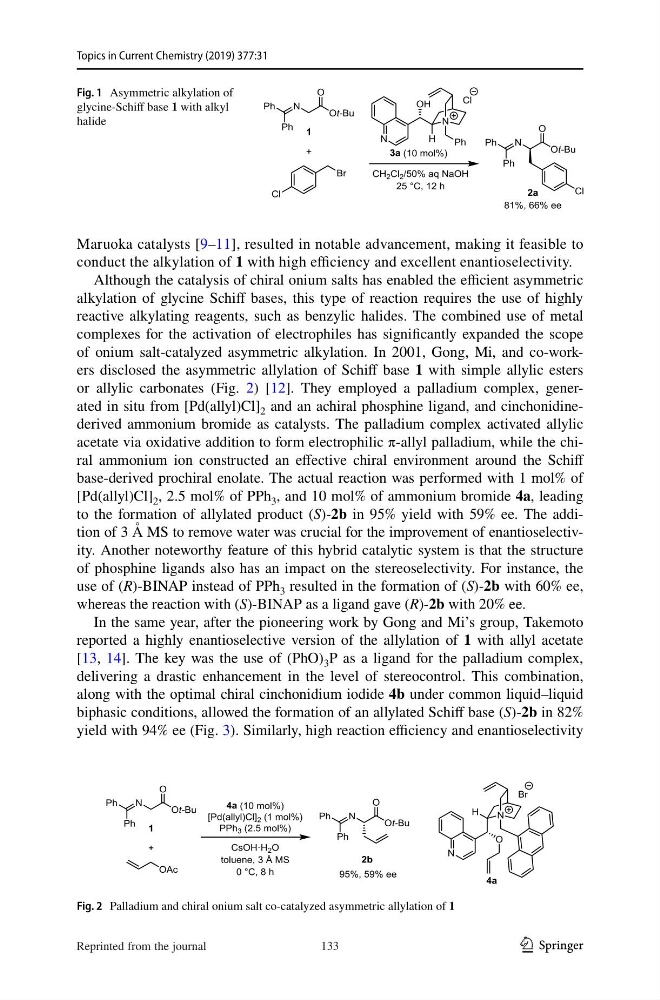
of onium salt-catalyzed asymmetric alkylation. In 2001, Gong, Mi, and co-workers disclosed the asymmetric allylation of Schiff base 1 with simple allylic esters
or allylic carbonates (Fig. 2) [12]. They employed a palladium complex, generated in situ from [Pd(allyl)Cl] 2 and an achiral phosphine ligand, and cinchonidinederived ammonium bromide as catalysts. The palladium complex activated allylic
acetate via oxidative addition to form electrophilic π-allyl palladium, while the chiral ammonium ion constructed an effective chiral environment around the Schiff
base-derived prochiral enolate. The actual reaction was performed with 1 mol% of
[Pd(allyl)Cl] 2 , 2.5 mol% of PPh 3 , and 10 mol% of ammonium bromide 4a, leading
to the formation of allylated product (S)-2b in 95% yield with 59% ee. The addition of 3 Å MS to remove water was crucial for the improvement of enantioselectivity. Another noteworthy feature of this hybrid catalytic system is that the structure
of phosphine ligands also has an impact on the stereoselectivity. For instance, the
use of (R)-BINAP instead of PPh 3 resulted in the formation of (S)-2b with 60% ee,
whereas the reaction with (S)-BINAP as a ligand gave (R)-2b with 20% ee.
In the same year, after the pioneering work by Gong and Mi’s group, Takemoto
reported a highly enantioselective version of the allylation of 1 with allyl acetate
[13, 14]. The key was the use of (PhO) 3 P as a ligand for the palladium complex,
delivering a drastic enhancement in the level of stereocontrol. This combination,
along with the optimal chiral cinchonidium iodide 4b under common liquid–liquid
biphasic conditions, allowed the formation of an allylated Schiff base (S)-2b in 82%
yield with 94% ee (Fig. 3). Similarly, high reaction efficiency and enantioselectivity
Fig. 1 Asymmetric alkylation of
glycine-Schiff base 1 with alkyl
halide
Fig. 2 Palladium and chiral onium salt co-catalyzed asymmetric allylation of 1
Reprinted from the journal
133
Topics in Current Chemistry (2019) 377:31
Maruoka catalysts [9–11], resulted in notable advancement, making it feasible to
conduct the alkylation of 1 with high efficiency and excellent enantioselectivity.
Although the catalysis of chiral onium salts has enabled the efficient asymmetric
alkylation of glycine Schiff bases, this type of reaction requires the use of highly
reactive alkylating reagents, such as benzylic halides. The combined use of metal
complexes for the activation of electrophiles has significantly expanded the scope
of onium salt-catalyzed asymmetric alkylation. In 2001, Gong, Mi, and co-workers disclosed the asymmetric allylation of Schiff base 1 with simple allylic esters
or allylic carbonates (Fig. 2) [12]. They employed a palladium complex, generated in situ from [Pd(allyl)Cl] 2 and an achiral phosphine ligand, and cinchonidinederived ammonium bromide as catalysts. The palladium complex activated allylic
acetate via oxidative addition to form electrophilic π-allyl palladium, while the chiral ammonium ion constructed an effective chiral environment around the Schiff
base-derived prochiral enolate. The actual reaction was performed with 1 mol% of
[Pd(allyl)Cl] 2 , 2.5 mol% of PPh 3 , and 10 mol% of ammonium bromide 4a, leading
to the formation of allylated product (S)-2b in 95% yield with 59% ee. The addition of 3 Å MS to remove water was crucial for the improvement of enantioselectivity. Another noteworthy feature of this hybrid catalytic system is that the structure
of phosphine ligands also has an impact on the stereoselectivity. For instance, the
use of (R)-BINAP instead of PPh 3 resulted in the formation of (S)-2b with 60% ee,
whereas the reaction with (S)-BINAP as a ligand gave (R)-2b with 20% ee.
In the same year, after the pioneering work by Gong and Mi’s group, Takemoto
reported a highly enantioselective version of the allylation of 1 with allyl acetate
[13, 14]. The key was the use of (PhO) 3 P as a ligand for the palladium complex,
delivering a drastic enhancement in the level of stereocontrol. This combination,
along with the optimal chiral cinchonidium iodide 4b under common liquid–liquid
biphasic conditions, allowed the formation of an allylated Schiff base (S)-2b in 82%
yield with 94% ee (Fig. 3). Similarly, high reaction efficiency and enantioselectivity
Fig. 1 Asymmetric alkylation of
glycine-Schiff base 1 with alkyl
halide
Fig. 2 Palladium and chiral onium salt co-catalyzed asymmetric allylation of 1
Reprinted from the journal
133