

1 3
Topics in Current Chemistry (2019) 377:31
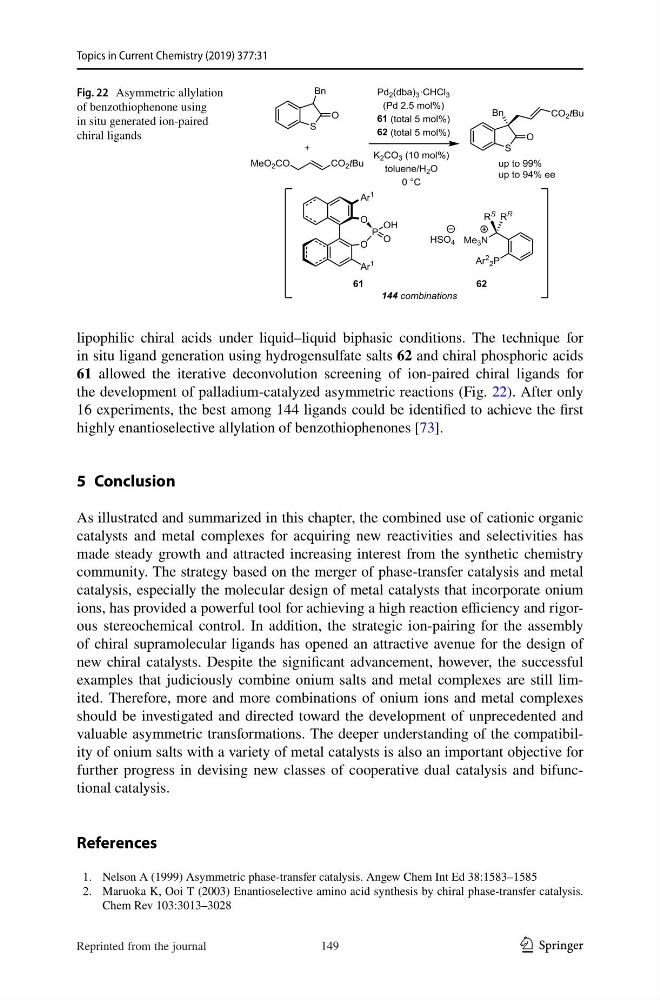
lipophilic chiral acids under liquid–liquid biphasic conditions. The technique for
in situ ligand generation using hydrogensulfate salts 62 and chiral phosphoric acids
61 allowed the iterative deconvolution screening of ion-paired chiral ligands for
the development of palladium-catalyzed asymmetric reactions (Fig. 22). After only
16 experiments, the best among 144 ligands could be identified to achieve the first
highly enantioselective allylation of benzothiophenones [73].
5 Conclusion
As illustrated and summarized in this chapter, the combined use of cationic organic
catalysts and metal complexes for acquiring new reactivities and selectivities has
made steady growth and attracted increasing interest from the synthetic chemistry
community. The strategy based on the merger of phase-transfer catalysis and metal
catalysis, especially the molecular design of metal catalysts that incorporate onium
ions, has provided a powerful tool for achieving a high reaction efficiency and rigorous stereochemical control. In addition, the strategic ion-pairing for the assembly
of chiral supramolecular ligands has opened an attractive avenue for the design of
new chiral catalysts. Despite the significant advancement, however, the successful
examples that judiciously combine onium salts and metal complexes are still limited. Therefore, more and more combinations of onium ions and metal complexes
should be investigated and directed toward the development of unprecedented and
valuable asymmetric transformations. The deeper understanding of the compatibility of onium salts with a variety of metal catalysts is also an important objective for
further progress in devising new classes of cooperative dual catalysis and bifunctional catalysis.
References
1. Nelson A (1999) Asymmetric phase-transfer catalysis. Angew Chem Int Ed 38:1583–1585
2. Maruoka K, Ooi T (2003) Enantioselective amino acid synthesis by chiral phase-transfer catalysis.
Chem Rev 103:3013–3028
Fig. 22 Asymmetric allylation
of benzothiophenone using
in situ generated ion-paired
chiral ligands
Reprinted from the journal
149
Topics in Current Chemistry (2019) 377:31
lipophilic chiral acids under liquid–liquid biphasic conditions. The technique for
in situ ligand generation using hydrogensulfate salts 62 and chiral phosphoric acids
61 allowed the iterative deconvolution screening of ion-paired chiral ligands for
the development of palladium-catalyzed asymmetric reactions (Fig. 22). After only
16 experiments, the best among 144 ligands could be identified to achieve the first
highly enantioselective allylation of benzothiophenones [73].
5 Conclusion
As illustrated and summarized in this chapter, the combined use of cationic organic
catalysts and metal complexes for acquiring new reactivities and selectivities has
made steady growth and attracted increasing interest from the synthetic chemistry
community. The strategy based on the merger of phase-transfer catalysis and metal
catalysis, especially the molecular design of metal catalysts that incorporate onium
ions, has provided a powerful tool for achieving a high reaction efficiency and rigorous stereochemical control. In addition, the strategic ion-pairing for the assembly
of chiral supramolecular ligands has opened an attractive avenue for the design of
new chiral catalysts. Despite the significant advancement, however, the successful
examples that judiciously combine onium salts and metal complexes are still limited. Therefore, more and more combinations of onium ions and metal complexes
should be investigated and directed toward the development of unprecedented and
valuable asymmetric transformations. The deeper understanding of the compatibility of onium salts with a variety of metal catalysts is also an important objective for
further progress in devising new classes of cooperative dual catalysis and bifunctional catalysis.
References
1. Nelson A (1999) Asymmetric phase-transfer catalysis. Angew Chem Int Ed 38:1583–1585
2. Maruoka K, Ooi T (2003) Enantioselective amino acid synthesis by chiral phase-transfer catalysis.
Chem Rev 103:3013–3028
Fig. 22 Asymmetric allylation
of benzothiophenone using
in situ generated ion-paired
chiral ligands
Reprinted from the journal
149