

Topics in Current Chemistry (2020) 378:16
1 3
excellent levels of diastereoselectivity and enantioselectivity (94–96% ee). Product
diversification is possible and a stereochemical model is also presented.
Shortly thereafter, the Cao and Wu groups described a similar process for the
synthesis of 3,4-dihydroquinolin-2-ones via a very similar process only differing
in the structure of the isothiourea catalyst and the method of ketene generation
(Scheme 33) [39].
Gong et al. have also investigated isothiourea Lewis base/copper cooperative
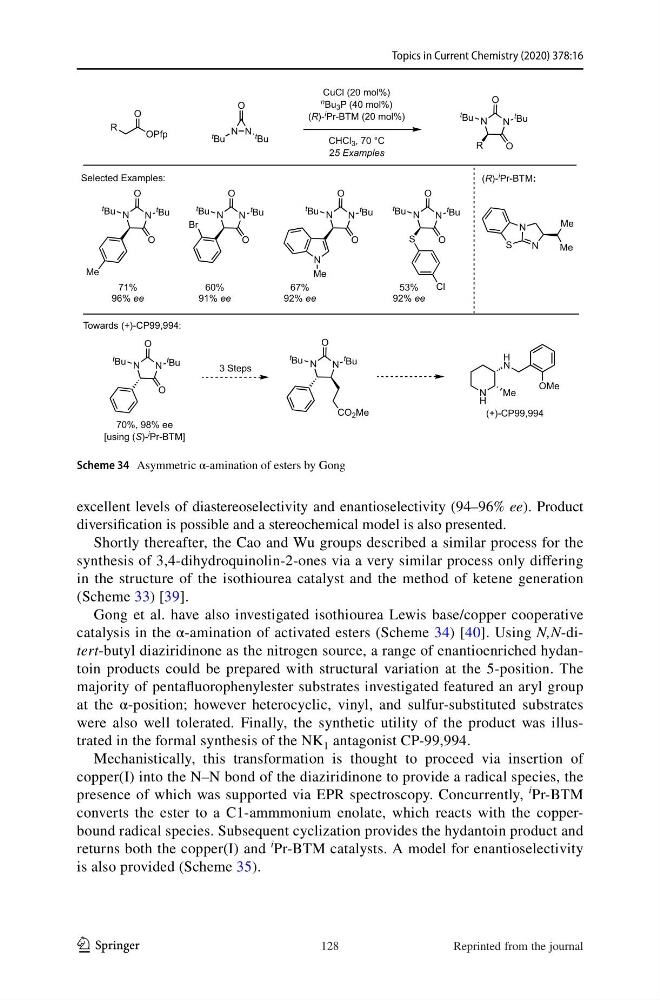
catalysis in the α-amination of activated esters (Scheme 34) [40]. Using N,N-ditert-butyl diaziridinone as the nitrogen source, a range of enantioenriched hydantoin products could be prepared with structural variation at the 5-position. The
majority of pentafluorophenylester substrates investigated featured an aryl group
at the α-position; however heterocyclic, vinyl, and sulfur-substituted substrates
were also well tolerated. Finally, the synthetic utility of the product was illustrated in the formal synthesis of the NK 1 antagonist CP-99,994.
Mechanistically, this transformation is thought to proceed via insertion of
copper(I) into the N–N bond of the diaziridinone to provide a radical species, the
presence of which was supported via EPR spectroscopy. Concurrently,
i
Pr-BTM
converts the ester to a C1-ammmonium enolate, which reacts with the copperbound radical species. Subsequent cyclization provides the hydantoin product and
returns both the copper(I) and
i
Pr-BTM catalysts. A model for enantioselectivity
is also provided (Scheme 35).
R
OPfp
O
N
N
R
O
O
t Bu
t Bu
S
N
N
Me
Me
N
N
O
t Bu
t Bu
CuCl (20 mol%)
n Bu 3 P (40 mol%)
(R)- i Pr-BTM (20 mol%)
CHCl 3 , 70 °C
25 Examples
N
N
O
O
t Bu
t Bu
N
N
O
O
t Bu
t Bu
N
N
O
O
t Bu
t Bu
N
N
S
O
O
t Bu
t Bu
71%
96% ee
Me
Br
N
Me
60%
91% ee
53%
92% ee
67%
92% ee
(R)- i Pr-BTM:
Selected Examples:
N
N
O
O
t Bu
t Bu
70%, 98% ee
[using (S)- i Pr-BTM]
N
N
O
t Bu
t Bu
CO 2 Me
N
H
Me
H
N
OMe
3 Steps
Towards (+)-CP99,994:
Cl
(+)-CP99,994
Scheme 34 Asymmetric α-amination of esters by Gong
Reprinted from the journal
128
1 3
excellent levels of diastereoselectivity and enantioselectivity (94–96% ee). Product
diversification is possible and a stereochemical model is also presented.
Shortly thereafter, the Cao and Wu groups described a similar process for the
synthesis of 3,4-dihydroquinolin-2-ones via a very similar process only differing
in the structure of the isothiourea catalyst and the method of ketene generation
(Scheme 33) [39].
Gong et al. have also investigated isothiourea Lewis base/copper cooperative
catalysis in the α-amination of activated esters (Scheme 34) [40]. Using N,N-ditert-butyl diaziridinone as the nitrogen source, a range of enantioenriched hydantoin products could be prepared with structural variation at the 5-position. The
majority of pentafluorophenylester substrates investigated featured an aryl group
at the α-position; however heterocyclic, vinyl, and sulfur-substituted substrates
were also well tolerated. Finally, the synthetic utility of the product was illustrated in the formal synthesis of the NK 1 antagonist CP-99,994.
Mechanistically, this transformation is thought to proceed via insertion of
copper(I) into the N–N bond of the diaziridinone to provide a radical species, the
presence of which was supported via EPR spectroscopy. Concurrently,
i
Pr-BTM
converts the ester to a C1-ammmonium enolate, which reacts with the copperbound radical species. Subsequent cyclization provides the hydantoin product and
returns both the copper(I) and
i
Pr-BTM catalysts. A model for enantioselectivity
is also provided (Scheme 35).
R
OPfp
O
N
N
R
O
O
t Bu
t Bu
S
N
N
Me
Me
N
N
O
t Bu
t Bu
CuCl (20 mol%)
n Bu 3 P (40 mol%)
(R)- i Pr-BTM (20 mol%)
CHCl 3 , 70 °C
25 Examples
N
N
O
O
t Bu
t Bu
N
N
O
O
t Bu
t Bu
N
N
O
O
t Bu
t Bu
N
N
S
O
O
t Bu
t Bu
71%
96% ee
Me
Br
N
Me
60%
91% ee
53%
92% ee
67%
92% ee
(R)- i Pr-BTM:
Selected Examples:
N
N
O
O
t Bu
t Bu
70%, 98% ee
[using (S)- i Pr-BTM]
N
N
O
t Bu
t Bu
CO 2 Me
N
H
Me
H
N
OMe
3 Steps
Towards (+)-CP99,994:
Cl
(+)-CP99,994
Scheme 34 Asymmetric α-amination of esters by Gong
Reprinted from the journal
128