

1 3
Topics in Current Chemistry (2020) 378:16
[4+3] cyclization (35–75%); however, a wide range of substitution patterns on the
aromatic ring of the MBH carbonate were tolerated. Once again, 4-(piperidinyl)pyridine was the most effective Lewis base, while a vastly different cyclometallated cationic Ir(I) catalyst was required.
3.3 Cooperative Tertiary Amine Lewis Base/Copper Catalysis
In concert with developments in isothiourea Lewis base/palladium cooperative
catalysis, useful cooperative reactions involving copper catalysis have also emerged.
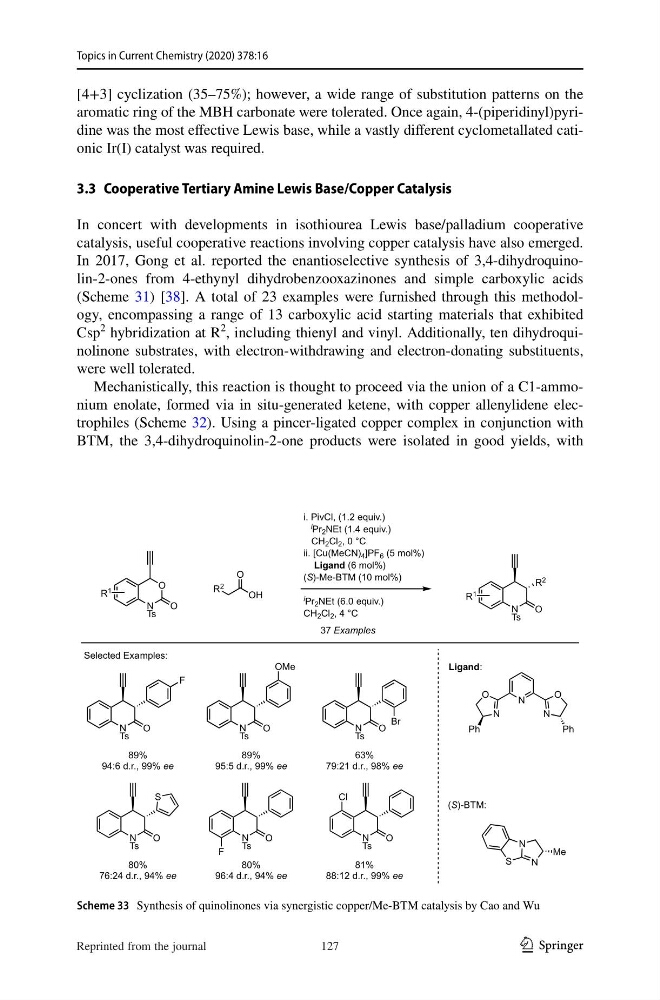
In 2017, Gong et al. reported the enantioselective synthesis of 3,4-dihydroquinolin-2-ones from 4-ethynyl dihydrobenzooxazinones and simple carboxylic acids
(Scheme 31) [38]. A total of 23 examples were furnished through this methodology, encompassing a range of 13 carboxylic acid starting materials that exhibited
Csp
2
hybridization at R
2
, including thienyl and vinyl. Additionally, ten dihydroquinolinone substrates, with electron-withdrawing and electron-donating substituents,
were well tolerated.
Mechanistically, this reaction is thought to proceed via the union of a C1-ammonium enolate, formed via in situ-generated ketene, with copper allenylidene electrophiles (Scheme 32). Using a pincer-ligated copper complex in conjunction with
BTM, the 3,4-dihydroquinolin-2-one products were isolated in good yields, with
Selected Examples:
N
Ts
O
O
R 2
OH
O
N
Ts
O
R 2
N
O
N
N
O
Ph
Ph
S
N
N
Me
i. PivCl, (1.2 equiv.)
i Pr 2 NEt (1.4 equiv.)
CH 2 Cl 2 , 0 °C
ii. [Cu(MeCN) 4 ]PF 6 (5 mol%)
Ligand (6 mol%)
(S)-Me-BTM (10 mol%)
i Pr 2 NEt (6.0 equiv.)
CH 2 Cl 2 , 4 °C
Ligand:
(S)-BTM:
N
Ts
O
89%
94:6 d.r., 99% ee
N
Ts
O
89%
95:5 d.r., 99% ee
N
Ts
O
63%
79:21 d.r., 98% ee
N
Ts
O
80%
76:24 d.r., 94% ee
N
Ts
O
80%
96:4 d.r., 94% ee
N
Ts
O
81%
88:12 d.r., 99% ee
F
OMe
S
F
R 1
R 1
Br
Cl
37 Examples
Scheme 33 Synthesis of quinolinones via synergistic copper/Me-BTM catalysis by Cao and Wu
Reprinted from the journal
127
Topics in Current Chemistry (2020) 378:16
[4+3] cyclization (35–75%); however, a wide range of substitution patterns on the
aromatic ring of the MBH carbonate were tolerated. Once again, 4-(piperidinyl)pyridine was the most effective Lewis base, while a vastly different cyclometallated cationic Ir(I) catalyst was required.
3.3 Cooperative Tertiary Amine Lewis Base/Copper Catalysis
In concert with developments in isothiourea Lewis base/palladium cooperative
catalysis, useful cooperative reactions involving copper catalysis have also emerged.
In 2017, Gong et al. reported the enantioselective synthesis of 3,4-dihydroquinolin-2-ones from 4-ethynyl dihydrobenzooxazinones and simple carboxylic acids
(Scheme 31) [38]. A total of 23 examples were furnished through this methodology, encompassing a range of 13 carboxylic acid starting materials that exhibited
Csp
2
hybridization at R
2
, including thienyl and vinyl. Additionally, ten dihydroquinolinone substrates, with electron-withdrawing and electron-donating substituents,
were well tolerated.
Mechanistically, this reaction is thought to proceed via the union of a C1-ammonium enolate, formed via in situ-generated ketene, with copper allenylidene electrophiles (Scheme 32). Using a pincer-ligated copper complex in conjunction with
BTM, the 3,4-dihydroquinolin-2-one products were isolated in good yields, with
Selected Examples:
N
Ts
O
O
R 2
OH
O
N
Ts
O
R 2
N
O
N
N
O
Ph
Ph
S
N
N
Me
i. PivCl, (1.2 equiv.)
i Pr 2 NEt (1.4 equiv.)
CH 2 Cl 2 , 0 °C
ii. [Cu(MeCN) 4 ]PF 6 (5 mol%)
Ligand (6 mol%)
(S)-Me-BTM (10 mol%)
i Pr 2 NEt (6.0 equiv.)
CH 2 Cl 2 , 4 °C
Ligand:
(S)-BTM:
N
Ts
O
89%
94:6 d.r., 99% ee
N
Ts
O
89%
95:5 d.r., 99% ee
N
Ts
O
63%
79:21 d.r., 98% ee
N
Ts
O
80%
76:24 d.r., 94% ee
N
Ts
O
80%
96:4 d.r., 94% ee
N
Ts
O
81%
88:12 d.r., 99% ee
F
OMe
S
F
R 1
R 1
Br
Cl
37 Examples
Scheme 33 Synthesis of quinolinones via synergistic copper/Me-BTM catalysis by Cao and Wu
Reprinted from the journal
127