

1 3
Topics in Current Chemistry (2019) 377:38
solvents. Thus, the reactions can be performed in laboratories that do not have the
special equipment necessary for some types of organometallic chemistry (e.g.,
glove box) and are less moisture sensitive. In fact, sometimes a small amount of
water (e.g., 10 mol %) and oxygen are necessary for the transformations to occur
[10, 81].
2 α‑Allylic Alkylation of Aldehydes and Ketones
The first demonstration of a successful combination of catalytic enamine activation
and transition metal catalysis was disclosed by Córdova et al. [12]. This concept
has been shown to be a very powerful tool for a variety of chemical reactions [5].
With respect to the direct α-allylic alkylation (AAA) of aldehydes and ketones, the
research group managed to obtain the corresponding alkylated product in moderateto-high yields.
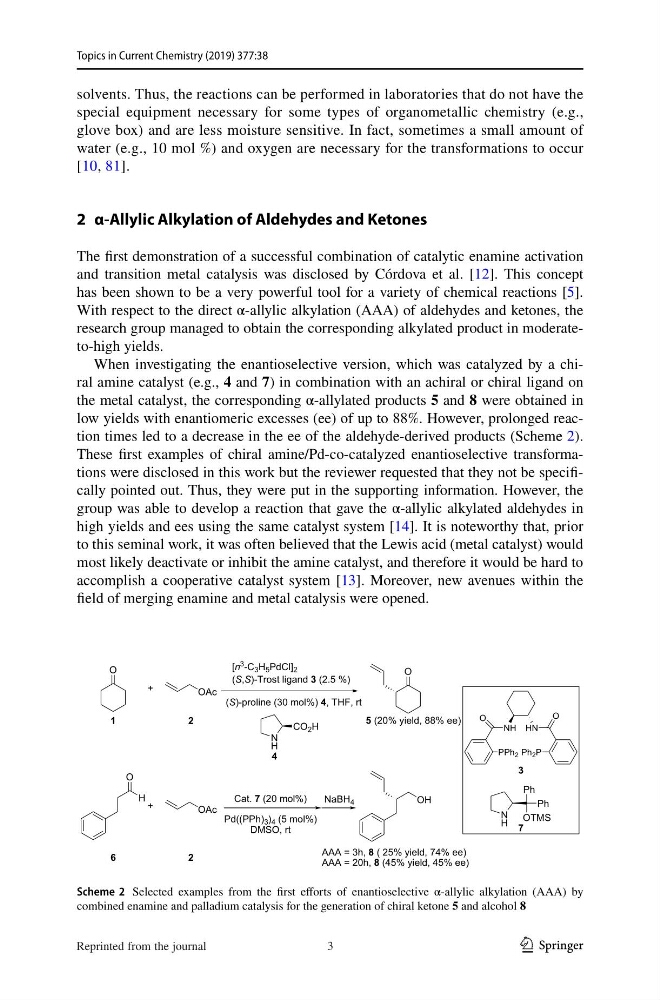
When investigating the enantioselective version, which was catalyzed by a chiral amine catalyst (e.g., 4 and 7) in combination with an achiral or chiral ligand on
the metal catalyst, the corresponding α-allylated products 5 and 8 were obtained in
low yields with enantiomeric excesses (ee) of up to 88%. However, prolonged reaction times led to a decrease in the ee of the aldehyde-derived products (Scheme 2).
These first examples of chiral amine/Pd-co-catalyzed enantioselective transformations were disclosed in this work but the reviewer requested that they not be specifically pointed out. Thus, they were put in the supporting information. However, the
group was able to develop a reaction that gave the α-allylic alkylated aldehydes in
high yields and ees using the same catalyst system [14]. It is noteworthy that, prior
to this seminal work, it was often believed that the Lewis acid (metal catalyst) would
most likely deactivate or inhibit the amine catalyst, and therefore it would be hard to
accomplish a cooperative catalyst system [13]. Moreover, new avenues within the
field of merging enamine and metal catalysis were opened.
O
OAc
+
O
5 (20% yield, 88% ee)
[n
3
-C 3 H 5 PdCl] 2
(S,S)-Trost ligand 3 (2.5 %)
NH HN
O
O
PPh 2 Ph 2 P
3
H
O
OAc
+
Cat. 7 (20 mol%)
NaBH 4
OH
AAA = 3h, 8 ( 25% yield, 74% ee)
AAA = 20h, 8 (45% yield, 45% ee)
1
2
6
2
N
H
N
H
CO 2 H
Ph
Ph
OTMS
7
(S)-proline (30 mol%) 4, THF, rt
Pd((PPh) 3 ) 4 (5 mol%)
DMSO, rt
4
Scheme 2 Selected examples from the first efforts of enantioselective α-allylic alkylation (AAA) by
combined enamine and palladium catalysis for the generation of chiral ketone 5 and alcohol 8
Reprinted from the journal
3
Topics in Current Chemistry (2019) 377:38
solvents. Thus, the reactions can be performed in laboratories that do not have the
special equipment necessary for some types of organometallic chemistry (e.g.,
glove box) and are less moisture sensitive. In fact, sometimes a small amount of
water (e.g., 10 mol %) and oxygen are necessary for the transformations to occur
[10, 81].
2 α‑Allylic Alkylation of Aldehydes and Ketones
The first demonstration of a successful combination of catalytic enamine activation
and transition metal catalysis was disclosed by Córdova et al. [12]. This concept
has been shown to be a very powerful tool for a variety of chemical reactions [5].
With respect to the direct α-allylic alkylation (AAA) of aldehydes and ketones, the
research group managed to obtain the corresponding alkylated product in moderateto-high yields.
When investigating the enantioselective version, which was catalyzed by a chiral amine catalyst (e.g., 4 and 7) in combination with an achiral or chiral ligand on
the metal catalyst, the corresponding α-allylated products 5 and 8 were obtained in
low yields with enantiomeric excesses (ee) of up to 88%. However, prolonged reaction times led to a decrease in the ee of the aldehyde-derived products (Scheme 2).
These first examples of chiral amine/Pd-co-catalyzed enantioselective transformations were disclosed in this work but the reviewer requested that they not be specifically pointed out. Thus, they were put in the supporting information. However, the
group was able to develop a reaction that gave the α-allylic alkylated aldehydes in
high yields and ees using the same catalyst system [14]. It is noteworthy that, prior
to this seminal work, it was often believed that the Lewis acid (metal catalyst) would
most likely deactivate or inhibit the amine catalyst, and therefore it would be hard to
accomplish a cooperative catalyst system [13]. Moreover, new avenues within the
field of merging enamine and metal catalysis were opened.
O
OAc
+
O
5 (20% yield, 88% ee)
[n
3
-C 3 H 5 PdCl] 2
(S,S)-Trost ligand 3 (2.5 %)
NH HN
O
O
PPh 2 Ph 2 P
3
H
O
OAc
+
Cat. 7 (20 mol%)
NaBH 4
OH
AAA = 3h, 8 ( 25% yield, 74% ee)
AAA = 20h, 8 (45% yield, 45% ee)
1
2
6
2
N
H
N
H
CO 2 H
Ph
Ph
OTMS
7
(S)-proline (30 mol%) 4, THF, rt
Pd((PPh) 3 ) 4 (5 mol%)
DMSO, rt
4
Scheme 2 Selected examples from the first efforts of enantioselective α-allylic alkylation (AAA) by
combined enamine and palladium catalysis for the generation of chiral ketone 5 and alcohol 8
Reprinted from the journal
3