

Topics in Current Chemistry (2019) 377:38
1 3
the amine catalyst is combined with a transition metal catalyst, allowing unprecedented chemical reactions to ensue [5]. In the case when the amine catalyst provides a nucleophilic enamine, the intermediate can react directly with an electrophilic component activated by the transition metal catalyst [6, 7]. Specifically,
the amine-catalyzed enamine formation of carbonyl compounds proceeds through
the condensation reaction between the carbonyl component and the amine catalyst providing a nucleophilic enamine intermediate (enamine catalysis). In parallel, the transition metal can activate a wide range of substrates through various
activation modes (e.g., through the formation of a π-allyl-metal complex, through
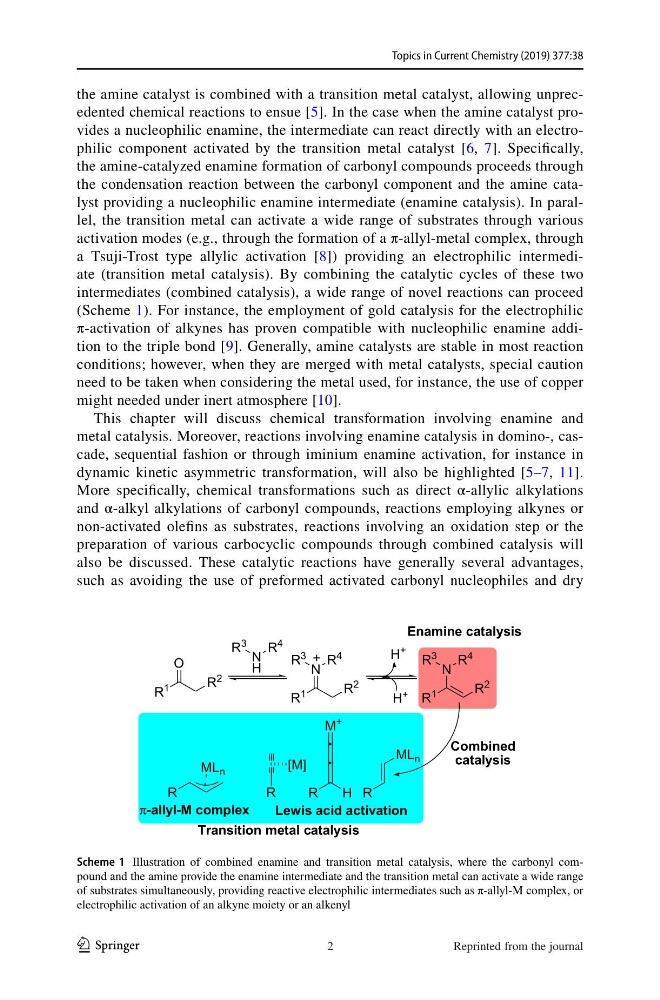
a Tsuji-Trost type allylic activation [8]) providing an electrophilic intermediate (transition metal catalysis). By combining the catalytic cycles of these two
intermediates (combined catalysis), a wide range of novel reactions can proceed
(Scheme 1). For instance, the employment of gold catalysis for the electrophilic
π-activation of alkynes has proven compatible with nucleophilic enamine addition to the triple bond [9]. Generally, amine catalysts are stable in most reaction
conditions; however, when they are merged with metal catalysts, special caution
need to be taken when considering the metal used, for instance, the use of copper
might needed under inert atmosphere [10].
This chapter will discuss chemical transformation involving enamine and
metal catalysis. Moreover, reactions involving enamine catalysis in domino-, cascade, sequential fashion or through iminium enamine activation, for instance in
dynamic kinetic asymmetric transformation, will also be highlighted [5–7, 11].
More specifically, chemical transformations such as direct α-allylic alkylations
and α-alkyl alkylations of carbonyl compounds, reactions employing alkynes or
non-activated olefins as substrates, reactions involving an oxidation step or the
preparation of various carbocyclic compounds through combined catalysis will
also be discussed. These catalytic reactions have generally several advantages,
such as avoiding the use of preformed activated carbonyl nucleophiles and dry
R
1
O
R
2
N
H
R
4
R
3
R
1
N
R
2
R
3
R
4
H
+
H
+ R
1
N
R
2
R
3
R
4
+
R
ML n
π-allyl-M complex
R
[M]
Lewis acid activation
H
R
M
+
Transition metal catalysis
Enamine catalysis
Combined
catalysis
R
ML n
Scheme 1 Illustration of combined enamine and transition metal catalysis, where the carbonyl compound and the amine provide the enamine intermediate and the transition metal can activate a wide range
of substrates simultaneously, providing reactive electrophilic intermediates such as π-allyl-M complex, or
electrophilic activation of an alkyne moiety or an alkenyl
Reprinted from the journal
2
1 3
the amine catalyst is combined with a transition metal catalyst, allowing unprecedented chemical reactions to ensue [5]. In the case when the amine catalyst provides a nucleophilic enamine, the intermediate can react directly with an electrophilic component activated by the transition metal catalyst [6, 7]. Specifically,
the amine-catalyzed enamine formation of carbonyl compounds proceeds through
the condensation reaction between the carbonyl component and the amine catalyst providing a nucleophilic enamine intermediate (enamine catalysis). In parallel, the transition metal can activate a wide range of substrates through various
activation modes (e.g., through the formation of a π-allyl-metal complex, through
a Tsuji-Trost type allylic activation [8]) providing an electrophilic intermediate (transition metal catalysis). By combining the catalytic cycles of these two
intermediates (combined catalysis), a wide range of novel reactions can proceed
(Scheme 1). For instance, the employment of gold catalysis for the electrophilic
π-activation of alkynes has proven compatible with nucleophilic enamine addition to the triple bond [9]. Generally, amine catalysts are stable in most reaction
conditions; however, when they are merged with metal catalysts, special caution
need to be taken when considering the metal used, for instance, the use of copper
might needed under inert atmosphere [10].
This chapter will discuss chemical transformation involving enamine and
metal catalysis. Moreover, reactions involving enamine catalysis in domino-, cascade, sequential fashion or through iminium enamine activation, for instance in
dynamic kinetic asymmetric transformation, will also be highlighted [5–7, 11].
More specifically, chemical transformations such as direct α-allylic alkylations
and α-alkyl alkylations of carbonyl compounds, reactions employing alkynes or
non-activated olefins as substrates, reactions involving an oxidation step or the
preparation of various carbocyclic compounds through combined catalysis will
also be discussed. These catalytic reactions have generally several advantages,
such as avoiding the use of preformed activated carbonyl nucleophiles and dry
R
1
O
R
2
N
H
R
4
R
3
R
1
N
R
2
R
3
R
4
H
+
H
+ R
1
N
R
2
R
3
R
4
+
R
ML n
π-allyl-M complex
R
[M]
Lewis acid activation
H
R
M
+
Transition metal catalysis
Enamine catalysis
Combined
catalysis
R
ML n
Scheme 1 Illustration of combined enamine and transition metal catalysis, where the carbonyl compound and the amine provide the enamine intermediate and the transition metal can activate a wide range
of substrates simultaneously, providing reactive electrophilic intermediates such as π-allyl-M complex, or
electrophilic activation of an alkyne moiety or an alkenyl
Reprinted from the journal
2