

Topics in Current Chemistry (2019) 377:38
1 3
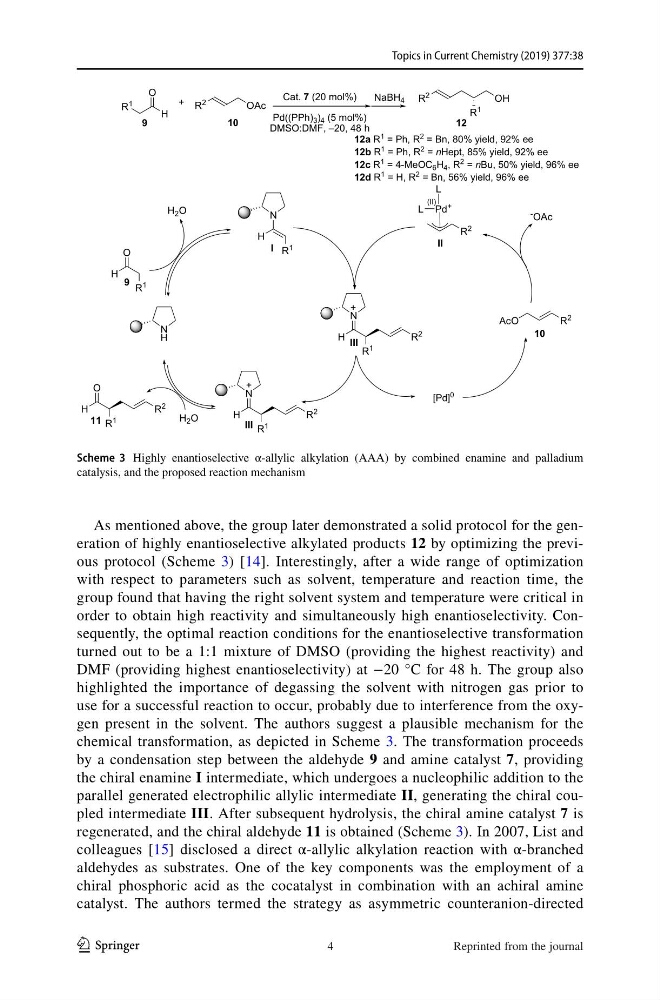
As mentioned above, the group later demonstrated a solid protocol for the generation of highly enantioselective alkylated products 12 by optimizing the previous protocol (Scheme 3) [14]. Interestingly, after a wide range of optimization
with respect to parameters such as solvent, temperature and reaction time, the
group found that having the right solvent system and temperature were critical in
order to obtain high reactivity and simultaneously high enantioselectivity. Consequently, the optimal reaction conditions for the enantioselective transformation
turned out to be a 1:1 mixture of DMSO (providing the highest reactivity) and
DMF (providing highest enantioselectivity) at −20 °C for 48 h. The group also
highlighted the importance of degassing the solvent with nitrogen gas prior to
use for a successful reaction to occur, probably due to interference from the oxygen present in the solvent. The authors suggest a plausible mechanism for the
chemical transformation, as depicted in Scheme 3. The transformation proceeds
by a condensation step between the aldehyde 9 and amine catalyst 7, providing
the chiral enamine I intermediate, which undergoes a nucleophilic addition to the
parallel generated electrophilic allylic intermediate II, generating the chiral coupled intermediate III. After subsequent hydrolysis, the chiral amine catalyst 7 is
regenerated, and the chiral aldehyde 11 is obtained (Scheme 3). In 2007, List and
colleagues [15] disclosed a direct α-allylic alkylation reaction with α-branched
aldehydes as substrates. One of the key components was the employment of a
chiral phosphoric acid as the cocatalyst in combination with an achiral amine
catalyst. The authors termed the strategy as asymmetric counteranion-directed
Cat. 7 (20 mol%)
NaBH 4
Pd((PPh) 3 ) 4 (5 mol%)
DMSO:DMF, –20, 48 h
H
O
H 2 O
R
2
Pd
+
[Pd]
0
R
2
10
- OAc
H 2 O
II
AcO
N
H
9 R
1
N
R
1
H
I
L
L
(II)
N
R
1
H III
R
2
+
N
R
1
H III
R
2
+
O
R
1
H
11
R
2
O
+
OAc
9
10
H
R
2
OH
R
1
R
2
12
12a R
1 = Ph, R
2 = Bn, 80% yield, 92% ee
12b R
1 = Ph, R
2 = nHept, 85% yield, 92% ee
12c R
1 = 4-MeOC 6 H 4 , R
2 = nBu, 50% yield, 96% ee
12d R
1 = H, R
2 = Bn, 56% yield, 96% ee
R
1
Scheme 3 Highly enantioselective α-allylic alkylation (AAA) by combined enamine and palladium
catalysis, and the proposed reaction mechanism
Reprinted from the journal
4
1 3
As mentioned above, the group later demonstrated a solid protocol for the generation of highly enantioselective alkylated products 12 by optimizing the previous protocol (Scheme 3) [14]. Interestingly, after a wide range of optimization
with respect to parameters such as solvent, temperature and reaction time, the
group found that having the right solvent system and temperature were critical in
order to obtain high reactivity and simultaneously high enantioselectivity. Consequently, the optimal reaction conditions for the enantioselective transformation
turned out to be a 1:1 mixture of DMSO (providing the highest reactivity) and
DMF (providing highest enantioselectivity) at −20 °C for 48 h. The group also
highlighted the importance of degassing the solvent with nitrogen gas prior to
use for a successful reaction to occur, probably due to interference from the oxygen present in the solvent. The authors suggest a plausible mechanism for the
chemical transformation, as depicted in Scheme 3. The transformation proceeds
by a condensation step between the aldehyde 9 and amine catalyst 7, providing
the chiral enamine I intermediate, which undergoes a nucleophilic addition to the
parallel generated electrophilic allylic intermediate II, generating the chiral coupled intermediate III. After subsequent hydrolysis, the chiral amine catalyst 7 is
regenerated, and the chiral aldehyde 11 is obtained (Scheme 3). In 2007, List and
colleagues [15] disclosed a direct α-allylic alkylation reaction with α-branched
aldehydes as substrates. One of the key components was the employment of a
chiral phosphoric acid as the cocatalyst in combination with an achiral amine
catalyst. The authors termed the strategy as asymmetric counteranion-directed
Cat. 7 (20 mol%)
NaBH 4
Pd((PPh) 3 ) 4 (5 mol%)
DMSO:DMF, –20, 48 h
H
O
H 2 O
R
2
Pd
+
[Pd]
0
R
2
10
- OAc
H 2 O
II
AcO
N
H
9 R
1
N
R
1
H
I
L
L
(II)
N
R
1
H III
R
2
+
N
R
1
H III
R
2
+
O
R
1
H
11
R
2
O
+
OAc
9
10
H
R
2
OH
R
1
R
2
12
12a R
1 = Ph, R
2 = Bn, 80% yield, 92% ee
12b R
1 = Ph, R
2 = nHept, 85% yield, 92% ee
12c R
1 = 4-MeOC 6 H 4 , R
2 = nBu, 50% yield, 96% ee
12d R
1 = H, R
2 = Bn, 56% yield, 96% ee
R
1
Scheme 3 Highly enantioselective α-allylic alkylation (AAA) by combined enamine and palladium
catalysis, and the proposed reaction mechanism
Reprinted from the journal
4