

Topics in Current Chemistry (2020) 378:16
1 3
catalyzed α-allylation of esters via the union of C1-ammonium enolates with cationic π(allyl)Pd electrophiles (Scheme 17) [25]. Using Buchwald’s XantphosPd
G3 precatalyst [26] in cooperation with BTM a variety of α-allylated esters could
be prepared directly from aryl acetic acid pentafluorophenyl esters and allyl electrophiles in good yields and with high levels of enantioselectivity. Although this
method was limited to allyl mesylate or cinnamyl t-butyl carbonate electrophiles,
a wide variety of substituents was well tolerated. Finally, based on earlier work
by Smith [23], a stereochemical model to rationalize the observed stereochemical outcome of the reaction where the intermediate (Z)O-C1-ammonium enolate
is rigidified through a stabilizing n O –σ
*
C–S interaction and the facial selectivity is
governed by the phenyl group blocking electrophile approach from the distal face.
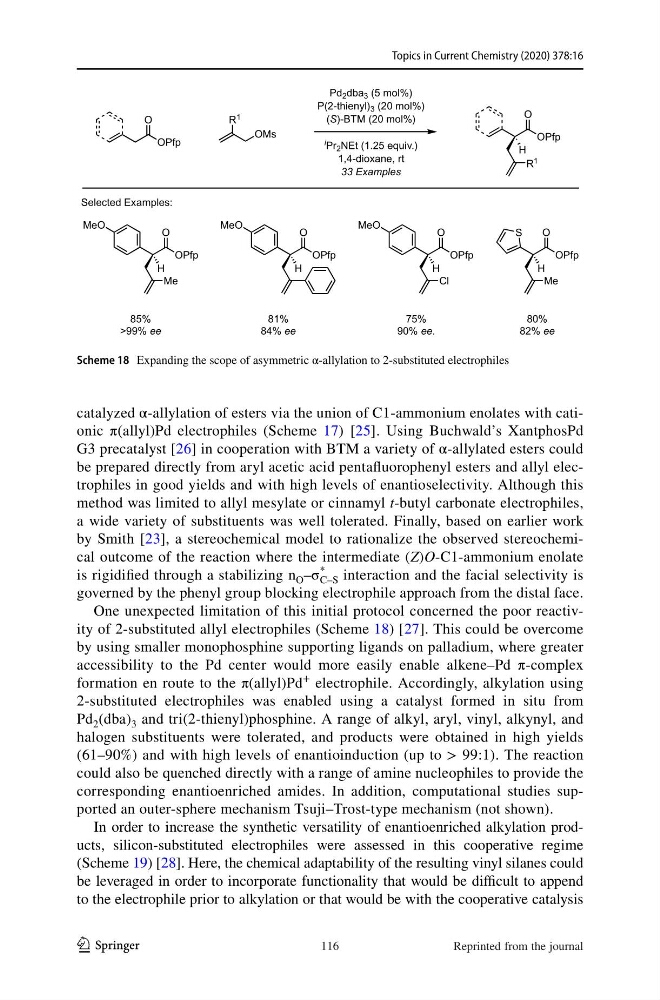
One unexpected limitation of this initial protocol concerned the poor reactivity of 2-substituted allyl electrophiles (Scheme 18) [27]. This could be overcome
by using smaller monophosphine supporting ligands on palladium, where greater
accessibility to the Pd center would more easily enable alkene–Pd π-complex
formation en route to the π(allyl)Pd
+
electrophile. Accordingly, alkylation using
2-substituted electrophiles was enabled using a catalyst formed in situ from
Pd 2 (dba) 3 and tri(2-thienyl)phosphine. A range of alkyl, aryl, vinyl, alkynyl, and
halogen substituents were tolerated, and products were obtained in high yields
(61–90%) and with high levels of enantioinduction (up to > 99:1). The reaction
could also be quenched directly with a range of amine nucleophiles to provide the
corresponding enantioenriched amides. In addition, computational studies supported an outer-sphere mechanism Tsuji–Trost-type mechanism (not shown).
In order to increase the synthetic versatility of enantioenriched alkylation products, silicon-substituted electrophiles were assessed in this cooperative regime
(Scheme 19) [28]. Here, the chemical adaptability of the resulting vinyl silanes could
be leveraged in order to incorporate functionality that would be difficult to append
to the electrophile prior to alkylation or that would be with the cooperative catalysis
OPfp
O
OPfp
O
H
OMs
Pd 2 dba 3 (5 mol%)
P(2-thienyl) 3 (20 mol%)
(S)-BTM (20 mol%)
i Pr 2 NEt (1.25 equiv.)
1,4-dioxane, rt
33 Examples
R 1
R 1
OPfp
O
H
85%
>99% ee
Me
OPfp
O
H
81%
84% ee
MeO
MeO
OPfp
O
H
80%
82% ee
Me
S
OPfp
O
H
75%
90% ee.
Cl
MeO
Selected Examples:
Scheme 18 Expanding the scope of asymmetric α-allylation to 2-substituted electrophiles
Reprinted from the journal
116
1 3
catalyzed α-allylation of esters via the union of C1-ammonium enolates with cationic π(allyl)Pd electrophiles (Scheme 17) [25]. Using Buchwald’s XantphosPd
G3 precatalyst [26] in cooperation with BTM a variety of α-allylated esters could
be prepared directly from aryl acetic acid pentafluorophenyl esters and allyl electrophiles in good yields and with high levels of enantioselectivity. Although this
method was limited to allyl mesylate or cinnamyl t-butyl carbonate electrophiles,
a wide variety of substituents was well tolerated. Finally, based on earlier work
by Smith [23], a stereochemical model to rationalize the observed stereochemical outcome of the reaction where the intermediate (Z)O-C1-ammonium enolate
is rigidified through a stabilizing n O –σ
*
C–S interaction and the facial selectivity is
governed by the phenyl group blocking electrophile approach from the distal face.
One unexpected limitation of this initial protocol concerned the poor reactivity of 2-substituted allyl electrophiles (Scheme 18) [27]. This could be overcome
by using smaller monophosphine supporting ligands on palladium, where greater
accessibility to the Pd center would more easily enable alkene–Pd π-complex
formation en route to the π(allyl)Pd
+
electrophile. Accordingly, alkylation using
2-substituted electrophiles was enabled using a catalyst formed in situ from
Pd 2 (dba) 3 and tri(2-thienyl)phosphine. A range of alkyl, aryl, vinyl, alkynyl, and
halogen substituents were tolerated, and products were obtained in high yields
(61–90%) and with high levels of enantioinduction (up to > 99:1). The reaction
could also be quenched directly with a range of amine nucleophiles to provide the
corresponding enantioenriched amides. In addition, computational studies supported an outer-sphere mechanism Tsuji–Trost-type mechanism (not shown).
In order to increase the synthetic versatility of enantioenriched alkylation products, silicon-substituted electrophiles were assessed in this cooperative regime
(Scheme 19) [28]. Here, the chemical adaptability of the resulting vinyl silanes could
be leveraged in order to incorporate functionality that would be difficult to append
to the electrophile prior to alkylation or that would be with the cooperative catalysis
OPfp
O
OPfp
O
H
OMs
Pd 2 dba 3 (5 mol%)
P(2-thienyl) 3 (20 mol%)
(S)-BTM (20 mol%)
i Pr 2 NEt (1.25 equiv.)
1,4-dioxane, rt
33 Examples
R 1
R 1
OPfp
O
H
85%
>99% ee
Me
OPfp
O
H
81%
84% ee
MeO
MeO
OPfp
O
H
80%
82% ee
Me
S
OPfp
O
H
75%
90% ee.
Cl
MeO
Selected Examples:
Scheme 18 Expanding the scope of asymmetric α-allylation to 2-substituted electrophiles
Reprinted from the journal
116