

1 3
Topics in Current Chemistry (2020) 378:16
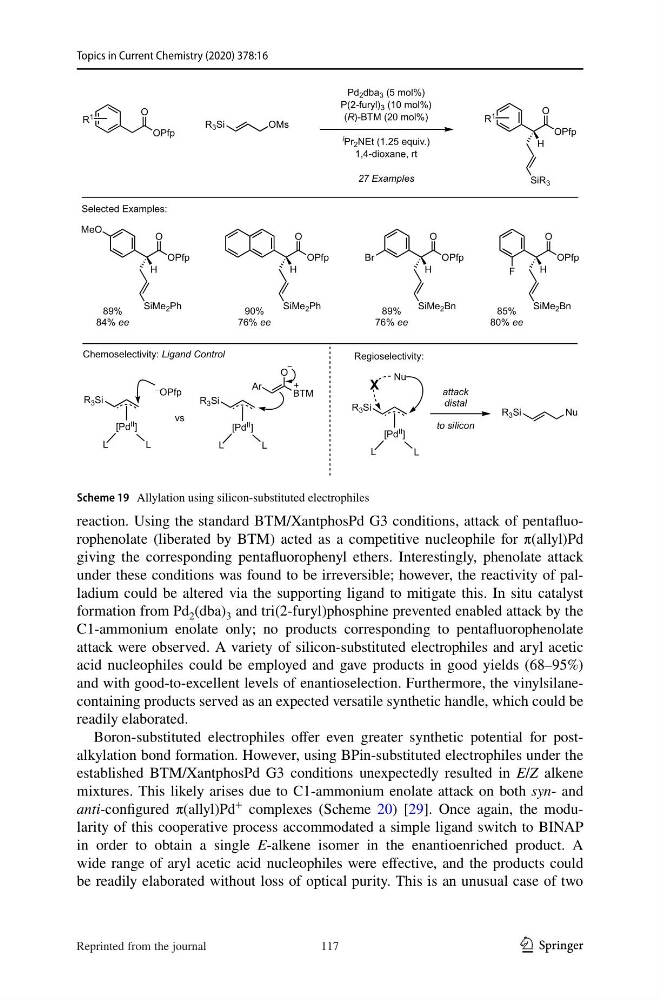
reaction. Using the standard BTM/XantphosPd G3 conditions, attack of pentafluorophenolate (liberated by BTM) acted as a competitive nucleophile for π(allyl)Pd
giving the corresponding pentafluorophenyl ethers. Interestingly, phenolate attack
under these conditions was found to be irreversible; however, the reactivity of palladium could be altered via the supporting ligand to mitigate this. In situ catalyst
formation from Pd 2 (dba) 3 and tri(2-furyl)phosphine prevented enabled attack by the
C1-ammonium enolate only; no products corresponding to pentafluorophenolate
attack were observed. A variety of silicon-substituted electrophiles and aryl acetic
acid nucleophiles could be employed and gave products in good yields (68–95%)
and with good-to-excellent levels of enantioselection. Furthermore, the vinylsilanecontaining products served as an expected versatile synthetic handle, which could be
readily elaborated.
Boron-substituted electrophiles offer even greater synthetic potential for postalkylation bond formation. However, using BPin-substituted electrophiles under the
established BTM/XantphosPd G3 conditions unexpectedly resulted in E/Z alkene
mixtures. This likely arises due to C1-ammonium enolate attack on both syn- and
anti-configured π(allyl)Pd
+
complexes (Scheme 20) [29]. Once again, the modularity of this cooperative process accommodated a simple ligand switch to BINAP
in order to obtain a single E-alkene isomer in the enantioenriched product. A
wide range of aryl acetic acid nucleophiles were effective, and the products could
be readily elaborated without loss of optical purity. This is an unusual case of two
OPfp
O
OPfp
O
H
R 3 Si
OMs
R 1
R 1
Pd 2 dba 3 (5 mol%)
P(2-furyl) 3 (10 mol%)
(R)-BTM (20 mol%)
i Pr 2 NEt (1.25 equiv.)
1,4-dioxane, rt
27 Examples
SiR 3
OPfp
O
H
MeO
SiMe 2 Ph
OPfp
O
H
SiMe 2 Ph
OPfp
O
H
SiMe 2 Bn
Br
89%
84% ee
90%
76% ee
89%
76% ee
OPfp
O
H
SiMe 2 Bn
85%
80% ee
F
[Pd II ]
R 3 Si
L
L
– OPfp
[Pd II ]
R 3 Si
L
L
Ar
BTM
O
vs
[Pd II ]
R 3 Si
L
L
Nu
R 3 Si
Nu
attack
distal
to silicon
Selected Examples:
Chemoselectivity: Ligand Control
Regioselectivity:
X
Scheme 19 Allylation using silicon-substituted electrophiles
Reprinted from the journal
117
Topics in Current Chemistry (2020) 378:16
reaction. Using the standard BTM/XantphosPd G3 conditions, attack of pentafluorophenolate (liberated by BTM) acted as a competitive nucleophile for π(allyl)Pd
giving the corresponding pentafluorophenyl ethers. Interestingly, phenolate attack
under these conditions was found to be irreversible; however, the reactivity of palladium could be altered via the supporting ligand to mitigate this. In situ catalyst
formation from Pd 2 (dba) 3 and tri(2-furyl)phosphine prevented enabled attack by the
C1-ammonium enolate only; no products corresponding to pentafluorophenolate
attack were observed. A variety of silicon-substituted electrophiles and aryl acetic
acid nucleophiles could be employed and gave products in good yields (68–95%)
and with good-to-excellent levels of enantioselection. Furthermore, the vinylsilanecontaining products served as an expected versatile synthetic handle, which could be
readily elaborated.
Boron-substituted electrophiles offer even greater synthetic potential for postalkylation bond formation. However, using BPin-substituted electrophiles under the
established BTM/XantphosPd G3 conditions unexpectedly resulted in E/Z alkene
mixtures. This likely arises due to C1-ammonium enolate attack on both syn- and
anti-configured π(allyl)Pd
+
complexes (Scheme 20) [29]. Once again, the modularity of this cooperative process accommodated a simple ligand switch to BINAP
in order to obtain a single E-alkene isomer in the enantioenriched product. A
wide range of aryl acetic acid nucleophiles were effective, and the products could
be readily elaborated without loss of optical purity. This is an unusual case of two
OPfp
O
OPfp
O
H
R 3 Si
OMs
R 1
R 1
Pd 2 dba 3 (5 mol%)
P(2-furyl) 3 (10 mol%)
(R)-BTM (20 mol%)
i Pr 2 NEt (1.25 equiv.)
1,4-dioxane, rt
27 Examples
SiR 3
OPfp
O
H
MeO
SiMe 2 Ph
OPfp
O
H
SiMe 2 Ph
OPfp
O
H
SiMe 2 Bn
Br
89%
84% ee
90%
76% ee
89%
76% ee
OPfp
O
H
SiMe 2 Bn
85%
80% ee
F
[Pd II ]
R 3 Si
L
L
– OPfp
[Pd II ]
R 3 Si
L
L
Ar
BTM
O
vs
[Pd II ]
R 3 Si
L
L
Nu
R 3 Si
Nu
attack
distal
to silicon
Selected Examples:
Chemoselectivity: Ligand Control
Regioselectivity:
X
Scheme 19 Allylation using silicon-substituted electrophiles
Reprinted from the journal
117