

1 3
Topics in Current Chemistry (2020) 378:16
3.1 Cooperative Tertiary Amine Lewis Base/Palladium
In 2017, Smith et al. described an extension of their earlier Lewis-base catalyzed
[2,3]-sigmatropic rearrangement [23] to a single-step combined palladium/benzotetramisole (BTM) Lewis base catalysis protocol, which enables the enantioselective
synthesis of α-amino acid derivatives (Scheme 16) [24]. The postulated mechanism
scenario involves sequential Pd-catalyzed allylic amination followed by C1-ammonium enolate formation and subsequent stereoselective [2,3]-sigmatropic rearrangement. Turnover of the Lewis base was achieved via an unusual phenolate rebound
strategy. Overall, 20 products were prepared in good yields and with excellent levels
of both diastereo- and enantioselectivity. The ester products could also be manipulated without erosion of enantioselectivity.
In direct response to the many challenges surrounding the use of acyclic
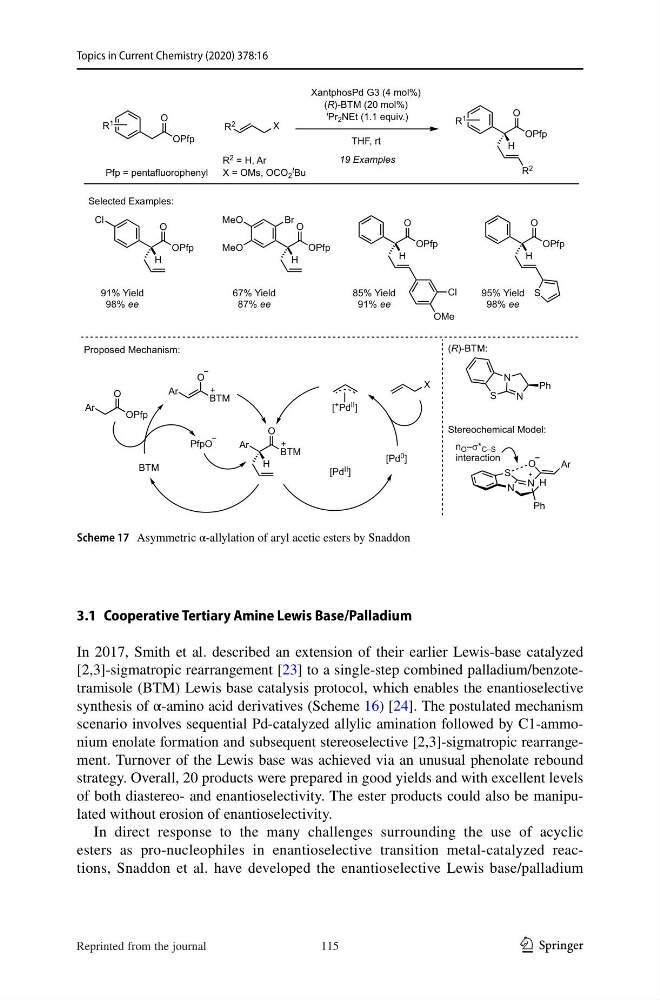
esters as pro-nucleophiles in enantioselective transition metal-catalyzed reactions, Snaddon et al. have developed the enantioselective Lewis base/palladium
OPfp
O
OPfp
O
H
X
R 1
R 1
XantphosPd G3 (4 mol%)
(R)-BTM (20 mol%)
i Pr 2 NEt (1.1 equiv.)
THF, rt
19 Examples
S
N
N
Ph
(R)-BTM:
OPfp
O
H
OPfp
O
H
OPfp
O
H
OPfp
O
H
Cl
MeO
MeO
Br
95% Yield
98% ee
85% Yield
91% ee
67% Yield
87% ee
91% Yield
98% ee
R 2
BTM
Ar
OPfp
O
Ar
BTM
O
PfpO
[Pd 0 ]
[Pd II ]
Ar
BTM
O
H
X
N
S
N H
Ph
O
Ar
R 2
S
OMe
Cl
Stereochemical Model:
Selected Examples:
Proposed Mechanism:
R 2 = H, Ar
X = OMs, OCO 2
t Bu
[ + Pd II ]
Pfp = pentafluorophenyl
+
Scheme 17 Asymmetric α-allylation of aryl acetic esters by Snaddon
Reprinted from the journal
115
Topics in Current Chemistry (2020) 378:16
3.1 Cooperative Tertiary Amine Lewis Base/Palladium
In 2017, Smith et al. described an extension of their earlier Lewis-base catalyzed
[2,3]-sigmatropic rearrangement [23] to a single-step combined palladium/benzotetramisole (BTM) Lewis base catalysis protocol, which enables the enantioselective
synthesis of α-amino acid derivatives (Scheme 16) [24]. The postulated mechanism
scenario involves sequential Pd-catalyzed allylic amination followed by C1-ammonium enolate formation and subsequent stereoselective [2,3]-sigmatropic rearrangement. Turnover of the Lewis base was achieved via an unusual phenolate rebound
strategy. Overall, 20 products were prepared in good yields and with excellent levels
of both diastereo- and enantioselectivity. The ester products could also be manipulated without erosion of enantioselectivity.
In direct response to the many challenges surrounding the use of acyclic
esters as pro-nucleophiles in enantioselective transition metal-catalyzed reactions, Snaddon et al. have developed the enantioselective Lewis base/palladium
OPfp
O
OPfp
O
H
X
R 1
R 1
XantphosPd G3 (4 mol%)
(R)-BTM (20 mol%)
i Pr 2 NEt (1.1 equiv.)
THF, rt
19 Examples
S
N
N
Ph
(R)-BTM:
OPfp
O
H
OPfp
O
H
OPfp
O
H
OPfp
O
H
Cl
MeO
MeO
Br
95% Yield
98% ee
85% Yield
91% ee
67% Yield
87% ee
91% Yield
98% ee
R 2
BTM
Ar
OPfp
O
Ar
BTM
O
PfpO
[Pd 0 ]
[Pd II ]
Ar
BTM
O
H
X
N
S
N H
Ph
O
Ar
R 2
S
OMe
Cl
Stereochemical Model:
Selected Examples:
Proposed Mechanism:
R 2 = H, Ar
X = OMs, OCO 2
t Bu
[ + Pd II ]
Pfp = pentafluorophenyl
+
Scheme 17 Asymmetric α-allylation of aryl acetic esters by Snaddon
Reprinted from the journal
115