

Topics in Current Chemistry (2020) 378:16
1 3
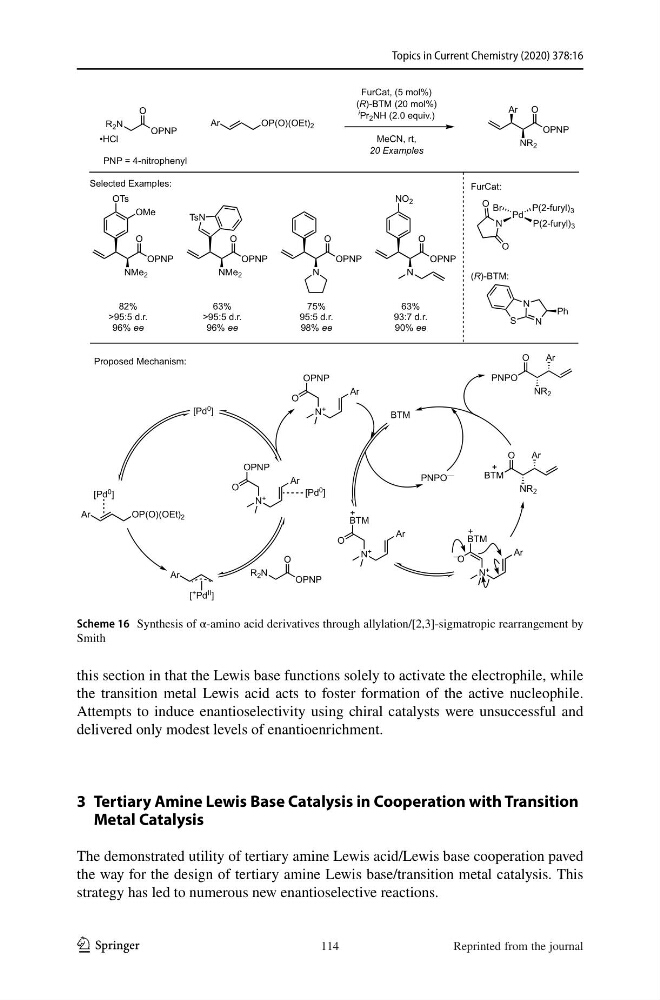
this section in that the Lewis base functions solely to activate the electrophile, while
the transition metal Lewis acid acts to foster formation of the active nucleophile.
Attempts to induce enantioselectivity using chiral catalysts were unsuccessful and
delivered only modest levels of enantioenrichment.
3 Tertiary Amine Lewis Base Catalysis in Cooperation with Transition
Metal Catalysis
The demonstrated utility of tertiary amine Lewis acid/Lewis base cooperation paved
the way for the design of tertiary amine Lewis base/transition metal catalysis. This
strategy has led to numerous new enantioselective reactions.
R 2 N
OPNP
O
•HCl
Ar
OP(O)(OEt) 2
S
N
N
Ph
OPNP
O
NR 2
Ar
FurCat, (5 mol%)
(R)-BTM (20 mol%)
i Pr 2 NH (2.0 equiv.)
MeCN, rt,
20 Examples
OPNP
O
NMe 2
82%
>95:5 d.r.
96% ee
OPNP
O
NMe 2
63%
>95:5 d.r.
96% ee
OPNP
O
N
75%
95:5 d.r.
98% ee
OPNP
O
N
63%
93:7 d.r.
90% ee
OTs
OMe
TsN
NO 2
FurCat:
(R)-BTM:
[Pd 0 ]
Ar
OP(O)(OEt) 2
[Pd 0 ]
Ar
O
OPNP
N +
Ar
[Pd 0 ]
O
OPNP
N +
Ar
BTM
O
BTM
N +
Ar
– O
BTM
N +
Ar
PNPO –
BTM
O
NR 2
Ar
PNPO
O
NR 2
Ar
Selected Examples:
Proposed Mechanism:
R 2 N
OPNP
O
PNP = 4-nitrophenyl
Pd
N
Br
P(2-furyl) 3
P(2-furyl) 3
O
O
[ + Pd II ]
Scheme 16 Synthesis of α-amino acid derivatives through allylation/[2,3]-sigmatropic rearrangement by
Smith
Reprinted from the journal
114
1 3
this section in that the Lewis base functions solely to activate the electrophile, while
the transition metal Lewis acid acts to foster formation of the active nucleophile.
Attempts to induce enantioselectivity using chiral catalysts were unsuccessful and
delivered only modest levels of enantioenrichment.
3 Tertiary Amine Lewis Base Catalysis in Cooperation with Transition
Metal Catalysis
The demonstrated utility of tertiary amine Lewis acid/Lewis base cooperation paved
the way for the design of tertiary amine Lewis base/transition metal catalysis. This
strategy has led to numerous new enantioselective reactions.
R 2 N
OPNP
O
•HCl
Ar
OP(O)(OEt) 2
S
N
N
Ph
OPNP
O
NR 2
Ar
FurCat, (5 mol%)
(R)-BTM (20 mol%)
i Pr 2 NH (2.0 equiv.)
MeCN, rt,
20 Examples
OPNP
O
NMe 2
82%
>95:5 d.r.
96% ee
OPNP
O
NMe 2
63%
>95:5 d.r.
96% ee
OPNP
O
N
75%
95:5 d.r.
98% ee
OPNP
O
N
63%
93:7 d.r.
90% ee
OTs
OMe
TsN
NO 2
FurCat:
(R)-BTM:
[Pd 0 ]
Ar
OP(O)(OEt) 2
[Pd 0 ]
Ar
O
OPNP
N +
Ar
[Pd 0 ]
O
OPNP
N +
Ar
BTM
O
BTM
N +
Ar
– O
BTM
N +
Ar
PNPO –
BTM
O
NR 2
Ar
PNPO
O
NR 2
Ar
Selected Examples:
Proposed Mechanism:
R 2 N
OPNP
O
PNP = 4-nitrophenyl
Pd
N
Br
P(2-furyl) 3
P(2-furyl) 3
O
O
[ + Pd II ]
Scheme 16 Synthesis of α-amino acid derivatives through allylation/[2,3]-sigmatropic rearrangement by
Smith
Reprinted from the journal
114