

1 3
Topics in Current Chemistry (2020) 378:16
are optimal Lewis acids for this process, several d-block metal salts were also efficacious (Scheme 11). A stereochemical model which rationalizes the observed
sense of diastereoselectivity was also proposed, wherein the transition state leading
towards the anti-product experiences significant steric clash between the ester group
of the glyoxalate and the alkyl substituent of the nucleophile. This unfavorable interaction results in the syn-product being preferentially formed.
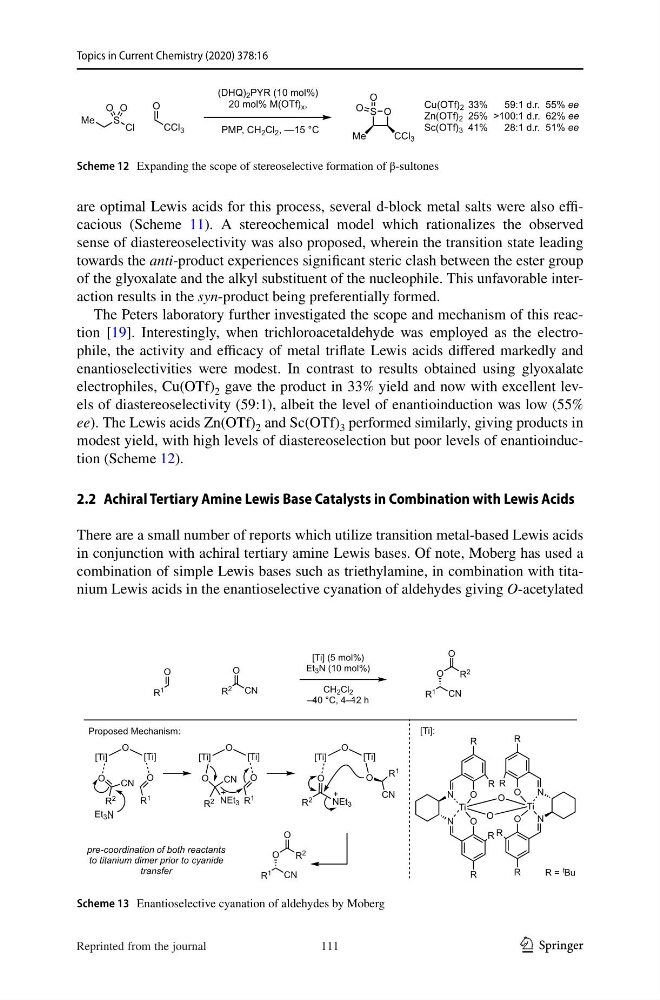
The Peters laboratory further investigated the scope and mechanism of this reaction [19]. Interestingly, when trichloroacetaldehyde was employed as the electrophile, the activity and efficacy of metal triflate Lewis acids differed markedly and
enantioselectivities were modest. In contrast to results obtained using glyoxalate
electrophiles, Cu(OTf) 2 gave the product in 33% yield and now with excellent levels of diastereoselectivity (59:1), albeit the level of enantioinduction was low (55%
ee). The Lewis acids Zn(OTf) 2 and Sc(OTf) 3 performed similarly, giving products in
modest yield, with high levels of diastereoselection but poor levels of enantioinduction (Scheme 12).
2.2 Achiral Tertiary Amine Lewis Base Catalysts in Combination with Lewis Acids
There are a small number of reports which utilize transition metal-based Lewis acids
in conjunction with achiral tertiary amine Lewis bases. Of note, Moberg has used a
combination of simple Lewis bases such as triethylamine, in combination with titanium Lewis acids in the enantioselective cyanation of aldehydes giving O-acetylated
S
Me
Cl
O O
CCl 3
O
S O
O
O
Me
CCl 3
(DHQ) 2 PYR (10 mol%)
20 mol% M(OTf) x ,
PMP, CH 2 Cl 2 , –15 °C
Cu(OTf) 2
Zn(OTf) 2
Sc(OTf) 3
33%
59:1 d.r. 55% ee
25% >100:1 d.r. 62% ee
41%
28:1 d.r. 51% ee
Scheme 12 Expanding the scope of stereoselective formation of β-sultones
R 1
O
R 2 CN
O
R 1 CN
O
O
R 2
[Ti] (5 mol%)
Et 3 N (10 mol%)
CH 2 Cl 2
– 40 °C, 4– 12 h
N
N
O
O
Ti
O
N
N
O
O
Ti
O
R
R
R R
R
R
R
R
R = t Bu
[Ti]:
[Ti]
O
O
[Ti]
O
CN
R 2
R 1
Et 3 N
[Ti]
O
O
[Ti]
O
CN
R 2
R 1
NEt 3
[Ti]
O
O
[Ti]
O
R 2
R 1
NEt 3
CN
R 1 CN
O
O
R 2
pre-coordination of both reactants
to titanium dimer prior to cyanide
transfer
Proposed Mechanism:
Scheme 13 Enantioselective cyanation of aldehydes by Moberg
Reprinted from the journal
111
Topics in Current Chemistry (2020) 378:16
are optimal Lewis acids for this process, several d-block metal salts were also efficacious (Scheme 11). A stereochemical model which rationalizes the observed
sense of diastereoselectivity was also proposed, wherein the transition state leading
towards the anti-product experiences significant steric clash between the ester group
of the glyoxalate and the alkyl substituent of the nucleophile. This unfavorable interaction results in the syn-product being preferentially formed.
The Peters laboratory further investigated the scope and mechanism of this reaction [19]. Interestingly, when trichloroacetaldehyde was employed as the electrophile, the activity and efficacy of metal triflate Lewis acids differed markedly and
enantioselectivities were modest. In contrast to results obtained using glyoxalate
electrophiles, Cu(OTf) 2 gave the product in 33% yield and now with excellent levels of diastereoselectivity (59:1), albeit the level of enantioinduction was low (55%
ee). The Lewis acids Zn(OTf) 2 and Sc(OTf) 3 performed similarly, giving products in
modest yield, with high levels of diastereoselection but poor levels of enantioinduction (Scheme 12).
2.2 Achiral Tertiary Amine Lewis Base Catalysts in Combination with Lewis Acids
There are a small number of reports which utilize transition metal-based Lewis acids
in conjunction with achiral tertiary amine Lewis bases. Of note, Moberg has used a
combination of simple Lewis bases such as triethylamine, in combination with titanium Lewis acids in the enantioselective cyanation of aldehydes giving O-acetylated
S
Me
Cl
O O
CCl 3
O
S O
O
O
Me
CCl 3
(DHQ) 2 PYR (10 mol%)
20 mol% M(OTf) x ,
PMP, CH 2 Cl 2 , –15 °C
Cu(OTf) 2
Zn(OTf) 2
Sc(OTf) 3
33%
59:1 d.r. 55% ee
25% >100:1 d.r. 62% ee
41%
28:1 d.r. 51% ee
Scheme 12 Expanding the scope of stereoselective formation of β-sultones
R 1
O
R 2 CN
O
R 1 CN
O
O
R 2
[Ti] (5 mol%)
Et 3 N (10 mol%)
CH 2 Cl 2
– 40 °C, 4– 12 h
N
N
O
O
Ti
O
N
N
O
O
Ti
O
R
R
R R
R
R
R
R
R = t Bu
[Ti]:
[Ti]
O
O
[Ti]
O
CN
R 2
R 1
Et 3 N
[Ti]
O
O
[Ti]
O
CN
R 2
R 1
NEt 3
[Ti]
O
O
[Ti]
O
R 2
R 1
NEt 3
CN
R 1 CN
O
O
R 2
pre-coordination of both reactants
to titanium dimer prior to cyanide
transfer
Proposed Mechanism:
Scheme 13 Enantioselective cyanation of aldehydes by Moberg
Reprinted from the journal
111