

Topics in Current Chemistry (2020) 378:16
1 3
either p-methoxyphenylacetyl chloride or 3-phthalimidopropionyl chloride, in conjunction with the palladium/BzQD catalyst system previously described, nine natural product derivatives were prepared in good yields (32–98%) and with good-toexcellent levels of diastereocontrol.
Noting that in previous studies acyl chloride substrates containing non-aromatic
substituents at the α-position tended to perform poorly in these fluorination reactions, Lectka next sought to further refine the catalyst system (Scheme 10) [17].
In order to resolve this issue, lithium chlorate was introduced as a second Lewis
acid. Although the role of the lithium chlorate is complex, it plays a critical role
in enhancing the electrophilicity of NFSI. In addition to the detailed mechanistic
experiments, the findings of this investigation were further supported by transition state calculations. Using this new catalyst system, substrates which previously
afforded only trace or very low yields now gave products in useful yields (40–83%)
with high levels of enantioselectivity.
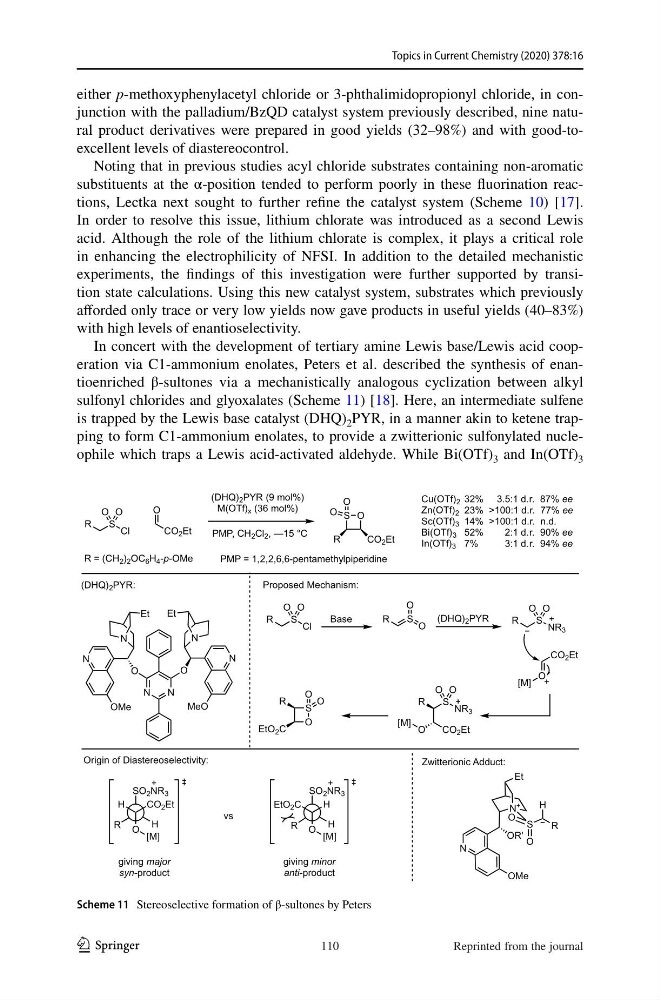
In concert with the development of tertiary amine Lewis base/Lewis acid cooperation via C1-ammonium enolates, Peters et al. described the synthesis of enantioenriched β-sultones via a mechanistically analogous cyclization between alkyl
sulfonyl chlorides and glyoxalates (Scheme 11) [18]. Here, an intermediate sulfene
is trapped by the Lewis base catalyst (DHQ) 2 PYR, in a manner akin to ketene trapping to form C1-ammonium enolates, to provide a zwitterionic sulfonylated nucleophile which traps a Lewis acid-activated aldehyde. While Bi(OTf) 3 and In(OTf) 3
S
R
Cl
O O
CO 2 Et
O
S O
O
O
R
CO 2 Et
(DHQ) 2 PYR (9 mol%)
M(OTf) x (36 mol%)
PMP, CH 2 Cl 2 , –15 °C
Cu(OTf) 2
Zn(OTf) 2
Sc(OTf) 3
Bi(OTf) 3
In(OTf) 3
(DHQ) 2 PYR:
N
Et
O
N
MeO
N
Et
O
N
OMe
S
R
Cl
O O
S
R
O
O
S
R
NR 3
O O
O
CO 2 Et
[M]
S
R
NR 3
O O
CO 2 Et
O
[M]
Base
R
EtO 2 C
O
S
O O
N
N
CO 2 Et
H
O [M]
SO 2 NR 3
R
H
H
EtO 2 C
O [M]
SO 2 NR 3
R
H
giving major
syn-product
giving minor
anti-product
N +
Et
OR'
N
OMe
S
O
O
R
H
Zwitterionic Adduct:
vs
Origin of Diastereoselectivity:
Proposed Mechanism:
R = (CH 2 ) 2 OC 6 H 4 -p-OMe
PMP = 1,2,2,6,6-pentamethylpiperidine
32% 3.5:1 d.r. 87% ee
23% >100:1 d.r. 77% ee
14% >100:1 d.r. n.d.
52%
2:1 d.r. 90% ee
7%
3:1 d.r. 94% ee
(DHQ) 2 PYR
Scheme 11 Stereoselective formation of β-sultones by Peters
Reprinted from the journal
110
1 3
either p-methoxyphenylacetyl chloride or 3-phthalimidopropionyl chloride, in conjunction with the palladium/BzQD catalyst system previously described, nine natural product derivatives were prepared in good yields (32–98%) and with good-toexcellent levels of diastereocontrol.
Noting that in previous studies acyl chloride substrates containing non-aromatic
substituents at the α-position tended to perform poorly in these fluorination reactions, Lectka next sought to further refine the catalyst system (Scheme 10) [17].
In order to resolve this issue, lithium chlorate was introduced as a second Lewis
acid. Although the role of the lithium chlorate is complex, it plays a critical role
in enhancing the electrophilicity of NFSI. In addition to the detailed mechanistic
experiments, the findings of this investigation were further supported by transition state calculations. Using this new catalyst system, substrates which previously
afforded only trace or very low yields now gave products in useful yields (40–83%)
with high levels of enantioselectivity.
In concert with the development of tertiary amine Lewis base/Lewis acid cooperation via C1-ammonium enolates, Peters et al. described the synthesis of enantioenriched β-sultones via a mechanistically analogous cyclization between alkyl
sulfonyl chlorides and glyoxalates (Scheme 11) [18]. Here, an intermediate sulfene
is trapped by the Lewis base catalyst (DHQ) 2 PYR, in a manner akin to ketene trapping to form C1-ammonium enolates, to provide a zwitterionic sulfonylated nucleophile which traps a Lewis acid-activated aldehyde. While Bi(OTf) 3 and In(OTf) 3
S
R
Cl
O O
CO 2 Et
O
S O
O
O
R
CO 2 Et
(DHQ) 2 PYR (9 mol%)
M(OTf) x (36 mol%)
PMP, CH 2 Cl 2 , –15 °C
Cu(OTf) 2
Zn(OTf) 2
Sc(OTf) 3
Bi(OTf) 3
In(OTf) 3
(DHQ) 2 PYR:
N
Et
O
N
MeO
N
Et
O
N
OMe
S
R
Cl
O O
S
R
O
O
S
R
NR 3
O O
O
CO 2 Et
[M]
S
R
NR 3
O O
CO 2 Et
O
[M]
Base
R
EtO 2 C
O
S
O O
N
N
CO 2 Et
H
O [M]
SO 2 NR 3
R
H
H
EtO 2 C
O [M]
SO 2 NR 3
R
H
giving major
syn-product
giving minor
anti-product
N +
Et
OR'
N
OMe
S
O
O
R
H
Zwitterionic Adduct:
vs
Origin of Diastereoselectivity:
Proposed Mechanism:
R = (CH 2 ) 2 OC 6 H 4 -p-OMe
PMP = 1,2,2,6,6-pentamethylpiperidine
32% 3.5:1 d.r. 87% ee
23% >100:1 d.r. 77% ee
14% >100:1 d.r. n.d.
52%
2:1 d.r. 90% ee
7%
3:1 d.r. 94% ee
(DHQ) 2 PYR
Scheme 11 Stereoselective formation of β-sultones by Peters
Reprinted from the journal
110