

1 3
Topics in Current Chemistry (2020) 378:16
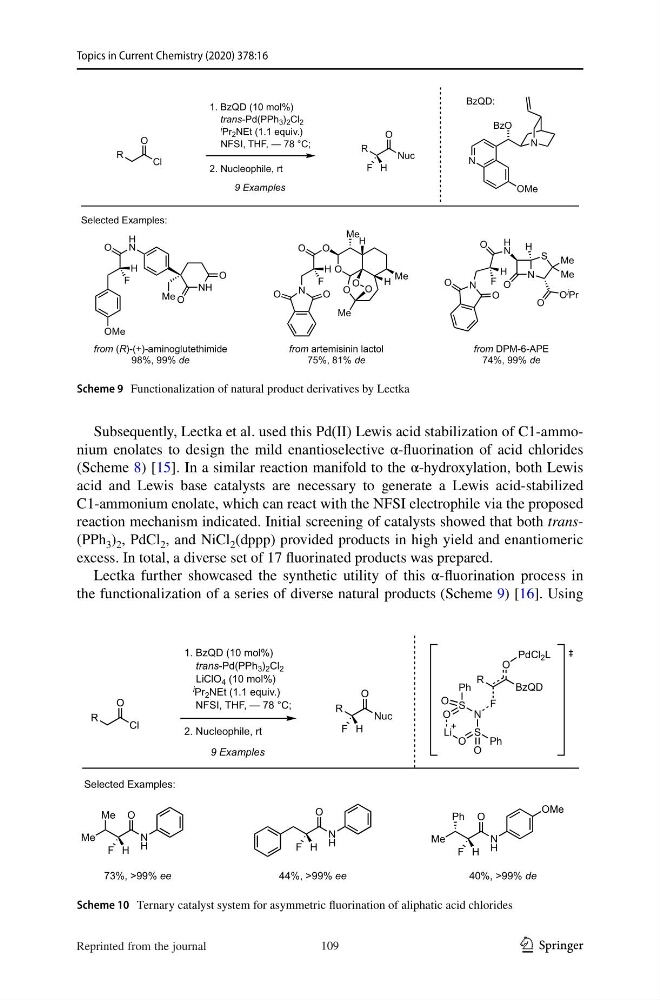
Subsequently, Lectka et al. used this Pd(II) Lewis acid stabilization of C1-ammonium enolates to design the mild enantioselective α-fluorination of acid chlorides
(Scheme 8) [15]. In a similar reaction manifold to the α-hydroxylation, both Lewis
acid and Lewis base catalysts are necessary to generate a Lewis acid-stabilized
C1-ammonium enolate, which can react with the NFSI electrophile via the proposed
reaction mechanism indicated. Initial screening of catalysts showed that both trans(PPh 3 ) 2 , PdCl 2 , and NiCl 2 (dppp) provided products in high yield and enantiomeric
excess. In total, a diverse set of 17 fluorinated products was prepared.
Lectka further showcased the synthetic utility of this α-fluorination process in
the functionalization of a series of diverse natural products (Scheme 9) [16]. Using
R
Cl
O
R
Nuc
O
F H
O
O
H
O
O
O
H
Me
Me
Me
O
F
H
N
O
O
N
S Me
Me
H
O
O i Pr
H
N
O
O
F
H
N
O
O
NH
O
O
Me
H
N
O
F
H
OMe
from (R)-(+)-aminoglutethimide
98%, 99% de
from artemisinin lactol
75%, 81% de
from DPM-6-APE
74%, 99% de
BzQD:
Selected Examples:
1. BzQD (10 mol%)
trans-Pd(PPh 3 ) 2 Cl 2
i Pr 2 NEt (1.1 equiv.)
NFSI, THF, – 78 °C;
2. Nucleophile, rt
9 Examples
N
BzO
N
OMe
Scheme 9 Functionalization of natural product derivatives by Lectka
R
Cl
O
R
Nuc
O
F H
N
H
O
F H
Me
Me
N
H
O
F H
Me
Ph
OMe
N
H
O
F H
73%, >99% ee
44%, >99% ee
40%, >99% de
N
F
R
BzQD
O
PdCl 2 L
S
S
Ph
Ph
O
O
O
Li O
Selected Examples:
1. BzQD (10 mol%)
trans-Pd(PPh 3 ) 2 Cl 2
LiClO 4 (10 mol%)
i Pr 2 NEt (1.1 equiv.)
NFSI, THF, – 78 °C;
2. Nucleophile, rt
9 Examples
Scheme 10 Ternary catalyst system for asymmetric fluorination of aliphatic acid chlorides
Reprinted from the journal
109
Topics in Current Chemistry (2020) 378:16
Subsequently, Lectka et al. used this Pd(II) Lewis acid stabilization of C1-ammonium enolates to design the mild enantioselective α-fluorination of acid chlorides
(Scheme 8) [15]. In a similar reaction manifold to the α-hydroxylation, both Lewis
acid and Lewis base catalysts are necessary to generate a Lewis acid-stabilized
C1-ammonium enolate, which can react with the NFSI electrophile via the proposed
reaction mechanism indicated. Initial screening of catalysts showed that both trans(PPh 3 ) 2 , PdCl 2 , and NiCl 2 (dppp) provided products in high yield and enantiomeric
excess. In total, a diverse set of 17 fluorinated products was prepared.
Lectka further showcased the synthetic utility of this α-fluorination process in
the functionalization of a series of diverse natural products (Scheme 9) [16]. Using
R
Cl
O
R
Nuc
O
F H
O
O
H
O
O
O
H
Me
Me
Me
O
F
H
N
O
O
N
S Me
Me
H
O
O i Pr
H
N
O
O
F
H
N
O
O
NH
O
O
Me
H
N
O
F
H
OMe
from (R)-(+)-aminoglutethimide
98%, 99% de
from artemisinin lactol
75%, 81% de
from DPM-6-APE
74%, 99% de
BzQD:
Selected Examples:
1. BzQD (10 mol%)
trans-Pd(PPh 3 ) 2 Cl 2
i Pr 2 NEt (1.1 equiv.)
NFSI, THF, – 78 °C;
2. Nucleophile, rt
9 Examples
N
BzO
N
OMe
Scheme 9 Functionalization of natural product derivatives by Lectka
R
Cl
O
R
Nuc
O
F H
N
H
O
F H
Me
Me
N
H
O
F H
Me
Ph
OMe
N
H
O
F H
73%, >99% ee
44%, >99% ee
40%, >99% de
N
F
R
BzQD
O
PdCl 2 L
S
S
Ph
Ph
O
O
O
Li O
Selected Examples:
1. BzQD (10 mol%)
trans-Pd(PPh 3 ) 2 Cl 2
LiClO 4 (10 mol%)
i Pr 2 NEt (1.1 equiv.)
NFSI, THF, – 78 °C;
2. Nucleophile, rt
9 Examples
Scheme 10 Ternary catalyst system for asymmetric fluorination of aliphatic acid chlorides
Reprinted from the journal
109