

Topics in Current Chemistry (2020) 378:16
1 3
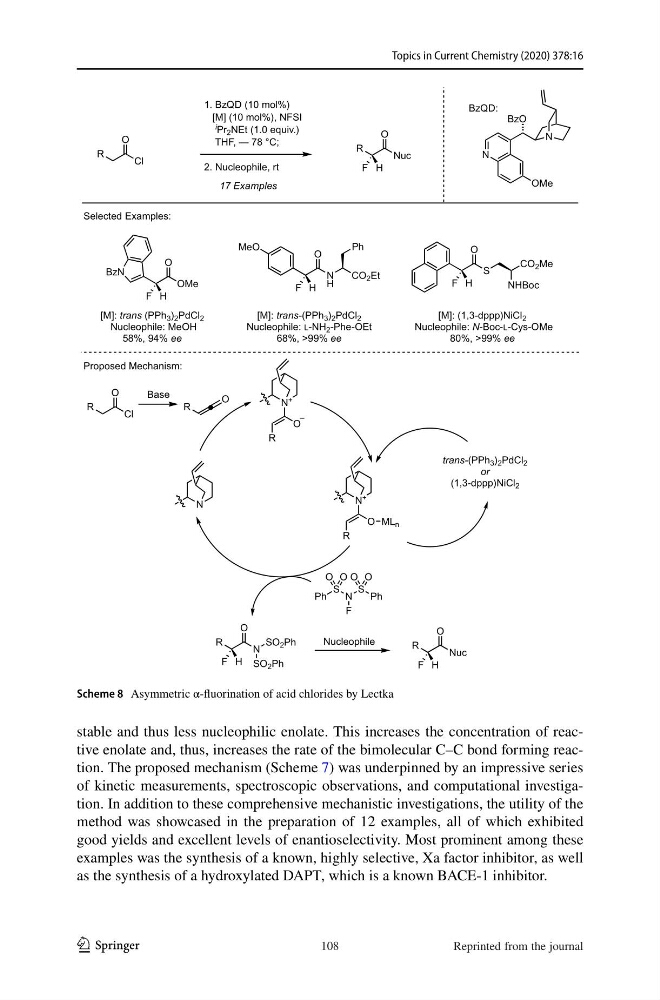
stable and thus less nucleophilic enolate. This increases the concentration of reactive enolate and, thus, increases the rate of the bimolecular C–C bond forming reaction. The proposed mechanism (Scheme 7) was underpinned by an impressive series
of kinetic measurements, spectroscopic observations, and computational investigation. In addition to these comprehensive mechanistic investigations, the utility of the
method was showcased in the preparation of 12 examples, all of which exhibited
good yields and excellent levels of enantioselectivity. Most prominent among these
examples was the synthesis of a known, highly selective, Xa factor inhibitor, as well
as the synthesis of a hydroxylated DAPT, which is a known BACE-1 inhibitor.
R
Cl
O
R
Nuc
O
F H
trans-(PPh 3 ) 2 PdCl 2
or
(1,3-dppp)NiCl 2
OMe
O
F H
BzN
[M]: trans (PPh 3 ) 2 PdCl 2
Nucleophile: MeOH
58%, 94% ee
N
H
O
F H
[M]: trans-(PPh 3 ) 2 PdCl 2
Nucleophile: L-NH 2 -Phe-OEt
68%, >99% ee
MeO
CO 2 Et
Ph
S
O
F H
CO 2 Me
NHBoc
[M]: (1,3-dppp)NiCl 2
Nucleophile: N-Boc-L-Cys-OMe
80%, >99% ee
Proposed Mechanism:
BzQD:
Selected Examples:
17 Examples
1. BzQD (10 mol%)
[M] (10 mol%), NFSI
i Pr 2 NEt (1.0 equiv.)
THF, – 78 °C;
2. Nucleophile, rt
N +
N
O
R
N +
O
R
Nucleophile
R
Cl
O
R
O
Base
ML n
Ph
S N
S Ph
F
O O O O
R
N
O
F H
SO 2 Ph
SO 2 Ph
R
Nuc
O
F H
N
BzO
N
OMe
Scheme 8 Asymmetric α-fluorination of acid chlorides by Lectka
Reprinted from the journal
108
1 3
stable and thus less nucleophilic enolate. This increases the concentration of reactive enolate and, thus, increases the rate of the bimolecular C–C bond forming reaction. The proposed mechanism (Scheme 7) was underpinned by an impressive series
of kinetic measurements, spectroscopic observations, and computational investigation. In addition to these comprehensive mechanistic investigations, the utility of the
method was showcased in the preparation of 12 examples, all of which exhibited
good yields and excellent levels of enantioselectivity. Most prominent among these
examples was the synthesis of a known, highly selective, Xa factor inhibitor, as well
as the synthesis of a hydroxylated DAPT, which is a known BACE-1 inhibitor.
R
Cl
O
R
Nuc
O
F H
trans-(PPh 3 ) 2 PdCl 2
or
(1,3-dppp)NiCl 2
OMe
O
F H
BzN
[M]: trans (PPh 3 ) 2 PdCl 2
Nucleophile: MeOH
58%, 94% ee
N
H
O
F H
[M]: trans-(PPh 3 ) 2 PdCl 2
Nucleophile: L-NH 2 -Phe-OEt
68%, >99% ee
MeO
CO 2 Et
Ph
S
O
F H
CO 2 Me
NHBoc
[M]: (1,3-dppp)NiCl 2
Nucleophile: N-Boc-L-Cys-OMe
80%, >99% ee
Proposed Mechanism:
BzQD:
Selected Examples:
17 Examples
1. BzQD (10 mol%)
[M] (10 mol%), NFSI
i Pr 2 NEt (1.0 equiv.)
THF, – 78 °C;
2. Nucleophile, rt
N +
N
O
R
N +
O
R
Nucleophile
R
Cl
O
R
O
Base
ML n
Ph
S N
S Ph
F
O O O O
R
N
O
F H
SO 2 Ph
SO 2 Ph
R
Nuc
O
F H
N
BzO
N
OMe
Scheme 8 Asymmetric α-fluorination of acid chlorides by Lectka
Reprinted from the journal
108