

Topics in Current Chemistry (2020) 378:16
1 3
cyanohydrins (Scheme 13) [20, 21]. Stereocontrol in these reactions stems from the
dinuclear titanium–salen catalyst and leads to good levels of enantioselectivity. The
use of chiral Lewis bases such as sparteine and quinine did not induce enantioselectivity in the resultant products. A proposed mechanism involves pre-coordination of
both acyl nitrile and aldehyde substrates to different titanium centers of the catalyst.
Thereafter, nucleophilic attack of triethylamine at the acyl nitrile center results in a
tetrahedral intermediate primed for cyanide transfer to the proximal aldehyde.
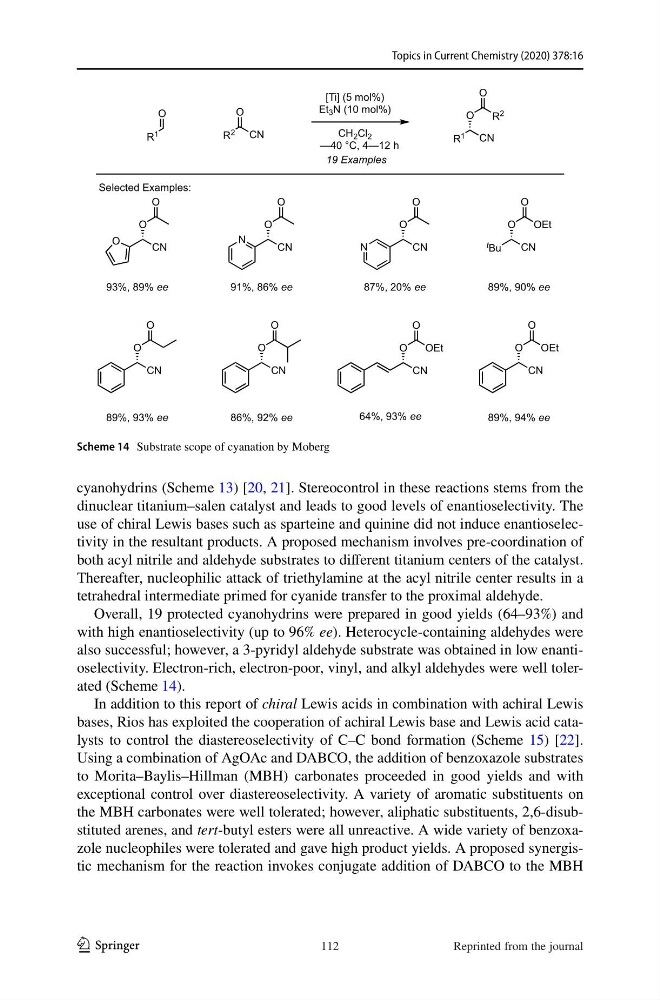
Overall, 19 protected cyanohydrins were prepared in good yields (64–93%) and
with high enantioselectivity (up to 96% ee). Heterocycle-containing aldehydes were
also successful; however, a 3-pyridyl aldehyde substrate was obtained in low enantioselectivity. Electron-rich, electron-poor, vinyl, and alkyl aldehydes were well tolerated (Scheme 14).
In addition to this report of chiral Lewis acids in combination with achiral Lewis
bases, Rios has exploited the cooperation of achiral Lewis base and Lewis acid catalysts to control the diastereoselectivity of C–C bond formation (Scheme 15) [22].
Using a combination of AgOAc and DABCO, the addition of benzoxazole substrates
to Morita–Baylis–Hillman (MBH) carbonates proceeded in good yields and with
exceptional control over diastereoselectivity. A variety of aromatic substituents on
the MBH carbonates were well tolerated; however, aliphatic substituents, 2,6-disubstituted arenes, and tert-butyl esters were all unreactive. A wide variety of benzoxazole nucleophiles were tolerated and gave high product yields. A proposed synergistic mechanism for the reaction invokes conjugate addition of DABCO to the MBH
CN
O
O
93%, 89% ee
CN
O
O
91%, 86% ee
CN
O
O
87%, 20% ee
CN
O
O
89%, 93% ee
CN
O
O
86%, 92% ee
O
N
N
CN
O
O
OEt
89%, 94% ee
CN
O
O
OEt
64%, 93% ee
t Bu
CN
O
O
OEt
89%, 90% ee
Selected Examples:
R 1
O
R 2 CN
O
R 1 CN
O
O
R 2
[Ti] (5 mol%)
Et 3 N (10 mol%)
CH 2 Cl 2
–40 °C, 4–12 h
19 Examples
Scheme 14 Substrate scope of cyanation by Moberg
Reprinted from the journal
112
1 3
cyanohydrins (Scheme 13) [20, 21]. Stereocontrol in these reactions stems from the
dinuclear titanium–salen catalyst and leads to good levels of enantioselectivity. The
use of chiral Lewis bases such as sparteine and quinine did not induce enantioselectivity in the resultant products. A proposed mechanism involves pre-coordination of
both acyl nitrile and aldehyde substrates to different titanium centers of the catalyst.
Thereafter, nucleophilic attack of triethylamine at the acyl nitrile center results in a
tetrahedral intermediate primed for cyanide transfer to the proximal aldehyde.
Overall, 19 protected cyanohydrins were prepared in good yields (64–93%) and
with high enantioselectivity (up to 96% ee). Heterocycle-containing aldehydes were
also successful; however, a 3-pyridyl aldehyde substrate was obtained in low enantioselectivity. Electron-rich, electron-poor, vinyl, and alkyl aldehydes were well tolerated (Scheme 14).
In addition to this report of chiral Lewis acids in combination with achiral Lewis
bases, Rios has exploited the cooperation of achiral Lewis base and Lewis acid catalysts to control the diastereoselectivity of C–C bond formation (Scheme 15) [22].
Using a combination of AgOAc and DABCO, the addition of benzoxazole substrates
to Morita–Baylis–Hillman (MBH) carbonates proceeded in good yields and with
exceptional control over diastereoselectivity. A variety of aromatic substituents on
the MBH carbonates were well tolerated; however, aliphatic substituents, 2,6-disubstituted arenes, and tert-butyl esters were all unreactive. A wide variety of benzoxazole nucleophiles were tolerated and gave high product yields. A proposed synergistic mechanism for the reaction invokes conjugate addition of DABCO to the MBH
CN
O
O
93%, 89% ee
CN
O
O
91%, 86% ee
CN
O
O
87%, 20% ee
CN
O
O
89%, 93% ee
CN
O
O
86%, 92% ee
O
N
N
CN
O
O
OEt
89%, 94% ee
CN
O
O
OEt
64%, 93% ee
t Bu
CN
O
O
OEt
89%, 90% ee
Selected Examples:
R 1
O
R 2 CN
O
R 1 CN
O
O
R 2
[Ti] (5 mol%)
Et 3 N (10 mol%)
CH 2 Cl 2
–40 °C, 4–12 h
19 Examples
Scheme 14 Substrate scope of cyanation by Moberg
Reprinted from the journal
112