

Topics in Current Chemistry (2020) 378:16
1 3
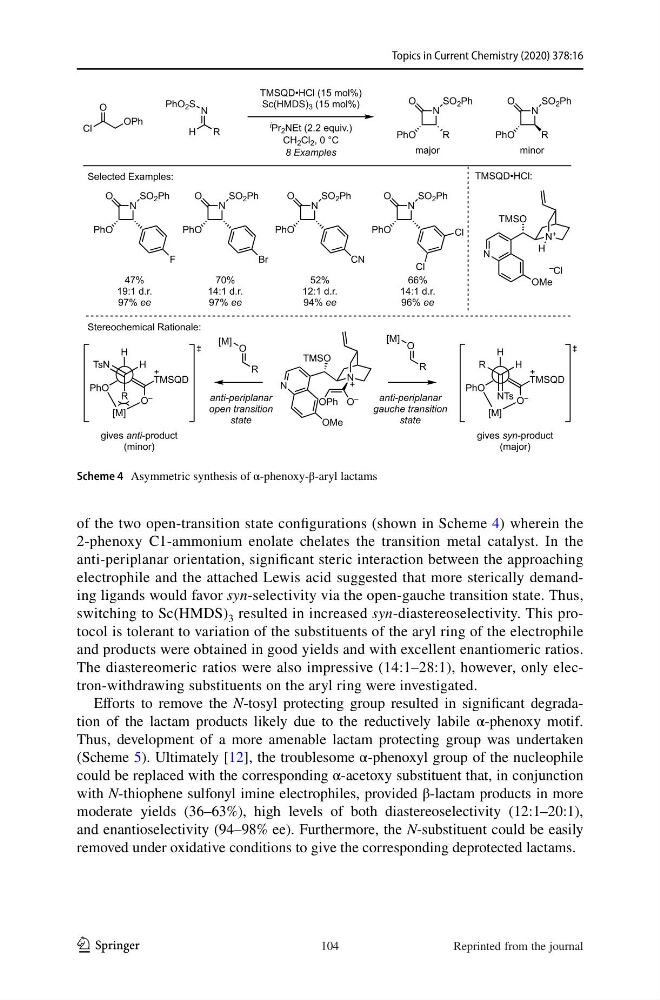
of the two open-transition state configurations (shown in Scheme 4) wherein the
2-phenoxy C1-ammonium enolate chelates the transition metal catalyst. In the
anti-periplanar orientation, significant steric interaction between the approaching
electrophile and the attached Lewis acid suggested that more sterically demanding ligands would favor syn-selectivity via the open-gauche transition state. Thus,
switching to Sc(HMDS) 3 resulted in increased syn-diastereoselectivity. This protocol is tolerant to variation of the substituents of the aryl ring of the electrophile
and products were obtained in good yields and with excellent enantiomeric ratios.
The diastereomeric ratios were also impressive (14:1–28:1), however, only electron-withdrawing substituents on the aryl ring were investigated.
Efforts to remove the N-tosyl protecting group resulted in significant degradation of the lactam products likely due to the reductively labile α-phenoxy motif.
Thus, development of a more amenable lactam protecting group was undertaken
(Scheme 5). Ultimately [12], the troublesome α-phenoxyl group of the nucleophile
could be replaced with the corresponding α-acetoxy substituent that, in conjunction
with N-thiophene sulfonyl imine electrophiles, provided β-lactam products in more
moderate yields (36–63%), high levels of both diastereoselectivity (12:1–20:1),
and enantioselectivity (94–98% ee). Furthermore, the N-substituent could be easily
removed under oxidative conditions to give the corresponding deprotected lactams.
Scheme 4 Asymmetric synthesis of α-phenoxy-β-aryl lactams
Reprinted from the journal
104
1 3
of the two open-transition state configurations (shown in Scheme 4) wherein the
2-phenoxy C1-ammonium enolate chelates the transition metal catalyst. In the
anti-periplanar orientation, significant steric interaction between the approaching
electrophile and the attached Lewis acid suggested that more sterically demanding ligands would favor syn-selectivity via the open-gauche transition state. Thus,
switching to Sc(HMDS) 3 resulted in increased syn-diastereoselectivity. This protocol is tolerant to variation of the substituents of the aryl ring of the electrophile
and products were obtained in good yields and with excellent enantiomeric ratios.
The diastereomeric ratios were also impressive (14:1–28:1), however, only electron-withdrawing substituents on the aryl ring were investigated.
Efforts to remove the N-tosyl protecting group resulted in significant degradation of the lactam products likely due to the reductively labile α-phenoxy motif.
Thus, development of a more amenable lactam protecting group was undertaken
(Scheme 5). Ultimately [12], the troublesome α-phenoxyl group of the nucleophile
could be replaced with the corresponding α-acetoxy substituent that, in conjunction
with N-thiophene sulfonyl imine electrophiles, provided β-lactam products in more
moderate yields (36–63%), high levels of both diastereoselectivity (12:1–20:1),
and enantioselectivity (94–98% ee). Furthermore, the N-substituent could be easily
removed under oxidative conditions to give the corresponding deprotected lactams.
Scheme 4 Asymmetric synthesis of α-phenoxy-β-aryl lactams
Reprinted from the journal
104