

1 3
Topics in Current Chemistry (2020) 378:16
studied thoroughly, from a mechanistic standpoint. These findings have undoubtedly
supported further work within this area.
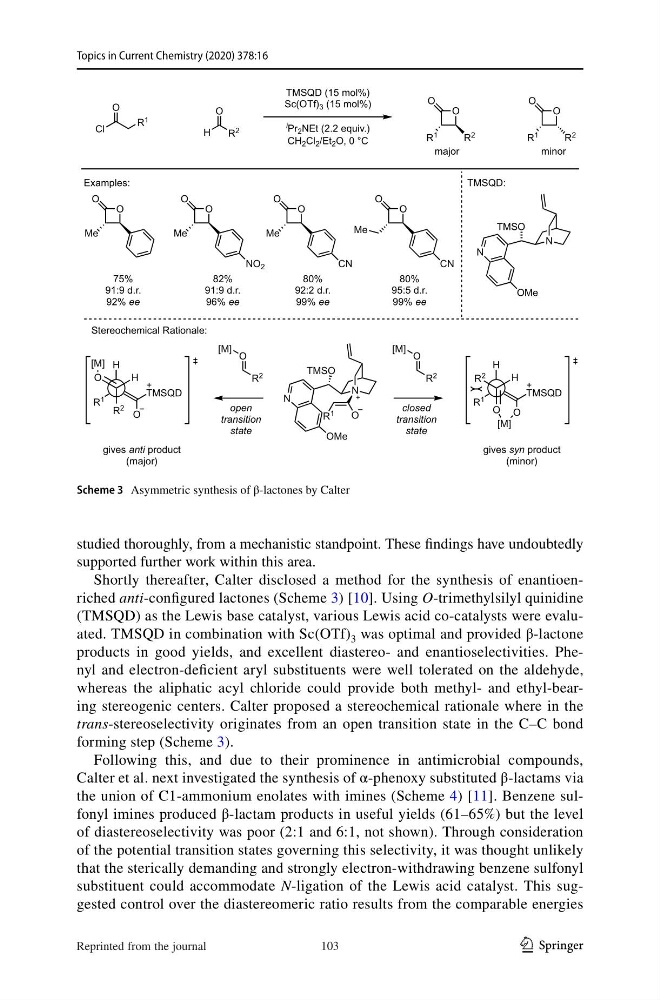
Shortly thereafter, Calter disclosed a method for the synthesis of enantioenriched anti-configured lactones (Scheme 3) [10]. Using O-trimethylsilyl quinidine
(TMSQD) as the Lewis base catalyst, various Lewis acid co-catalysts were evaluated. TMSQD in combination with Sc(OTf) 3 was optimal and provided β-lactone
products in good yields, and excellent diastereo- and enantioselectivities. Phenyl and electron-deficient aryl substituents were well tolerated on the aldehyde,
whereas the aliphatic acyl chloride could provide both methyl- and ethyl-bearing stereogenic centers. Calter proposed a stereochemical rationale where in the
trans-stereoselectivity originates from an open transition state in the C–C bond
forming step (Scheme 3).
Following this, and due to their prominence in antimicrobial compounds,
Calter et al. next investigated the synthesis of α-phenoxy substituted β-lactams via
the union of C1-ammonium enolates with imines (Scheme 4) [11]. Benzene sulfonyl imines produced β-lactam products in useful yields (61–65%) but the level
of diastereoselectivity was poor (2:1 and 6:1, not shown). Through consideration
of the potential transition states governing this selectivity, it was thought unlikely
that the sterically demanding and strongly electron-withdrawing benzene sulfonyl
substituent could accommodate N-ligation of the Lewis acid catalyst. This suggested control over the diastereomeric ratio results from the comparable energies
Cl
O
R 1
H
R 2
O
O
O
R 1
R 2
O
O
R 1
R 2
TMSQD (15 mol%)
Sc(OTf) 3 (15 mol%)
i Pr 2 NEt (2.2 equiv.)
CH 2 Cl 2 /Et 2 O, 0 °C
major
m inor
N
75%
91:9 d.r.
92% ee
82%
91:9 d.r.
96% ee
80%
92:2 d.r.
99% ee
80%
95:5 d.r.
99% ee
TMSQD:
O
O
Me
O
O
Me
O
O
Me
O
O
NO 2
CN
CN
Me
N
TMSO
N
OMe
O
R 1
O
R 2
[M]
R 2
O
H
H
R 1
TMSQD
O
O
R 2
H
H
R 1
TMSQD
O
[M]
[M]
gives anti product
(major)
gives syn product
(minor)
Stereochemical Rationale:
Examples:
O
R 2
[M]
TMSO
N
OMe
open
transition
state
closed
transition
state
+
Scheme 3 Asymmetric synthesis of β-lactones by Calter
Reprinted from the journal
103
Topics in Current Chemistry (2020) 378:16
studied thoroughly, from a mechanistic standpoint. These findings have undoubtedly
supported further work within this area.
Shortly thereafter, Calter disclosed a method for the synthesis of enantioenriched anti-configured lactones (Scheme 3) [10]. Using O-trimethylsilyl quinidine
(TMSQD) as the Lewis base catalyst, various Lewis acid co-catalysts were evaluated. TMSQD in combination with Sc(OTf) 3 was optimal and provided β-lactone
products in good yields, and excellent diastereo- and enantioselectivities. Phenyl and electron-deficient aryl substituents were well tolerated on the aldehyde,
whereas the aliphatic acyl chloride could provide both methyl- and ethyl-bearing stereogenic centers. Calter proposed a stereochemical rationale where in the
trans-stereoselectivity originates from an open transition state in the C–C bond
forming step (Scheme 3).
Following this, and due to their prominence in antimicrobial compounds,
Calter et al. next investigated the synthesis of α-phenoxy substituted β-lactams via
the union of C1-ammonium enolates with imines (Scheme 4) [11]. Benzene sulfonyl imines produced β-lactam products in useful yields (61–65%) but the level
of diastereoselectivity was poor (2:1 and 6:1, not shown). Through consideration
of the potential transition states governing this selectivity, it was thought unlikely
that the sterically demanding and strongly electron-withdrawing benzene sulfonyl
substituent could accommodate N-ligation of the Lewis acid catalyst. This suggested control over the diastereomeric ratio results from the comparable energies
Cl
O
R 1
H
R 2
O
O
O
R 1
R 2
O
O
R 1
R 2
TMSQD (15 mol%)
Sc(OTf) 3 (15 mol%)
i Pr 2 NEt (2.2 equiv.)
CH 2 Cl 2 /Et 2 O, 0 °C
major
m inor
N
75%
91:9 d.r.
92% ee
82%
91:9 d.r.
96% ee
80%
92:2 d.r.
99% ee
80%
95:5 d.r.
99% ee
TMSQD:
O
O
Me
O
O
Me
O
O
Me
O
O
NO 2
CN
CN
Me
N
TMSO
N
OMe
O
R 1
O
R 2
[M]
R 2
O
H
H
R 1
TMSQD
O
O
R 2
H
H
R 1
TMSQD
O
[M]
[M]
gives anti product
(major)
gives syn product
(minor)
Stereochemical Rationale:
Examples:
O
R 2
[M]
TMSO
N
OMe
open
transition
state
closed
transition
state
+
Scheme 3 Asymmetric synthesis of β-lactones by Calter
Reprinted from the journal
103