

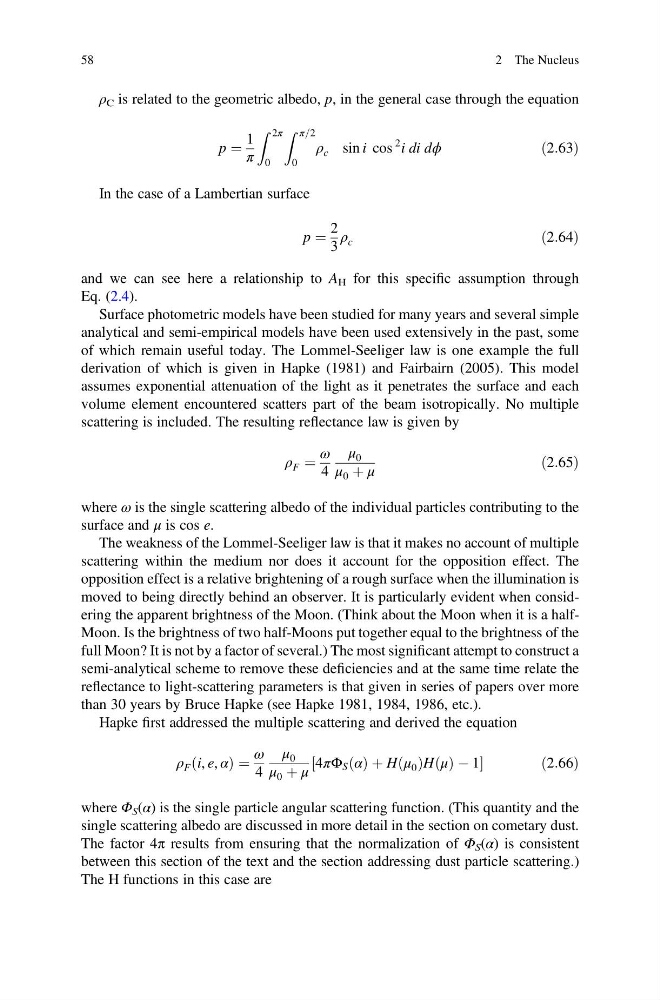
ρ C is related to the geometric albedo, p, in the general case through the equation
p ¼
1
π
Z 2π
0
Z π=2
0
ρ c sin i cos
2 i di dϕ
ð2:63Þ
In the case of a Lambertian surface
p ¼
2
3
ρ c
ð2:64Þ
and we can see here a relationship to A H for this specific assumption through
Eq. (2.4).
Surface photometric models have been studied for many years and several simple
analytical and semi-empirical models have been used extensively in the past, some
of which remain useful today. The Lommel-Seeliger law is one example the full
derivation of which is given in Hapke (1981) and Fairbairn (2005). This model
assumes exponential attenuation of the light as it penetrates the surface and each
volume element encountered scatters part of the beam isotropically. No multiple
scattering is included. The resulting reflectance law is given by
ρ F ¼
ω
4
μ 0
μ 0 þ μ
ð2:65Þ
where ω is the single scattering albedo of the individual particles contributing to the
surface and μ is cos e.
The weakness of the Lommel-Seeliger law is that it makes no account of multiple
scattering within the medium nor does it account for the opposition effect. The
opposition effect is a relative brightening of a rough surface when the illumination is
moved to being directly behind an observer. It is particularly evident when considering the apparent brightness of the Moon. (Think about the Moon when it is a halfMoon. Is the brightness of two half-Moons put together equal to the brightness of the
full Moon? It is not by a factor of several.) The most significant attempt to construct a
semi-analytical scheme to remove these deficiencies and at the same time relate the
reflectance to light-scattering parameters is that given in series of papers over more
than 30 years by Bruce Hapke (see Hapke 1981, 1984, 1986, etc.).
Hapke first addressed the multiple scattering and derived the equation
ρ F i, e, α
ð
Þ¼
ω
4
μ 0
μ 0 þ μ
4πΦ S α
ð Þ þ H μ 0
ð ÞH μ
ð Þ À 1
½
ð 2:66Þ
where Φ S (α) is the single particle angular scattering function. (This quantity and the
single scattering albedo are discussed in more detail in the section on cometary dust.
The factor 4π results from ensuring that the normalization of Φ S (α) is consistent
between this section of the text and the section addressing dust particle scattering.)
The H functions in this case are
58
2 The Nucleus
p ¼
1
π
Z 2π
0
Z π=2
0
ρ c sin i cos
2 i di dϕ
ð2:63Þ
In the case of a Lambertian surface
p ¼
2
3
ρ c
ð2:64Þ
and we can see here a relationship to A H for this specific assumption through
Eq. (2.4).
Surface photometric models have been studied for many years and several simple
analytical and semi-empirical models have been used extensively in the past, some
of which remain useful today. The Lommel-Seeliger law is one example the full
derivation of which is given in Hapke (1981) and Fairbairn (2005). This model
assumes exponential attenuation of the light as it penetrates the surface and each
volume element encountered scatters part of the beam isotropically. No multiple
scattering is included. The resulting reflectance law is given by
ρ F ¼
ω
4
μ 0
μ 0 þ μ
ð2:65Þ
where ω is the single scattering albedo of the individual particles contributing to the
surface and μ is cos e.
The weakness of the Lommel-Seeliger law is that it makes no account of multiple
scattering within the medium nor does it account for the opposition effect. The
opposition effect is a relative brightening of a rough surface when the illumination is
moved to being directly behind an observer. It is particularly evident when considering the apparent brightness of the Moon. (Think about the Moon when it is a halfMoon. Is the brightness of two half-Moons put together equal to the brightness of the
full Moon? It is not by a factor of several.) The most significant attempt to construct a
semi-analytical scheme to remove these deficiencies and at the same time relate the
reflectance to light-scattering parameters is that given in series of papers over more
than 30 years by Bruce Hapke (see Hapke 1981, 1984, 1986, etc.).
Hapke first addressed the multiple scattering and derived the equation
ρ F i, e, α
ð
Þ¼
ω
4
μ 0
μ 0 þ μ
4πΦ S α
ð Þ þ H μ 0
ð ÞH μ
ð Þ À 1
½
ð 2:66Þ
where Φ S (α) is the single particle angular scattering function. (This quantity and the
single scattering albedo are discussed in more detail in the section on cometary dust.
The factor 4π results from ensuring that the normalization of Φ S (α) is consistent
between this section of the text and the section addressing dust particle scattering.)
The H functions in this case are
58
2 The Nucleus