

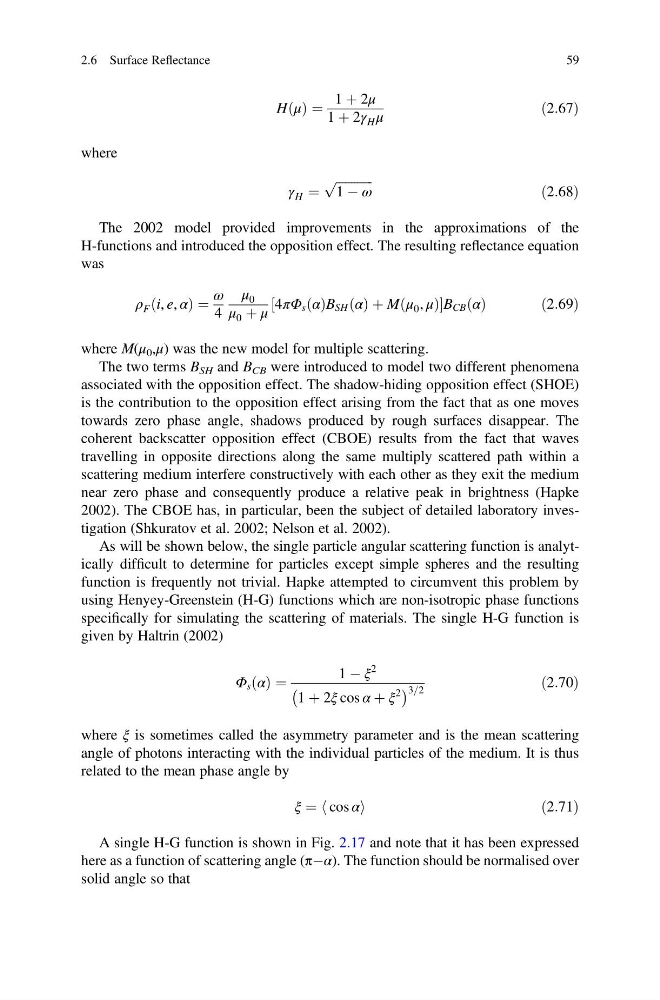
H μ
ð Þ ¼
1 þ 2μ
1 þ 2γ H μ
ð2:67Þ
where
γ H ¼
ffiffiffiffiffiffiffiffiffiffiffiffi
1 À ω
p
ð2:68Þ
The 2002 model provided improvements in the approximations of the
H-functions and introduced the opposition effect. The resulting reflectance equation
was
ρ F i, e, α
ð
Þ¼
ω
4
μ 0
μ 0 þ μ
4πΦ s α
ð ÞB SH α
ð Þ þ M μ 0 , μ
ð
Þ
½
B CB α
ð Þ
ð2:69Þ
where M(μ 0 ,μ) was the new model for multiple scattering.
The two terms B SH and B CB were introduced to model two different phenomena
associated with the opposition effect. The shadow-hiding opposition effect (SHOE)
is the contribution to the opposition effect arising from the fact that as one moves
towards zero phase angle, shadows produced by rough surfaces disappear. The
coherent backscatter opposition effect (CBOE) results from the fact that waves
travelling in opposite directions along the same multiply scattered path within a
scattering medium interfere constructively with each other as they exit the medium
near zero phase and consequently produce a relative peak in brightness (Hapke
2002). The CBOE has, in particular, been the subject of detailed laboratory investigation (Shkuratov et al. 2002; Nelson et al. 2002).
As will be shown below, the single particle angular scattering function is analytically difficult to determine for particles except simple spheres and the resulting
function is frequently not trivial. Hapke attempted to circumvent this problem by
using Henyey-Greenstein (H-G) functions which are non-isotropic phase functions
specifically for simulating the scattering of materials. The single H-G function is
given by Haltrin (2002)
Φ s α
ð Þ ¼
1 À ξ
2
1 þ 2ξ cos α þ ξ
2
À
Á 3=2
ð2:70Þ
where ξ is sometimes called the asymmetry parameter and is the mean scattering
angle of photons interacting with the individual particles of the medium. It is thus
related to the mean phase angle by
ξ ¼ cos α
h
i
ð2:71Þ
A single H-G function is shown in Fig. 2.17 and note that it has been expressed
here as a function of scattering angle (πÀα). The function should be normalised over
solid angle so that
2.6 Surface Reflectance
59
ð Þ ¼
1 þ 2μ
1 þ 2γ H μ
ð2:67Þ
where
γ H ¼
ffiffiffiffiffiffiffiffiffiffiffiffi
1 À ω
p
ð2:68Þ
The 2002 model provided improvements in the approximations of the
H-functions and introduced the opposition effect. The resulting reflectance equation
was
ρ F i, e, α
ð
Þ¼
ω
4
μ 0
μ 0 þ μ
4πΦ s α
ð ÞB SH α
ð Þ þ M μ 0 , μ
ð
Þ
½
B CB α
ð Þ
ð2:69Þ
where M(μ 0 ,μ) was the new model for multiple scattering.
The two terms B SH and B CB were introduced to model two different phenomena
associated with the opposition effect. The shadow-hiding opposition effect (SHOE)
is the contribution to the opposition effect arising from the fact that as one moves
towards zero phase angle, shadows produced by rough surfaces disappear. The
coherent backscatter opposition effect (CBOE) results from the fact that waves
travelling in opposite directions along the same multiply scattered path within a
scattering medium interfere constructively with each other as they exit the medium
near zero phase and consequently produce a relative peak in brightness (Hapke
2002). The CBOE has, in particular, been the subject of detailed laboratory investigation (Shkuratov et al. 2002; Nelson et al. 2002).
As will be shown below, the single particle angular scattering function is analytically difficult to determine for particles except simple spheres and the resulting
function is frequently not trivial. Hapke attempted to circumvent this problem by
using Henyey-Greenstein (H-G) functions which are non-isotropic phase functions
specifically for simulating the scattering of materials. The single H-G function is
given by Haltrin (2002)
Φ s α
ð Þ ¼
1 À ξ
2
1 þ 2ξ cos α þ ξ
2
À
Á 3=2
ð2:70Þ
where ξ is sometimes called the asymmetry parameter and is the mean scattering
angle of photons interacting with the individual particles of the medium. It is thus
related to the mean phase angle by
ξ ¼ cos α
h
i
ð2:71Þ
A single H-G function is shown in Fig. 2.17 and note that it has been expressed
here as a function of scattering angle (πÀα). The function should be normalised over
solid angle so that
2.6 Surface Reflectance
59