

where the integration occurs over a hemisphere (2π steradians) when referring to
surface emission.
There are several interpretational issues that are relevant and require explanation.
We begin with some definitions.
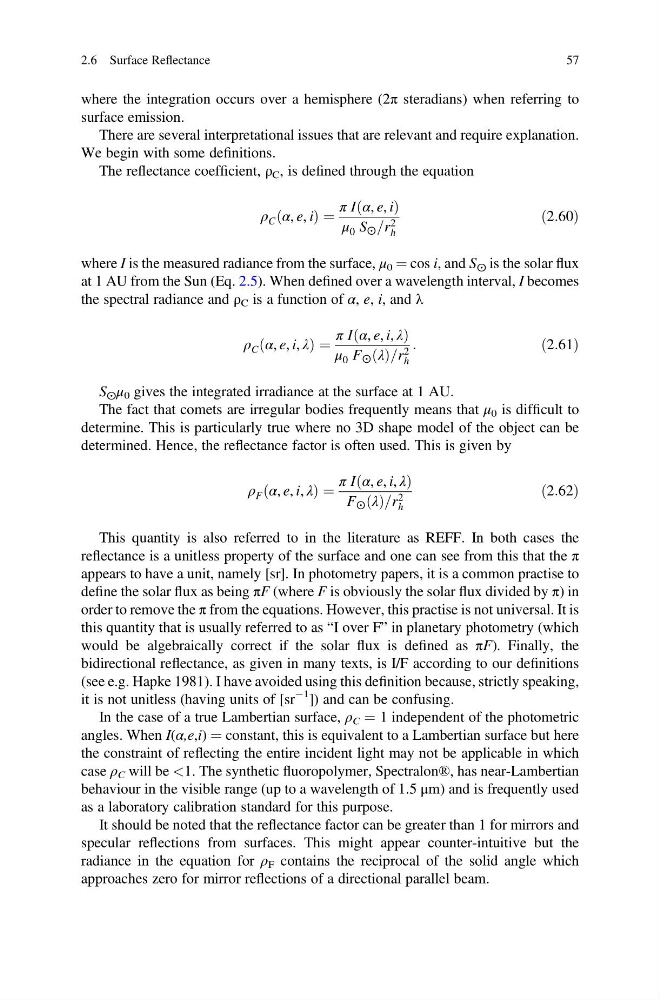
The reflectance coefficient, ρ C , is defined through the equation
ρ C α, e, i
ð
Þ¼
π I α, e, i
ð
Þ
μ 0 S ⨀ =r 2
h
ð2:60Þ
where I is the measured radiance from the surface, μ 0 ¼ cos i, and S ⨀ is the solar flux
at 1 AU from the Sun (Eq. 2.5). When defined over a wavelength interval, I becomes
the spectral radiance and ρ C is a function of α, e, i, and λ
ρ C α, e, i, λ
ð
Þ¼
π I α, e, i, λ
ð
Þ
μ 0 F ⨀ λ
ð Þ=r 2
h
:
ð2:61Þ
S ⨀ μ 0 gives the integrated irradiance at the surface at 1 AU.
The fact that comets are irregular bodies frequently means that μ 0 is difficult to
determine. This is particularly true where no 3D shape model of the object can be
determined. Hence, the reflectance factor is often used. This is given by
ρ F α, e, i, λ
ð
Þ¼
π I α, e, i, λ
ð
Þ
F ⨀ λ
ð Þ=r 2
h
ð2:62Þ
This quantity is also referred to in the literature as REFF. In both cases the
reflectance is a unitless property of the surface and one can see from this that the π
appears to have a unit, namely [sr]. In photometry papers, it is a common practise to
define the solar flux as being πF (where F is obviously the solar flux divided by π) in
order to remove the π from the equations. However, this practise is not universal. It is
this quantity that is usually referred to as “I over F” in planetary photometry (which
would be algebraically correct if the solar flux is defined as πF). Finally, the
bidirectional reflectance, as given in many texts, is I/F according to our definitions
(see e.g. Hapke 1981). I have avoided using this definition because, strictly speaking,
it is not unitless (having units of [sr
À1 ]) and can be confusing.
In the case of a true Lambertian surface, ρ C ¼ 1 independent of the photometric
angles. When I(α,e,i) ¼ constant, this is equivalent to a Lambertian surface but here
the constraint of reflecting the entire incident light may not be applicable in which
case ρ C will be <1. The synthetic fluoropolymer, Spectralon®, has near-Lambertian
behaviour in the visible range (up to a wavelength of 1.5 μm) and is frequently used
as a laboratory calibration standard for this purpose.
It should be noted that the reflectance factor can be greater than 1 for mirrors and
specular reflections from surfaces. This might appear counter-intuitive but the
radiance in the equation for ρ F contains the reciprocal of the solid angle which
approaches zero for mirror reflections of a directional parallel beam.
2.6 Surface Reflectance
57
surface emission.
There are several interpretational issues that are relevant and require explanation.
We begin with some definitions.
The reflectance coefficient, ρ C , is defined through the equation
ρ C α, e, i
ð
Þ¼
π I α, e, i
ð
Þ
μ 0 S ⨀ =r 2
h
ð2:60Þ
where I is the measured radiance from the surface, μ 0 ¼ cos i, and S ⨀ is the solar flux
at 1 AU from the Sun (Eq. 2.5). When defined over a wavelength interval, I becomes
the spectral radiance and ρ C is a function of α, e, i, and λ
ρ C α, e, i, λ
ð
Þ¼
π I α, e, i, λ
ð
Þ
μ 0 F ⨀ λ
ð Þ=r 2
h
:
ð2:61Þ
S ⨀ μ 0 gives the integrated irradiance at the surface at 1 AU.
The fact that comets are irregular bodies frequently means that μ 0 is difficult to
determine. This is particularly true where no 3D shape model of the object can be
determined. Hence, the reflectance factor is often used. This is given by
ρ F α, e, i, λ
ð
Þ¼
π I α, e, i, λ
ð
Þ
F ⨀ λ
ð Þ=r 2
h
ð2:62Þ
This quantity is also referred to in the literature as REFF. In both cases the
reflectance is a unitless property of the surface and one can see from this that the π
appears to have a unit, namely [sr]. In photometry papers, it is a common practise to
define the solar flux as being πF (where F is obviously the solar flux divided by π) in
order to remove the π from the equations. However, this practise is not universal. It is
this quantity that is usually referred to as “I over F” in planetary photometry (which
would be algebraically correct if the solar flux is defined as πF). Finally, the
bidirectional reflectance, as given in many texts, is I/F according to our definitions
(see e.g. Hapke 1981). I have avoided using this definition because, strictly speaking,
it is not unitless (having units of [sr
À1 ]) and can be confusing.
In the case of a true Lambertian surface, ρ C ¼ 1 independent of the photometric
angles. When I(α,e,i) ¼ constant, this is equivalent to a Lambertian surface but here
the constraint of reflecting the entire incident light may not be applicable in which
case ρ C will be <1. The synthetic fluoropolymer, Spectralon®, has near-Lambertian
behaviour in the visible range (up to a wavelength of 1.5 μm) and is frequently used
as a laboratory calibration standard for this purpose.
It should be noted that the reflectance factor can be greater than 1 for mirrors and
specular reflections from surfaces. This might appear counter-intuitive but the
radiance in the equation for ρ F contains the reciprocal of the solid angle which
approaches zero for mirror reflections of a directional parallel beam.
2.6 Surface Reflectance
57