

a fairly sizeable change in the main rotation period, the rotational state of 67P is close
to a pure spin.
Internal friction within the nucleus can lead to a reduction in the rotational energy
thereby bringing the object to a less excited state. This was first addressed by Burns
and Safronov (1973) who gave an estimate for the damping timescale, τ damp , as
τ damp $
μ rig Q damp
ρ N K
2 r 2
N Ω N
3
ð2:54Þ
where μ rig is the rigidity, Q damp is a quality factor of the material, and K is a shape
factor. The knowledge of the values of μ rig and Q damp are poor while K is related to
the oblateness, H, by being approximately 0.1 H
2 . De Pater and Lissauer (2015) gave
a more easily evaluated approximation for asteroids using nominal asteroid parameters as
τ damp $
0:7 2π
r 2
N Ω N
3
ð2:55Þ
where r N should be entered in units of [km] and the orbital period, computed through
2π/Ω N , is in units of [day]. The timescale is then given in units of [Gy]. Using
approximate numbers for 67P, we obtain 550,000 years which is long compared to
the comet’s lifetime in the inner Solar System and therefore unlikely to be of
relevance.
The total rotational angular momentum vector of 67P has an obliquity of 52.3
(e.g. Brugger et al. 2016) which is highly significant for the surface energy balance.
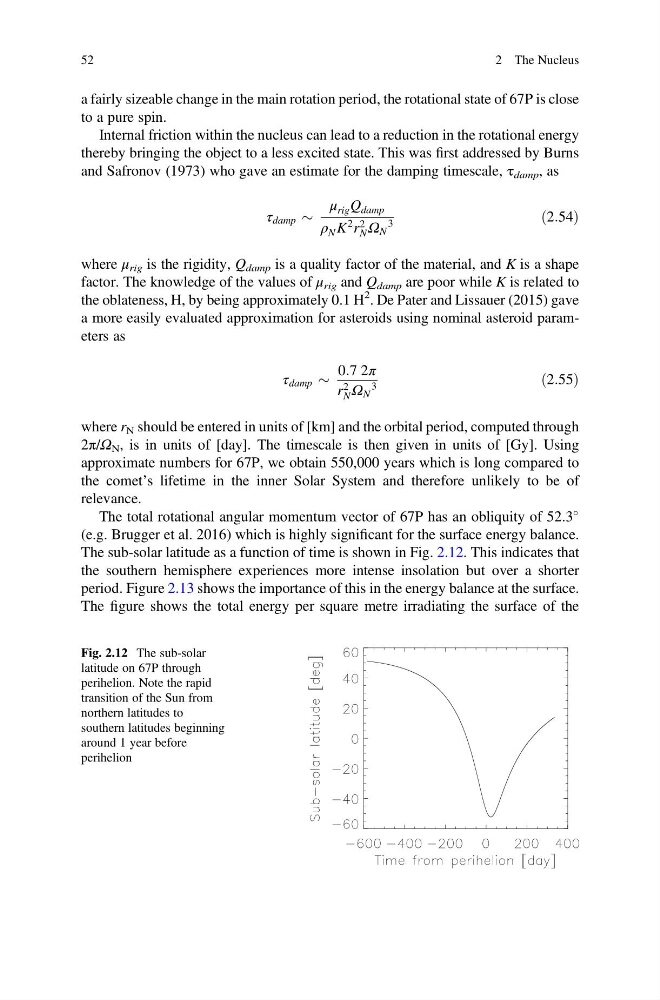
The sub-solar latitude as a function of time is shown in Fig. 2.12. This indicates that
the southern hemisphere experiences more intense insolation but over a shorter
period. Figure 2.13 shows the importance of this in the energy balance at the surface.
The figure shows the total energy per square metre irradiating the surface of the
Fig. 2.12 The sub-solar
latitude on 67P through
perihelion. Note the rapid
transition of the Sun from
northern latitudes to
southern latitudes beginning
around 1 year before
perihelion
52
2 The Nucleus
to a pure spin.
Internal friction within the nucleus can lead to a reduction in the rotational energy
thereby bringing the object to a less excited state. This was first addressed by Burns
and Safronov (1973) who gave an estimate for the damping timescale, τ damp , as
τ damp $
μ rig Q damp
ρ N K
2 r 2
N Ω N
3
ð2:54Þ
where μ rig is the rigidity, Q damp is a quality factor of the material, and K is a shape
factor. The knowledge of the values of μ rig and Q damp are poor while K is related to
the oblateness, H, by being approximately 0.1 H
2 . De Pater and Lissauer (2015) gave
a more easily evaluated approximation for asteroids using nominal asteroid parameters as
τ damp $
0:7 2π
r 2
N Ω N
3
ð2:55Þ
where r N should be entered in units of [km] and the orbital period, computed through
2π/Ω N , is in units of [day]. The timescale is then given in units of [Gy]. Using
approximate numbers for 67P, we obtain 550,000 years which is long compared to
the comet’s lifetime in the inner Solar System and therefore unlikely to be of
relevance.
The total rotational angular momentum vector of 67P has an obliquity of 52.3
(e.g. Brugger et al. 2016) which is highly significant for the surface energy balance.
The sub-solar latitude as a function of time is shown in Fig. 2.12. This indicates that
the southern hemisphere experiences more intense insolation but over a shorter
period. Figure 2.13 shows the importance of this in the energy balance at the surface.
The figure shows the total energy per square metre irradiating the surface of the
Fig. 2.12 The sub-solar
latitude on 67P through
perihelion. Note the rapid
transition of the Sun from
northern latitudes to
southern latitudes beginning
around 1 year before
perihelion
52
2 The Nucleus