

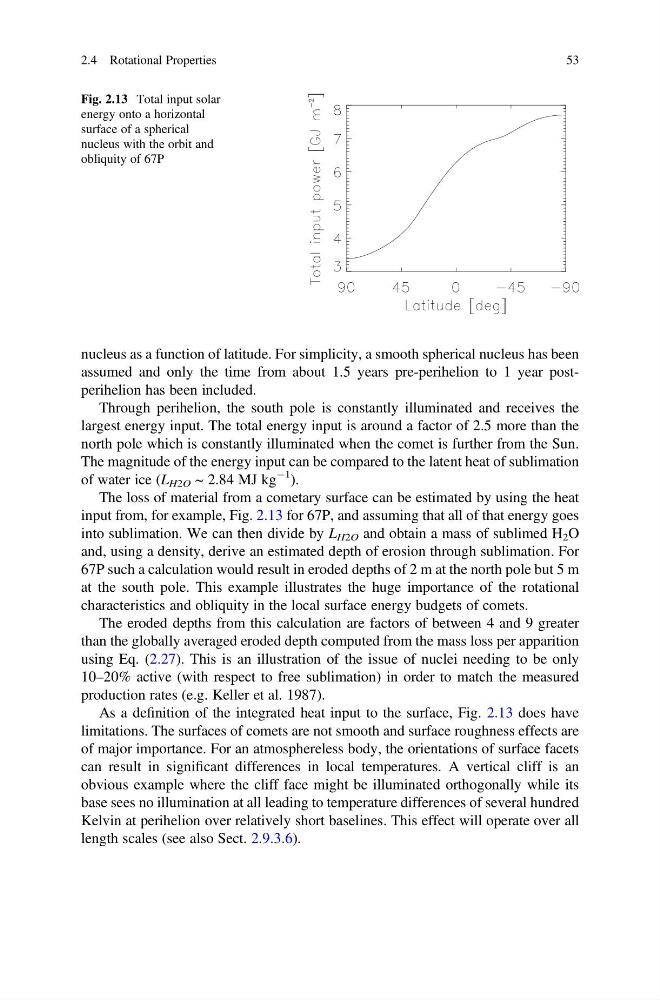
nucleus as a function of latitude. For simplicity, a smooth spherical nucleus has been
assumed and only the time from about 1.5 years pre-perihelion to 1 year postperihelion has been included.
Through perihelion, the south pole is constantly illuminated and receives the
largest energy input. The total energy input is around a factor of 2.5 more than the
north pole which is constantly illuminated when the comet is further from the Sun.
The magnitude of the energy input can be compared to the latent heat of sublimation
of water ice (L H2O ~ 2.84 MJ kg
À1 ).
The loss of material from a cometary surface can be estimated by using the heat
input from, for example, Fig. 2.13 for 67P, and assuming that all of that energy goes
into sublimation. We can then divide by L H2O and obtain a mass of sublimed H 2 O
and, using a density, derive an estimated depth of erosion through sublimation. For
67P such a calculation would result in eroded depths of 2 m at the north pole but 5 m
at the south pole. This example illustrates the huge importance of the rotational
characteristics and obliquity in the local surface energy budgets of comets.
The eroded depths from this calculation are factors of between 4 and 9 greater
than the globally averaged eroded depth computed from the mass loss per apparition
using Eq. (2.27). This is an illustration of the issue of nuclei needing to be only
10–20% active (with respect to free sublimation) in order to match the measured
production rates (e.g. Keller et al. 1987).
As a definition of the integrated heat input to the surface, Fig. 2.13 does have
limitations. The surfaces of comets are not smooth and surface roughness effects are
of major importance. For an atmosphereless body, the orientations of surface facets
can result in significant differences in local temperatures. A vertical cliff is an
obvious example where the cliff face might be illuminated orthogonally while its
base sees no illumination at all leading to temperature differences of several hundred
Kelvin at perihelion over relatively short baselines. This effect will operate over all
length scales (see also Sect. 2.9.3.6).
Fig. 2.13 Total input solar
energy onto a horizontal
surface of a spherical
nucleus with the orbit and
obliquity of 67P
2.4 Rotational Properties
53
assumed and only the time from about 1.5 years pre-perihelion to 1 year postperihelion has been included.
Through perihelion, the south pole is constantly illuminated and receives the
largest energy input. The total energy input is around a factor of 2.5 more than the
north pole which is constantly illuminated when the comet is further from the Sun.
The magnitude of the energy input can be compared to the latent heat of sublimation
of water ice (L H2O ~ 2.84 MJ kg
À1 ).
The loss of material from a cometary surface can be estimated by using the heat
input from, for example, Fig. 2.13 for 67P, and assuming that all of that energy goes
into sublimation. We can then divide by L H2O and obtain a mass of sublimed H 2 O
and, using a density, derive an estimated depth of erosion through sublimation. For
67P such a calculation would result in eroded depths of 2 m at the north pole but 5 m
at the south pole. This example illustrates the huge importance of the rotational
characteristics and obliquity in the local surface energy budgets of comets.
The eroded depths from this calculation are factors of between 4 and 9 greater
than the globally averaged eroded depth computed from the mass loss per apparition
using Eq. (2.27). This is an illustration of the issue of nuclei needing to be only
10–20% active (with respect to free sublimation) in order to match the measured
production rates (e.g. Keller et al. 1987).
As a definition of the integrated heat input to the surface, Fig. 2.13 does have
limitations. The surfaces of comets are not smooth and surface roughness effects are
of major importance. For an atmosphereless body, the orientations of surface facets
can result in significant differences in local temperatures. A vertical cliff is an
obvious example where the cliff face might be illuminated orthogonally while its
base sees no illumination at all leading to temperature differences of several hundred
Kelvin at perihelion over relatively short baselines. This effect will operate over all
length scales (see also Sect. 2.9.3.6).
Fig. 2.13 Total input solar
energy onto a horizontal
surface of a spherical
nucleus with the orbit and
obliquity of 67P
2.4 Rotational Properties
53