

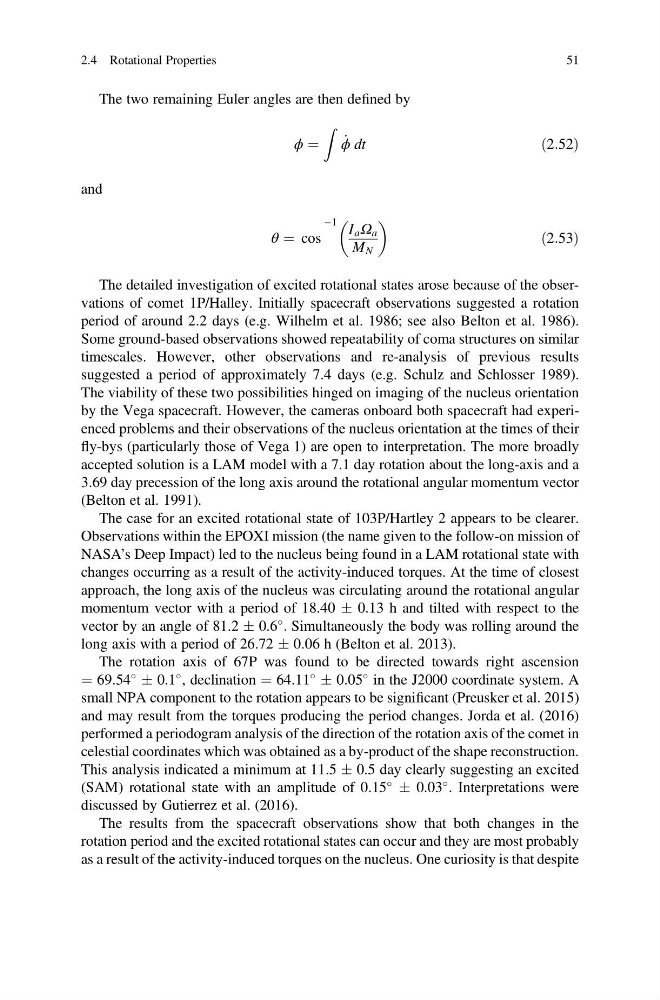
The two remaining Euler angles are then defined by
ϕ ¼
Z
_
ϕ dt
ð2:52Þ
and
θ ¼ cos
À1 I a Ω a
M N
ð2:53Þ
The detailed investigation of excited rotational states arose because of the observations of comet 1P/Halley. Initially spacecraft observations suggested a rotation
period of around 2.2 days (e.g. Wilhelm et al. 1986; see also Belton et al. 1986).
Some ground-based observations showed repeatability of coma structures on similar
timescales. However, other observations and re-analysis of previous results
suggested a period of approximately 7.4 days (e.g. Schulz and Schlosser 1989).
The viability of these two possibilities hinged on imaging of the nucleus orientation
by the Vega spacecraft. However, the cameras onboard both spacecraft had experienced problems and their observations of the nucleus orientation at the times of their
fly-bys (particularly those of Vega 1) are open to interpretation. The more broadly
accepted solution is a LAM model with a 7.1 day rotation about the long-axis and a
3.69 day precession of the long axis around the rotational angular momentum vector
(Belton et al. 1991).
The case for an excited rotational state of 103P/Hartley 2 appears to be clearer.
Observations within the EPOXI mission (the name given to the follow-on mission of
NASA’s Deep Impact) led to the nucleus being found in a LAM rotational state with
changes occurring as a result of the activity-induced torques. At the time of closest
approach, the long axis of the nucleus was circulating around the rotational angular
momentum vector with a period of 18.40 Æ 0.13 h and tilted with respect to the
vector by an angle of 81.2 Æ 0.6
. Simultaneously the body was rolling around the
long axis with a period of 26.72 Æ 0.06 h (Belton et al. 2013).
The rotation axis of 67P was found to be directed towards right ascension
¼ 69.54
Æ 0.1
, declination ¼ 64.11
Æ 0.05
in the J2000 coordinate system. A
small NPA component to the rotation appears to be significant (Preusker et al. 2015)
and may result from the torques producing the period changes. Jorda et al. (2016)
performed a periodogram analysis of the direction of the rotation axis of the comet in
celestial coordinates which was obtained as a by-product of the shape reconstruction.
This analysis indicated a minimum at 11.5 Æ 0.5 day clearly suggesting an excited
(SAM) rotational state with an amplitude of 0.15
Æ 0.03
. Interpretations were
discussed by Gutierrez et al. (2016).
The results from the spacecraft observations show that both changes in the
rotation period and the excited rotational states can occur and they are most probably
as a result of the activity-induced torques on the nucleus. One curiosity is that despite
2.4 Rotational Properties
51
ϕ ¼
Z
_
ϕ dt
ð2:52Þ
and
θ ¼ cos
À1 I a Ω a
M N
ð2:53Þ
The detailed investigation of excited rotational states arose because of the observations of comet 1P/Halley. Initially spacecraft observations suggested a rotation
period of around 2.2 days (e.g. Wilhelm et al. 1986; see also Belton et al. 1986).
Some ground-based observations showed repeatability of coma structures on similar
timescales. However, other observations and re-analysis of previous results
suggested a period of approximately 7.4 days (e.g. Schulz and Schlosser 1989).
The viability of these two possibilities hinged on imaging of the nucleus orientation
by the Vega spacecraft. However, the cameras onboard both spacecraft had experienced problems and their observations of the nucleus orientation at the times of their
fly-bys (particularly those of Vega 1) are open to interpretation. The more broadly
accepted solution is a LAM model with a 7.1 day rotation about the long-axis and a
3.69 day precession of the long axis around the rotational angular momentum vector
(Belton et al. 1991).
The case for an excited rotational state of 103P/Hartley 2 appears to be clearer.
Observations within the EPOXI mission (the name given to the follow-on mission of
NASA’s Deep Impact) led to the nucleus being found in a LAM rotational state with
changes occurring as a result of the activity-induced torques. At the time of closest
approach, the long axis of the nucleus was circulating around the rotational angular
momentum vector with a period of 18.40 Æ 0.13 h and tilted with respect to the
vector by an angle of 81.2 Æ 0.6
. Simultaneously the body was rolling around the
long axis with a period of 26.72 Æ 0.06 h (Belton et al. 2013).
The rotation axis of 67P was found to be directed towards right ascension
¼ 69.54
Æ 0.1
, declination ¼ 64.11
Æ 0.05
in the J2000 coordinate system. A
small NPA component to the rotation appears to be significant (Preusker et al. 2015)
and may result from the torques producing the period changes. Jorda et al. (2016)
performed a periodogram analysis of the direction of the rotation axis of the comet in
celestial coordinates which was obtained as a by-product of the shape reconstruction.
This analysis indicated a minimum at 11.5 Æ 0.5 day clearly suggesting an excited
(SAM) rotational state with an amplitude of 0.15
Æ 0.03
. Interpretations were
discussed by Gutierrez et al. (2016).
The results from the spacecraft observations show that both changes in the
rotation period and the excited rotational states can occur and they are most probably
as a result of the activity-induced torques on the nucleus. One curiosity is that despite
2.4 Rotational Properties
51