

object or regions on objects where the topographic relief is large. On the other hand,
flat, smooth terrains are not so easily reconstructed and errors on these types of
terrain can be significant. An example of an SPG reconstruction is shown in Fig. 2.3
and its application to 67P has been described by Preusker et al. (2017).
An alternative technique is stereo photoclinometry (SPC). Here it is assumed that
the reflectance properties of the surface elements are identical. Changes in the
brightness then correspond to changes in the photometric angles that in turn constrain the local shape. SPC is very powerful for flat, smooth terrains but is less
effective where topographic relief is high. Its application to 67P has been described
by Jorda et al. (2016). This technique is complimentary to SPG and combining the
results from applying both these techniques to one data set should provide an
optimum result. The Multi-resolution Stereo-photoclinometry by Deformation
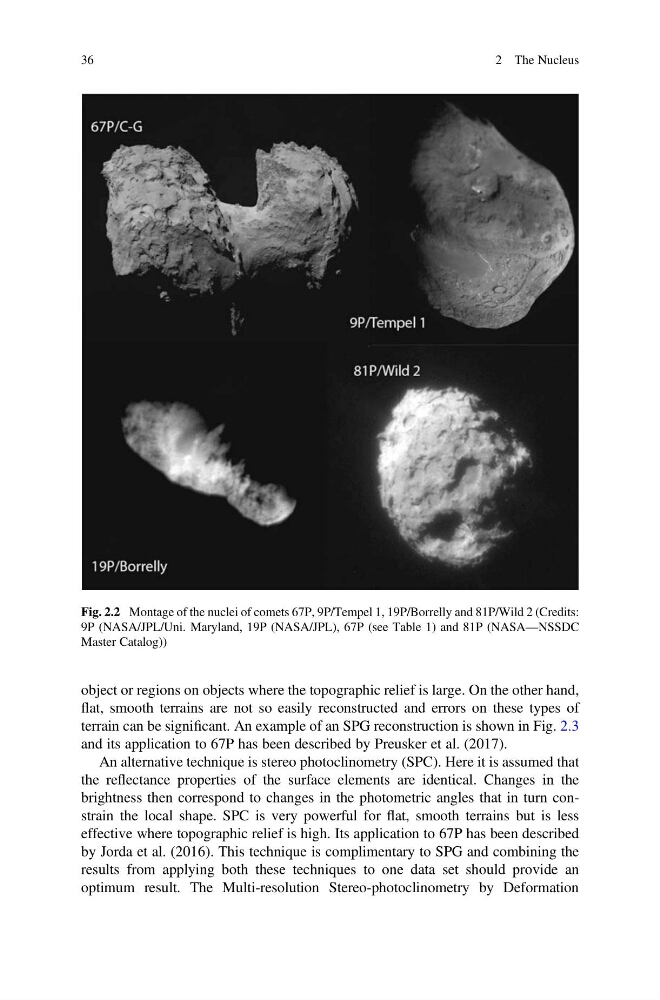
Fig. 2.2 Montage of the nuclei of comets 67P, 9P/Tempel 1, 19P/Borrelly and 81P/Wild 2 (Credits:
9P (NASA/JPL/Uni. Maryland, 19P (NASA/JPL), 67P (see Table 1) and 81P (NASA—NSSDC
Master Catalog))
36
2 The Nucleus
flat, smooth terrains are not so easily reconstructed and errors on these types of
terrain can be significant. An example of an SPG reconstruction is shown in Fig. 2.3
and its application to 67P has been described by Preusker et al. (2017).
An alternative technique is stereo photoclinometry (SPC). Here it is assumed that
the reflectance properties of the surface elements are identical. Changes in the
brightness then correspond to changes in the photometric angles that in turn constrain the local shape. SPC is very powerful for flat, smooth terrains but is less
effective where topographic relief is high. Its application to 67P has been described
by Jorda et al. (2016). This technique is complimentary to SPG and combining the
results from applying both these techniques to one data set should provide an
optimum result. The Multi-resolution Stereo-photoclinometry by Deformation
Fig. 2.2 Montage of the nuclei of comets 67P, 9P/Tempel 1, 19P/Borrelly and 81P/Wild 2 (Credits:
9P (NASA/JPL/Uni. Maryland, 19P (NASA/JPL), 67P (see Table 1) and 81P (NASA—NSSDC
Master Catalog))
36
2 The Nucleus