

paper in 1950. Although this paper was a landmark in cometary research, the Halley
observations showed that the dark material was dominant (leading Keller to describe
comets as “icy dirtballs” as a counterpoint to Whipple’s phrase) and that they really
could not be described as “balls” at all. The original description of comets by
Whipple (1950, 1951) referred to an icy conglomerate of ices with meteoritic
material. Compared to this concept, the mass of dark, non-volatile, material appeared
to be greater although it is important to note that Whipple never actually quantified
the non-volatile to ice ratio he envisaged. The idea of uniformly subliming, spherical, totally water-ice dominated, object was no longer tenable. The elongated shape
with axes roughly in the ratio 2:1:1 also seemed to be more consistent with a
formation process in which larger planetesimals accreted rather than growing uniformly by collection of gas and dust around a core.
The shapes of other nuclei observed by spacecraft (Fig. 2.2) have shown a wide
range (Table 2.2).
Even from a distance of 30,000 km, it was clear that the nucleus of 67P was
highly irregular in shape and it quickly became apparent that the nucleus had two
distinct lobes. The appearance of the nucleus in the early images was referred to as
being like a small duck leading to the smaller of the two lobes being referred to as the
head with the larger lobe being the body. A neck separated the two. (Quite why
cometary scientists feel the need to compare the shapes of nuclei to ducks, avocados,
baked potatoes, peanuts, etc. is something of a mystery to me but we will use the
terms head, neck and body for 67P purely out of solidarity!) This shape immediately
provided a challenge to the Rosetta science team in defining coordinate systems and
approaches to defining the 3D shape of the nucleus.
There are two main techniques for determining the shape of a resolved irregular
object. Stereo photogrammetry (SPG) uses parallax between images of the same
field taken from different viewing geometries to establish the elevation with respect
to an image plane. By combining many images of the object, the full 3D shape can be
reconstructed in a self-consistent way. The technique is particularly powerful for
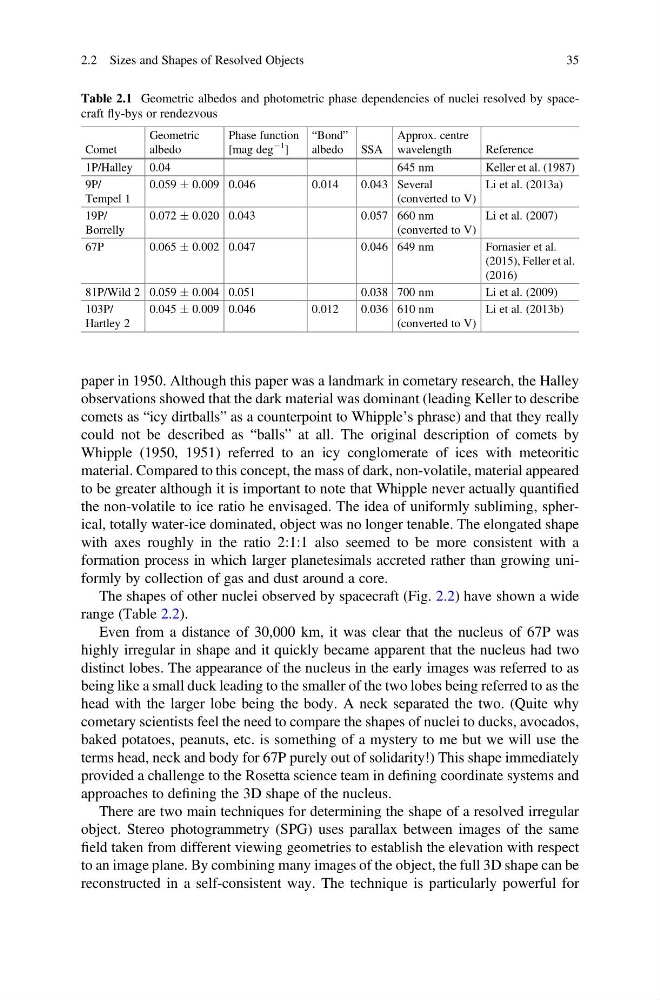
Table 2.1 Geometric albedos and photometric phase dependencies of nuclei resolved by spacecraft fly-bys or rendezvous
Comet
Geometric
albedo
Phase function
[mag deg
À1
]
“Bond”
albedo SSA
Approx. centre
wavelength
Reference
1P/Halley 0.04
645 nm
Keller et al. (1987)
9P/
Tempel 1
0.059 Æ 0.009 0.046
0.014
0.043 Several
(converted to V)
Li et al. (2013a)
19P/
Borrelly
0.072 Æ 0.020 0.043
0.057 660 nm
(converted to V)
Li et al. (2007)
67P
0.065 Æ 0.002 0.047
0.046 649 nm
Fornasier et al.
(2015), Feller et al.
(2016)
81P/Wild 2 0.059 Æ 0.004 0.051
0.038 700 nm
Li et al. (2009)
103P/
Hartley 2
0.045 Æ 0.009 0.046
0.012
0.036 610 nm
(converted to V)
Li et al. (2013b)
2.2 Sizes and Shapes of Resolved Objects
35
observations showed that the dark material was dominant (leading Keller to describe
comets as “icy dirtballs” as a counterpoint to Whipple’s phrase) and that they really
could not be described as “balls” at all. The original description of comets by
Whipple (1950, 1951) referred to an icy conglomerate of ices with meteoritic
material. Compared to this concept, the mass of dark, non-volatile, material appeared
to be greater although it is important to note that Whipple never actually quantified
the non-volatile to ice ratio he envisaged. The idea of uniformly subliming, spherical, totally water-ice dominated, object was no longer tenable. The elongated shape
with axes roughly in the ratio 2:1:1 also seemed to be more consistent with a
formation process in which larger planetesimals accreted rather than growing uniformly by collection of gas and dust around a core.
The shapes of other nuclei observed by spacecraft (Fig. 2.2) have shown a wide
range (Table 2.2).
Even from a distance of 30,000 km, it was clear that the nucleus of 67P was
highly irregular in shape and it quickly became apparent that the nucleus had two
distinct lobes. The appearance of the nucleus in the early images was referred to as
being like a small duck leading to the smaller of the two lobes being referred to as the
head with the larger lobe being the body. A neck separated the two. (Quite why
cometary scientists feel the need to compare the shapes of nuclei to ducks, avocados,
baked potatoes, peanuts, etc. is something of a mystery to me but we will use the
terms head, neck and body for 67P purely out of solidarity!) This shape immediately
provided a challenge to the Rosetta science team in defining coordinate systems and
approaches to defining the 3D shape of the nucleus.
There are two main techniques for determining the shape of a resolved irregular
object. Stereo photogrammetry (SPG) uses parallax between images of the same
field taken from different viewing geometries to establish the elevation with respect
to an image plane. By combining many images of the object, the full 3D shape can be
reconstructed in a self-consistent way. The technique is particularly powerful for
Table 2.1 Geometric albedos and photometric phase dependencies of nuclei resolved by spacecraft fly-bys or rendezvous
Comet
Geometric
albedo
Phase function
[mag deg
À1
]
“Bond”
albedo SSA
Approx. centre
wavelength
Reference
1P/Halley 0.04
645 nm
Keller et al. (1987)
9P/
Tempel 1
0.059 Æ 0.009 0.046
0.014
0.043 Several
(converted to V)
Li et al. (2013a)
19P/
Borrelly
0.072 Æ 0.020 0.043
0.057 660 nm
(converted to V)
Li et al. (2007)
67P
0.065 Æ 0.002 0.047
0.046 649 nm
Fornasier et al.
(2015), Feller et al.
(2016)
81P/Wild 2 0.059 Æ 0.004 0.051
0.038 700 nm
Li et al. (2009)
103P/
Hartley 2
0.045 Æ 0.009 0.046
0.012
0.036 610 nm
(converted to V)
Li et al. (2013b)
2.2 Sizes and Shapes of Resolved Objects
35