

F th ¼ σT
4 r
2
N
Δ
2
ð2:13Þ
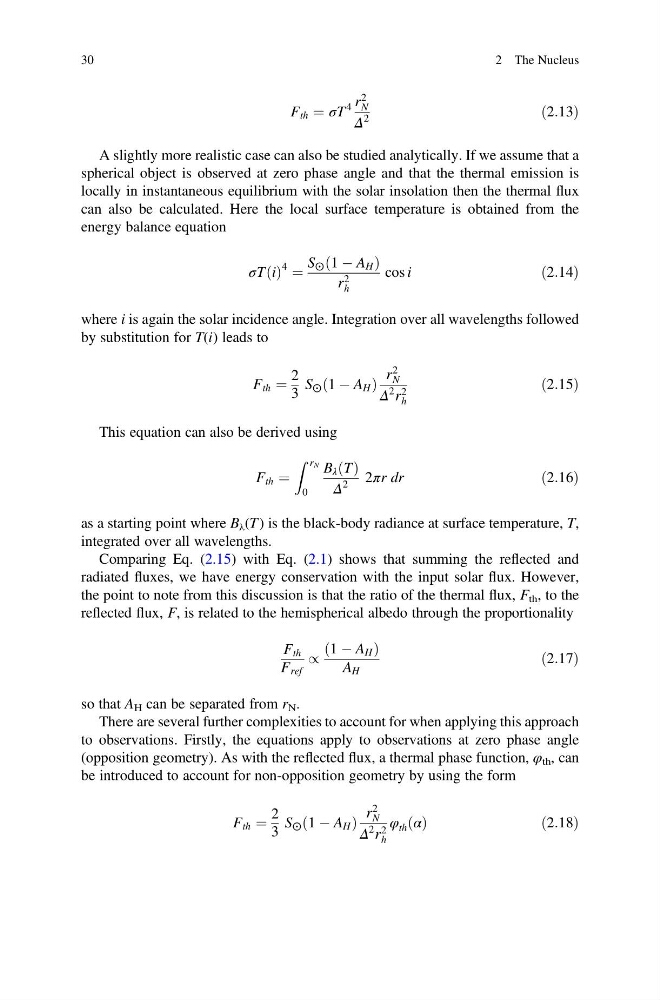
A slightly more realistic case can also be studied analytically. If we assume that a
spherical object is observed at zero phase angle and that the thermal emission is
locally in instantaneous equilibrium with the solar insolation then the thermal flux
can also be calculated. Here the local surface temperature is obtained from the
energy balance equation
σT i
ð Þ
4 ¼
S ⨀ 1 À A H
ð
Þ
r 2
h
cos i
ð2:14Þ
where i is again the solar incidence angle. Integration over all wavelengths followed
by substitution for T(i) leads to
F th ¼
2
3
S ⨀ 1 À A H
ð
Þ
r
2
N
Δ
2 r 2
h
ð2:15Þ
This equation can also be derived using
F th ¼
Z r N
0
B λ T
ð Þ
Δ
2
2πr dr
ð2:16Þ
as a starting point where B λ (T ) is the black-body radiance at surface temperature, T,
integrated over all wavelengths.
Comparing Eq. (2.15) with Eq. (2.1) shows that summing the reflected and
radiated fluxes, we have energy conservation with the input solar flux. However,
the point to note from this discussion is that the ratio of the thermal flux, F th , to the
reflected flux, F, is related to the hemispherical albedo through the proportionality
F th
F ref
/
1 À A H
ð
Þ
A H
ð2:17Þ
so that A H can be separated from r N .
There are several further complexities to account for when applying this approach
to observations. Firstly, the equations apply to observations at zero phase angle
(opposition geometry). As with the reflected flux, a thermal phase function, φ th , can
be introduced to account for non-opposition geometry by using the form
F th ¼
2
3
S ⨀ 1 À A H
ð
Þ
r
2
N
Δ
2 r 2
h
φ th α
ð Þ
ð2:18Þ
30
2 The Nucleus
4 r
2
N
Δ
2
ð2:13Þ
A slightly more realistic case can also be studied analytically. If we assume that a
spherical object is observed at zero phase angle and that the thermal emission is
locally in instantaneous equilibrium with the solar insolation then the thermal flux
can also be calculated. Here the local surface temperature is obtained from the
energy balance equation
σT i
ð Þ
4 ¼
S ⨀ 1 À A H
ð
Þ
r 2
h
cos i
ð2:14Þ
where i is again the solar incidence angle. Integration over all wavelengths followed
by substitution for T(i) leads to
F th ¼
2
3
S ⨀ 1 À A H
ð
Þ
r
2
N
Δ
2 r 2
h
ð2:15Þ
This equation can also be derived using
F th ¼
Z r N
0
B λ T
ð Þ
Δ
2
2πr dr
ð2:16Þ
as a starting point where B λ (T ) is the black-body radiance at surface temperature, T,
integrated over all wavelengths.
Comparing Eq. (2.15) with Eq. (2.1) shows that summing the reflected and
radiated fluxes, we have energy conservation with the input solar flux. However,
the point to note from this discussion is that the ratio of the thermal flux, F th , to the
reflected flux, F, is related to the hemispherical albedo through the proportionality
F th
F ref
/
1 À A H
ð
Þ
A H
ð2:17Þ
so that A H can be separated from r N .
There are several further complexities to account for when applying this approach
to observations. Firstly, the equations apply to observations at zero phase angle
(opposition geometry). As with the reflected flux, a thermal phase function, φ th , can
be introduced to account for non-opposition geometry by using the form
F th ¼
2
3
S ⨀ 1 À A H
ð
Þ
r
2
N
Δ
2 r 2
h
φ th α
ð Þ
ð2:18Þ
30
2 The Nucleus