

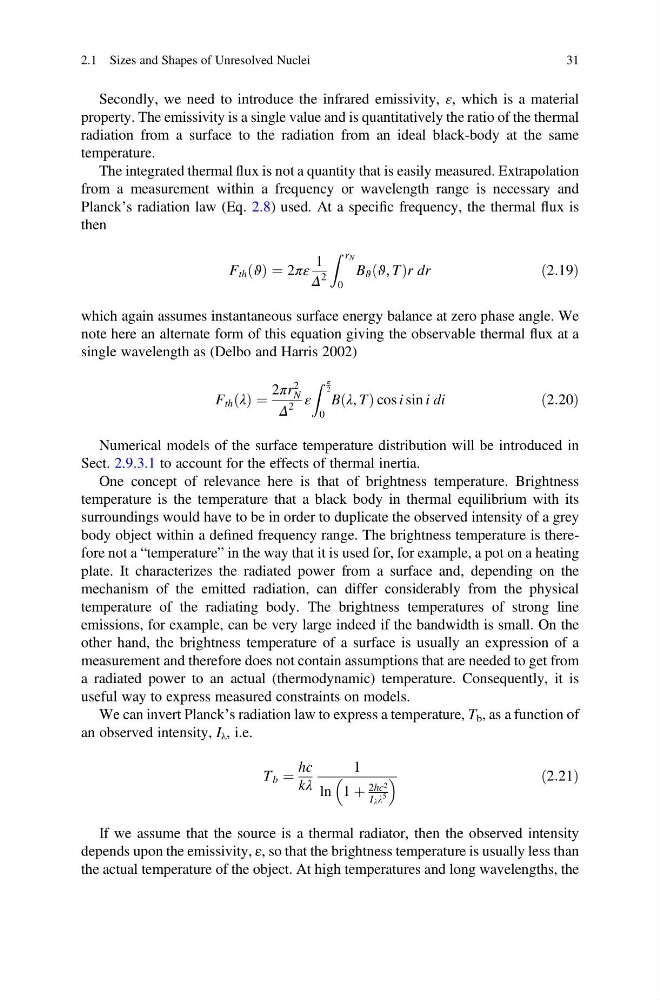
Secondly, we need to introduce the infrared emissivity, ε, which is a material
property. The emissivity is a single value and is quantitatively the ratio of the thermal
radiation from a surface to the radiation from an ideal black-body at the same
temperature.
The integrated thermal flux is not a quantity that is easily measured. Extrapolation
from a measurement within a frequency or wavelength range is necessary and
Planck’s radiation law (Eq. 2.8) used. At a specific frequency, the thermal flux is
then
F th ϑ
ð Þ ¼ 2πε
1
Δ
2
Z r N
0
B ϑ ϑ, T
ð
Þr dr
ð2:19Þ
which again assumes instantaneous surface energy balance at zero phase angle. We
note here an alternate form of this equation giving the observable thermal flux at a
single wavelength as (Delbo and Harris 2002)
F th λ
ð Þ ¼
2πr
2
N
Δ
2
ε
Z π
2
0
B λ, T
ð
Þcos i sin i di
ð2:20Þ
Numerical models of the surface temperature distribution will be introduced in
Sect. 2.9.3.1 to account for the effects of thermal inertia.
One concept of relevance here is that of brightness temperature. Brightness
temperature is the temperature that a black body in thermal equilibrium with its
surroundings would have to be in order to duplicate the observed intensity of a grey
body object within a defined frequency range. The brightness temperature is therefore not a “temperature” in the way that it is used for, for example, a pot on a heating
plate. It characterizes the radiated power from a surface and, depending on the
mechanism of the emitted radiation, can differ considerably from the physical
temperature of the radiating body. The brightness temperatures of strong line
emissions, for example, can be very large indeed if the bandwidth is small. On the
other hand, the brightness temperature of a surface is usually an expression of a
measurement and therefore does not contain assumptions that are needed to get from
a radiated power to an actual (thermodynamic) temperature. Consequently, it is
useful way to express measured constraints on models.
We can invert Planck’s radiation law to express a temperature, T b , as a function of
an observed intensity, I λ , i.e.
T b ¼
hc
kλ
1
ln 1 þ
2hc 2
I λ λ
5
ð2:21Þ
If we assume that the source is a thermal radiator, then the observed intensity
depends upon the emissivity, ε, so that the brightness temperature is usually less than
the actual temperature of the object. At high temperatures and long wavelengths, the
2.1 Sizes and Shapes of Unresolved Nuclei
31
property. The emissivity is a single value and is quantitatively the ratio of the thermal
radiation from a surface to the radiation from an ideal black-body at the same
temperature.
The integrated thermal flux is not a quantity that is easily measured. Extrapolation
from a measurement within a frequency or wavelength range is necessary and
Planck’s radiation law (Eq. 2.8) used. At a specific frequency, the thermal flux is
then
F th ϑ
ð Þ ¼ 2πε
1
Δ
2
Z r N
0
B ϑ ϑ, T
ð
Þr dr
ð2:19Þ
which again assumes instantaneous surface energy balance at zero phase angle. We
note here an alternate form of this equation giving the observable thermal flux at a
single wavelength as (Delbo and Harris 2002)
F th λ
ð Þ ¼
2πr
2
N
Δ
2
ε
Z π
2
0
B λ, T
ð
Þcos i sin i di
ð2:20Þ
Numerical models of the surface temperature distribution will be introduced in
Sect. 2.9.3.1 to account for the effects of thermal inertia.
One concept of relevance here is that of brightness temperature. Brightness
temperature is the temperature that a black body in thermal equilibrium with its
surroundings would have to be in order to duplicate the observed intensity of a grey
body object within a defined frequency range. The brightness temperature is therefore not a “temperature” in the way that it is used for, for example, a pot on a heating
plate. It characterizes the radiated power from a surface and, depending on the
mechanism of the emitted radiation, can differ considerably from the physical
temperature of the radiating body. The brightness temperatures of strong line
emissions, for example, can be very large indeed if the bandwidth is small. On the
other hand, the brightness temperature of a surface is usually an expression of a
measurement and therefore does not contain assumptions that are needed to get from
a radiated power to an actual (thermodynamic) temperature. Consequently, it is
useful way to express measured constraints on models.
We can invert Planck’s radiation law to express a temperature, T b , as a function of
an observed intensity, I λ , i.e.
T b ¼
hc
kλ
1
ln 1 þ
2hc 2
I λ λ
5
ð2:21Þ
If we assume that the source is a thermal radiator, then the observed intensity
depends upon the emissivity, ε, so that the brightness temperature is usually less than
the actual temperature of the object. At high temperatures and long wavelengths, the
2.1 Sizes and Shapes of Unresolved Nuclei
31