

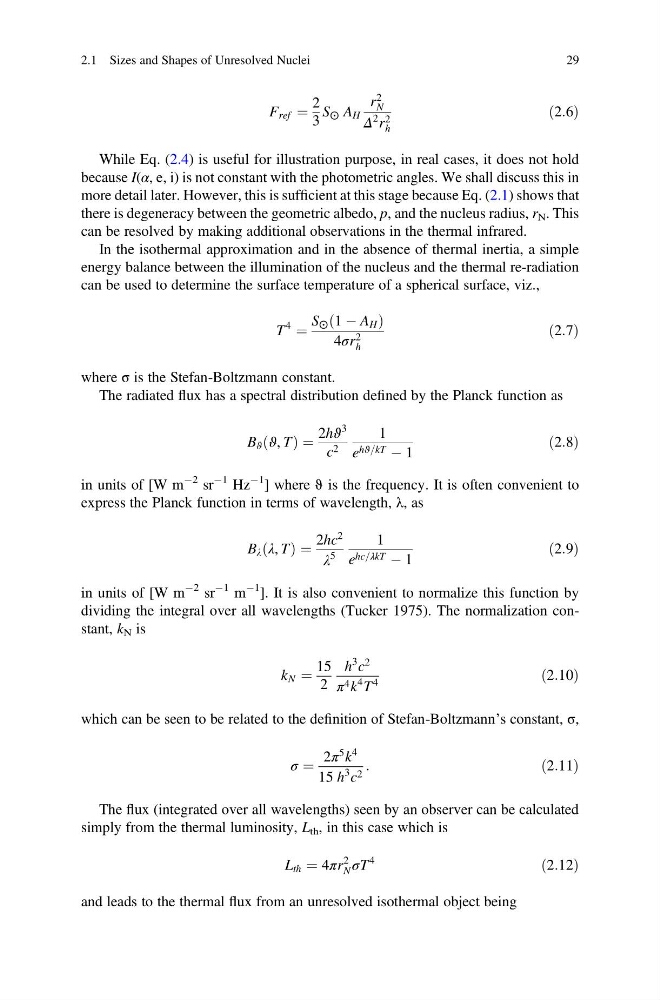
F ref ¼
2
3
S ⨀ A H
r
2
N
Δ
2 r 2
h
ð2:6Þ
While Eq. (2.4) is useful for illustration purpose, in real cases, it does not hold
because I(α, e, i) is not constant with the photometric angles. We shall discuss this in
more detail later. However, this is sufficient at this stage because Eq. (2.1) shows that
there is degeneracy between the geometric albedo, p, and the nucleus radius, r N . This
can be resolved by making additional observations in the thermal infrared.
In the isothermal approximation and in the absence of thermal inertia, a simple
energy balance between the illumination of the nucleus and the thermal re-radiation
can be used to determine the surface temperature of a spherical surface, viz.,
T
4
¼
S ⨀ 1 À A H
ð
Þ
4σr 2
h
ð2:7Þ
where σ is the Stefan-Boltzmann constant.
The radiated flux has a spectral distribution defined by the Planck function as
B ϑ ϑ, T
ð
Þ ¼
2hϑ
3
c 2
1
e hϑ=kT À 1
ð2:8Þ
in units of [W m
À2 sr
À1 Hz
À1 ] where ϑ is the frequency. It is often convenient to
express the Planck function in terms of wavelength, λ, as
B λ λ, T
ð Þ ¼
2hc
2
λ
5
1
e hc=λkT À 1
ð2:9Þ
in units of [W m
À2 sr
À1 m
À1
]. It is also convenient to normalize this function by
dividing the integral over all wavelengths (Tucker 1975). The normalization constant, k N is
k N ¼
15
2
h
3 c
2
π 4 k
4 T
4
ð2:10Þ
which can be seen to be related to the definition of Stefan-Boltzmann’s constant, σ,
σ ¼
2π
5 k
4
15 h
3 c 2 :
ð2:11Þ
The flux (integrated over all wavelengths) seen by an observer can be calculated
simply from the thermal luminosity, L th , in this case which is
L th ¼ 4πr
2
N σT
4
ð2:12Þ
and leads to the thermal flux from an unresolved isothermal object being
2.1 Sizes and Shapes of Unresolved Nuclei
29
2
3
S ⨀ A H
r
2
N
Δ
2 r 2
h
ð2:6Þ
While Eq. (2.4) is useful for illustration purpose, in real cases, it does not hold
because I(α, e, i) is not constant with the photometric angles. We shall discuss this in
more detail later. However, this is sufficient at this stage because Eq. (2.1) shows that
there is degeneracy between the geometric albedo, p, and the nucleus radius, r N . This
can be resolved by making additional observations in the thermal infrared.
In the isothermal approximation and in the absence of thermal inertia, a simple
energy balance between the illumination of the nucleus and the thermal re-radiation
can be used to determine the surface temperature of a spherical surface, viz.,
T
4
¼
S ⨀ 1 À A H
ð
Þ
4σr 2
h
ð2:7Þ
where σ is the Stefan-Boltzmann constant.
The radiated flux has a spectral distribution defined by the Planck function as
B ϑ ϑ, T
ð
Þ ¼
2hϑ
3
c 2
1
e hϑ=kT À 1
ð2:8Þ
in units of [W m
À2 sr
À1 Hz
À1 ] where ϑ is the frequency. It is often convenient to
express the Planck function in terms of wavelength, λ, as
B λ λ, T
ð Þ ¼
2hc
2
λ
5
1
e hc=λkT À 1
ð2:9Þ
in units of [W m
À2 sr
À1 m
À1
]. It is also convenient to normalize this function by
dividing the integral over all wavelengths (Tucker 1975). The normalization constant, k N is
k N ¼
15
2
h
3 c
2
π 4 k
4 T
4
ð2:10Þ
which can be seen to be related to the definition of Stefan-Boltzmann’s constant, σ,
σ ¼
2π
5 k
4
15 h
3 c 2 :
ð2:11Þ
The flux (integrated over all wavelengths) seen by an observer can be calculated
simply from the thermal luminosity, L th , in this case which is
L th ¼ 4πr
2
N σT
4
ð2:12Þ
and leads to the thermal flux from an unresolved isothermal object being
2.1 Sizes and Shapes of Unresolved Nuclei
29