

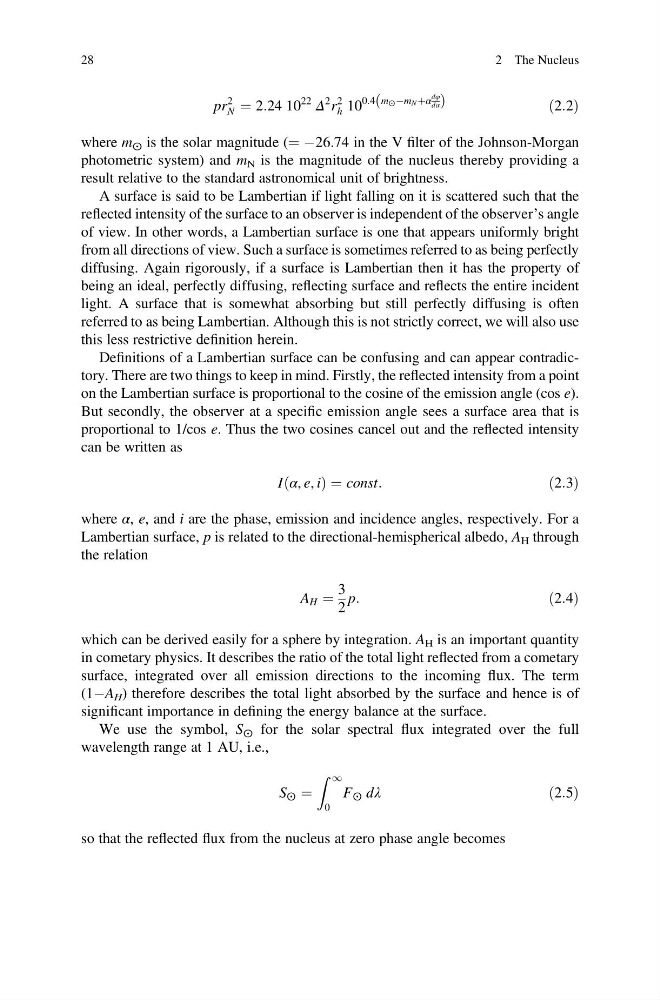
pr
2
N ¼ 2:24 10
22
Δ
2 r
2
h 10
0:4 m ⨀ Àm N þα
dφ
dα
ð
Þ
ð2:2Þ
where m ⨀ is the solar magnitude (¼ À26.74 in the V filter of the Johnson-Morgan
photometric system) and m N is the magnitude of the nucleus thereby providing a
result relative to the standard astronomical unit of brightness.
A surface is said to be Lambertian if light falling on it is scattered such that the
reflected intensity of the surface to an observer is independent of the observer’s angle
of view. In other words, a Lambertian surface is one that appears uniformly bright
from all directions of view. Such a surface is sometimes referred to as being perfectly
diffusing. Again rigorously, if a surface is Lambertian then it has the property of
being an ideal, perfectly diffusing, reflecting surface and reflects the entire incident
light. A surface that is somewhat absorbing but still perfectly diffusing is often
referred to as being Lambertian. Although this is not strictly correct, we will also use
this less restrictive definition herein.
Definitions of a Lambertian surface can be confusing and can appear contradictory. There are two things to keep in mind. Firstly, the reflected intensity from a point
on the Lambertian surface is proportional to the cosine of the emission angle (cos e).
But secondly, the observer at a specific emission angle sees a surface area that is
proportional to 1/cos e. Thus the two cosines cancel out and the reflected intensity
can be written as
I α, e, i
ð
Þ¼const:
ð2:3Þ
where α, e, and i are the phase, emission and incidence angles, respectively. For a
Lambertian surface, p is related to the directional-hemispherical albedo, A H through
the relation
A H ¼
3
2
p:
ð2:4Þ
which can be derived easily for a sphere by integration. A H is an important quantity
in cometary physics. It describes the ratio of the total light reflected from a cometary
surface, integrated over all emission directions to the incoming flux. The term
(1ÀA H ) therefore describes the total light absorbed by the surface and hence is of
significant importance in defining the energy balance at the surface.
We use the symbol, S ⨀ for the solar spectral flux integrated over the full
wavelength range at 1 AU, i.e.,
S ⨀ ¼
Z 1
0
F ⨀ dλ
ð2:5Þ
so that the reflected flux from the nucleus at zero phase angle becomes
28
2 The Nucleus
2
N ¼ 2:24 10
22
Δ
2 r
2
h 10
0:4 m ⨀ Àm N þα
dφ
dα
ð
Þ
ð2:2Þ
where m ⨀ is the solar magnitude (¼ À26.74 in the V filter of the Johnson-Morgan
photometric system) and m N is the magnitude of the nucleus thereby providing a
result relative to the standard astronomical unit of brightness.
A surface is said to be Lambertian if light falling on it is scattered such that the
reflected intensity of the surface to an observer is independent of the observer’s angle
of view. In other words, a Lambertian surface is one that appears uniformly bright
from all directions of view. Such a surface is sometimes referred to as being perfectly
diffusing. Again rigorously, if a surface is Lambertian then it has the property of
being an ideal, perfectly diffusing, reflecting surface and reflects the entire incident
light. A surface that is somewhat absorbing but still perfectly diffusing is often
referred to as being Lambertian. Although this is not strictly correct, we will also use
this less restrictive definition herein.
Definitions of a Lambertian surface can be confusing and can appear contradictory. There are two things to keep in mind. Firstly, the reflected intensity from a point
on the Lambertian surface is proportional to the cosine of the emission angle (cos e).
But secondly, the observer at a specific emission angle sees a surface area that is
proportional to 1/cos e. Thus the two cosines cancel out and the reflected intensity
can be written as
I α, e, i
ð
Þ¼const:
ð2:3Þ
where α, e, and i are the phase, emission and incidence angles, respectively. For a
Lambertian surface, p is related to the directional-hemispherical albedo, A H through
the relation
A H ¼
3
2
p:
ð2:4Þ
which can be derived easily for a sphere by integration. A H is an important quantity
in cometary physics. It describes the ratio of the total light reflected from a cometary
surface, integrated over all emission directions to the incoming flux. The term
(1ÀA H ) therefore describes the total light absorbed by the surface and hence is of
significant importance in defining the energy balance at the surface.
We use the symbol, S ⨀ for the solar spectral flux integrated over the full
wavelength range at 1 AU, i.e.,
S ⨀ ¼
Z 1
0
F ⨀ dλ
ð2:5Þ
so that the reflected flux from the nucleus at zero phase angle becomes
28
2 The Nucleus