

In Fig. 1.5, we have used the period alone to differentiate between two classes of
object. For many simple calculations, for example the computation of heat fluxes on
a cometary nucleus over a period of several months, the restricted two-body problem
is adequate and the orbital period is assumed not to change. However, the precise
computation of the positions of nuclei over several decades or centuries requires
detailed numerical integration taking into account the gravitational influence of the
planets. The major planets are continuously perturbing the orbits of SPCs and quite
significant changes in the period can occur on relatively short timescales. This is
especially apparent when a comet’s orbit makes passes close to one of the giant
planets. Interactions with Jupiter in particular are highly significant in cometary
research. Rickman (2017) lists objects that have undergone recent major perturbations. These include 67P that made a close approach to Jupiter (at a minimum
distance of 0.052 AU) in 1959 which resulted in a substantial reduction of its
perihelion distance (from 2.76 AU to 1.29 AU).
Levison (1996) introduced the use of the Tisserand parameter to analyse this
issue. The Tisserand parameter is a dynamical quantity that arises from a circular
restricted three-body system and is approximately conserved (at the 1% level—see
Murray and Dermott 1999) during an encounter between a planet orbiting a central
star and a small massless object. It therefore provides a way to connect the postencounter dynamical properties with the pre-encounter properties. The Tisserand
parameter also provides a measure of the relative speed of an object when it crosses
the orbit of a planet. Therefore, for a given object, different Tisserand parameters
exist for different planets.
The Tisserand parameter with respect to Jupiter, T J , is given by
T J ¼
a J
a s
þ 2
ffiffiffiffiffiffiffiffiffiffiffiffiffiffiffiffiffiffiffiffiffiffiffi
1 À e x
2
ð
Þ
a s
a J
r
cos i x
ð1:17Þ
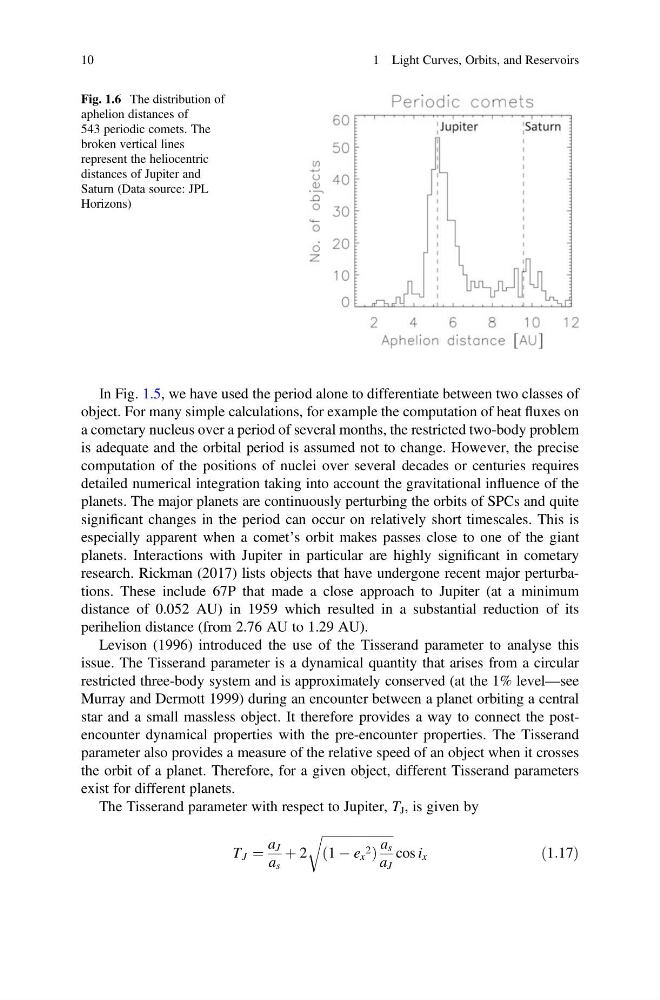
Fig. 1.6 The distribution of
aphelion distances of
543 periodic comets. The
broken vertical lines
represent the heliocentric
distances of Jupiter and
Saturn (Data source: JPL
Horizons)
10
1 Light Curves, Orbits, and Reservoirs
object. For many simple calculations, for example the computation of heat fluxes on
a cometary nucleus over a period of several months, the restricted two-body problem
is adequate and the orbital period is assumed not to change. However, the precise
computation of the positions of nuclei over several decades or centuries requires
detailed numerical integration taking into account the gravitational influence of the
planets. The major planets are continuously perturbing the orbits of SPCs and quite
significant changes in the period can occur on relatively short timescales. This is
especially apparent when a comet’s orbit makes passes close to one of the giant
planets. Interactions with Jupiter in particular are highly significant in cometary
research. Rickman (2017) lists objects that have undergone recent major perturbations. These include 67P that made a close approach to Jupiter (at a minimum
distance of 0.052 AU) in 1959 which resulted in a substantial reduction of its
perihelion distance (from 2.76 AU to 1.29 AU).
Levison (1996) introduced the use of the Tisserand parameter to analyse this
issue. The Tisserand parameter is a dynamical quantity that arises from a circular
restricted three-body system and is approximately conserved (at the 1% level—see
Murray and Dermott 1999) during an encounter between a planet orbiting a central
star and a small massless object. It therefore provides a way to connect the postencounter dynamical properties with the pre-encounter properties. The Tisserand
parameter also provides a measure of the relative speed of an object when it crosses
the orbit of a planet. Therefore, for a given object, different Tisserand parameters
exist for different planets.
The Tisserand parameter with respect to Jupiter, T J , is given by
T J ¼
a J
a s
þ 2
ffiffiffiffiffiffiffiffiffiffiffiffiffiffiffiffiffiffiffiffiffiffiffi
1 À e x
2
ð
Þ
a s
a J
r
cos i x
ð1:17Þ
Fig. 1.6 The distribution of
aphelion distances of
543 periodic comets. The
broken vertical lines
represent the heliocentric
distances of Jupiter and
Saturn (Data source: JPL
Horizons)
10
1 Light Curves, Orbits, and Reservoirs