

occurred in the specific cases of 226P/Pigott-LINEAR-Kowalski (formally D/1783
W1 (Pigott)) and 289P/Blanpain (formally D/1819 W1 (Blanpain)) (Rickman 2017).
The use of 200 years is arbitrary but roughly corresponds to the time since systematic
observations with instruments could be made. The prefix C/ is used for comets that
are not periodic according to the above definition. This is a little misleading in that
many comets have now been identified as being on closed, elliptical orbits and will
thus return to the inner solar system at some point although their orbital periods far
exceed 200 years. In spite of this, the C/ prefix is also used for comets on nearhyperbolic orbits that, in principle should never return. This has been recently
augmented by the prefix I/ for objects that are clearly interstellar in origin. The
prefix X/ is used for comets for which an orbit cannot be reasonably established.
As pointed out by Rickman (2017), there are numerous inconsistencies in the
definitions and use of designations but there is rarely confusion.
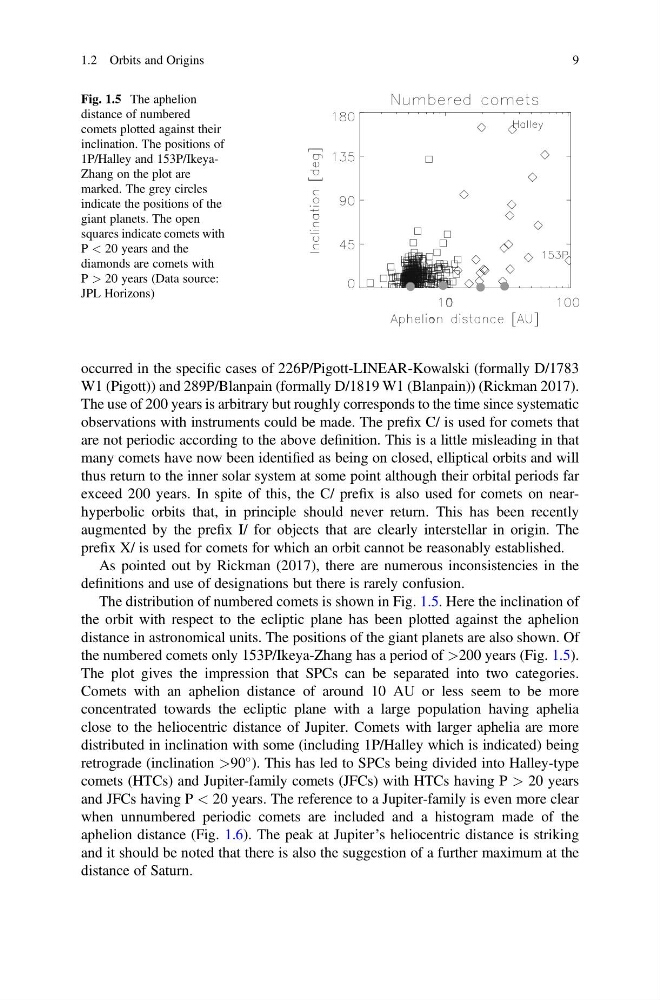
The distribution of numbered comets is shown in Fig. 1.5. Here the inclination of
the orbit with respect to the ecliptic plane has been plotted against the aphelion
distance in astronomical units. The positions of the giant planets are also shown. Of
the numbered comets only 153P/Ikeya-Zhang has a period of >200 years (Fig. 1.5).
The plot gives the impression that SPCs can be separated into two categories.
Comets with an aphelion distance of around 10 AU or less seem to be more
concentrated towards the ecliptic plane with a large population having aphelia
close to the heliocentric distance of Jupiter. Comets with larger aphelia are more
distributed in inclination with some (including 1P/Halley which is indicated) being
retrograde (inclination >90
). This has led to SPCs being divided into Halley-type
comets (HTCs) and Jupiter-family comets (JFCs) with HTCs having P > 20 years
and JFCs having P < 20 years. The reference to a Jupiter-family is even more clear
when unnumbered periodic comets are included and a histogram made of the
aphelion distance (Fig. 1.6). The peak at Jupiter’s heliocentric distance is striking
and it should be noted that there is also the suggestion of a further maximum at the
distance of Saturn.
Fig. 1.5 The aphelion
distance of numbered
comets plotted against their
inclination. The positions of
1P/Halley and 153P/IkeyaZhang on the plot are
marked. The grey circles
indicate the positions of the
giant planets. The open
squares indicate comets with
P < 20 years and the
diamonds are comets with
P > 20 years (Data source:
JPL Horizons)
1.2 Orbits and Origins
9
W1 (Pigott)) and 289P/Blanpain (formally D/1819 W1 (Blanpain)) (Rickman 2017).
The use of 200 years is arbitrary but roughly corresponds to the time since systematic
observations with instruments could be made. The prefix C/ is used for comets that
are not periodic according to the above definition. This is a little misleading in that
many comets have now been identified as being on closed, elliptical orbits and will
thus return to the inner solar system at some point although their orbital periods far
exceed 200 years. In spite of this, the C/ prefix is also used for comets on nearhyperbolic orbits that, in principle should never return. This has been recently
augmented by the prefix I/ for objects that are clearly interstellar in origin. The
prefix X/ is used for comets for which an orbit cannot be reasonably established.
As pointed out by Rickman (2017), there are numerous inconsistencies in the
definitions and use of designations but there is rarely confusion.
The distribution of numbered comets is shown in Fig. 1.5. Here the inclination of
the orbit with respect to the ecliptic plane has been plotted against the aphelion
distance in astronomical units. The positions of the giant planets are also shown. Of
the numbered comets only 153P/Ikeya-Zhang has a period of >200 years (Fig. 1.5).
The plot gives the impression that SPCs can be separated into two categories.
Comets with an aphelion distance of around 10 AU or less seem to be more
concentrated towards the ecliptic plane with a large population having aphelia
close to the heliocentric distance of Jupiter. Comets with larger aphelia are more
distributed in inclination with some (including 1P/Halley which is indicated) being
retrograde (inclination >90
). This has led to SPCs being divided into Halley-type
comets (HTCs) and Jupiter-family comets (JFCs) with HTCs having P > 20 years
and JFCs having P < 20 years. The reference to a Jupiter-family is even more clear
when unnumbered periodic comets are included and a histogram made of the
aphelion distance (Fig. 1.6). The peak at Jupiter’s heliocentric distance is striking
and it should be noted that there is also the suggestion of a further maximum at the
distance of Saturn.
Fig. 1.5 The aphelion
distance of numbered
comets plotted against their
inclination. The positions of
1P/Halley and 153P/IkeyaZhang on the plot are
marked. The grey circles
indicate the positions of the
giant planets. The open
squares indicate comets with
P < 20 years and the
diamonds are comets with
P > 20 years (Data source:
JPL Horizons)
1.2 Orbits and Origins
9