

where a J is Jupiter’s semi-major axis, and i x is the object’s inclination. To derive the
Tisserand parameter, one must express the Jacobi constant (the only known conserved quantity in the circular restricted three-body problem) in terms of orbital
parameters, i.e.
C J ¼ ñ
2 x
2
þ y
2
À
Á þ 2
μ 1
r 1
þ
μ 2
r 2
À _
x
2
þ _
y
2
þ _
z
2
À
Á :
ð1:18Þ
Here r 1 and r 2 are the distances of the massless object from the other two masses
and μ x ¼ GM x for the two masses. ñ is the mean motion of the masses about the
common barycentre.
If a comet intersects the orbit of the planet, then the Tisserand parameter with
respect to a planet x, T x , is related to the unperturbed relative velocity, V x , at which it
encounters the planet through the equation
V x ¼
ffiffiffiffiffiffiffiffiffiffiffiffiffi
3 À T x
p
ð1:19Þ
where V x is in units of the planet’s orbital velocity (see Duncan et al. 2004).
Inspection of this equation shows that T x cannot be greater than 3 and thus an object
with T x > 3 cannot intersect the planet’s orbit in the circular restricted case.
As T x becomes closer to 3, the influence of the planet on the comet’s orbit
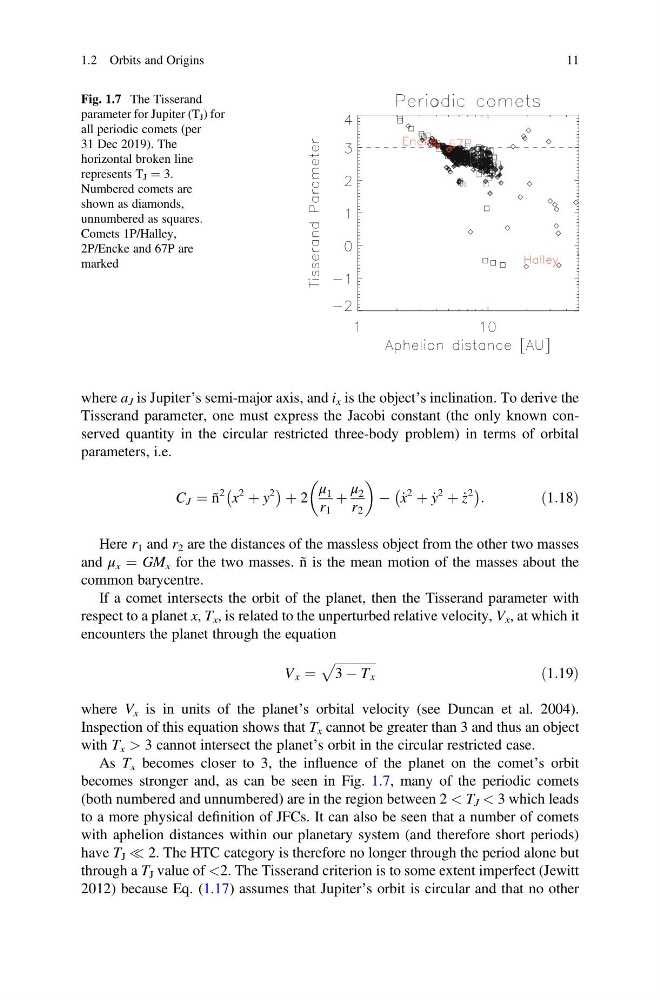
becomes stronger and, as can be seen in Fig. 1.7, many of the periodic comets
(both numbered and unnumbered) are in the region between 2 < T J < 3 which leads
to a more physical definition of JFCs. It can also be seen that a number of comets
with aphelion distances within our planetary system (and therefore short periods)
have T J ( 2. The HTC category is therefore no longer through the period alone but
through a T J value of <2. The Tisserand criterion is to some extent imperfect (Jewitt
2012) because Eq. (1.17) assumes that Jupiter’s orbit is circular and that no other
Fig. 1.7 The Tisserand
parameter for Jupiter (T J ) for
all periodic comets (per
31 Dec 2019). The
horizontal broken line
represents T J ¼ 3.
Numbered comets are
shown as diamonds,
unnumbered as squares.
Comets 1P/Halley,
2P/Encke and 67P are
marked
1.2 Orbits and Origins
11
Tisserand parameter, one must express the Jacobi constant (the only known conserved quantity in the circular restricted three-body problem) in terms of orbital
parameters, i.e.
C J ¼ ñ
2 x
2
þ y
2
À
Á þ 2
μ 1
r 1
þ
μ 2
r 2
À _
x
2
þ _
y
2
þ _
z
2
À
Á :
ð1:18Þ
Here r 1 and r 2 are the distances of the massless object from the other two masses
and μ x ¼ GM x for the two masses. ñ is the mean motion of the masses about the
common barycentre.
If a comet intersects the orbit of the planet, then the Tisserand parameter with
respect to a planet x, T x , is related to the unperturbed relative velocity, V x , at which it
encounters the planet through the equation
V x ¼
ffiffiffiffiffiffiffiffiffiffiffiffiffi
3 À T x
p
ð1:19Þ
where V x is in units of the planet’s orbital velocity (see Duncan et al. 2004).
Inspection of this equation shows that T x cannot be greater than 3 and thus an object
with T x > 3 cannot intersect the planet’s orbit in the circular restricted case.
As T x becomes closer to 3, the influence of the planet on the comet’s orbit
becomes stronger and, as can be seen in Fig. 1.7, many of the periodic comets
(both numbered and unnumbered) are in the region between 2 < T J < 3 which leads
to a more physical definition of JFCs. It can also be seen that a number of comets
with aphelion distances within our planetary system (and therefore short periods)
have T J ( 2. The HTC category is therefore no longer through the period alone but
through a T J value of <2. The Tisserand criterion is to some extent imperfect (Jewitt
2012) because Eq. (1.17) assumes that Jupiter’s orbit is circular and that no other
Fig. 1.7 The Tisserand
parameter for Jupiter (T J ) for
all periodic comets (per
31 Dec 2019). The
horizontal broken line
represents T J ¼ 3.
Numbered comets are
shown as diamonds,
unnumbered as squares.
Comets 1P/Halley,
2P/Encke and 67P are
marked
1.2 Orbits and Origins
11