

an example. Fragments can produce potentially dangerous near-Earth objects. For
example, the near-Earth object (NEO) 2004 TG10 may be a fragment of 2P/Encke
(Porubčan et al. 2006).
Fracturing and separation of cometary sub-nuclei do not necessarily result in the
break-up of a comet unless there are forces that ensure that the fragments reach
escape velocity. Re-accumulation of material is possible resulting in a “re-configuration” of the sub-nuclei thereby simply changing the shape and exposing “fresh”
surfaces (Jutzi and Benz 2017). This will strongly depend upon the additional forces
(either gravitational or non-gravitational arising from the jet action of outgassing)
acting on the sub-nuclei. We have at this point no observational evidence of
re-accumulation of comets after fragmentation but observations of binary asteroids
and even triple asteroid systems have been explained by rotational fission (Margot
et al. 2015) suggesting that similar processes can be considered.
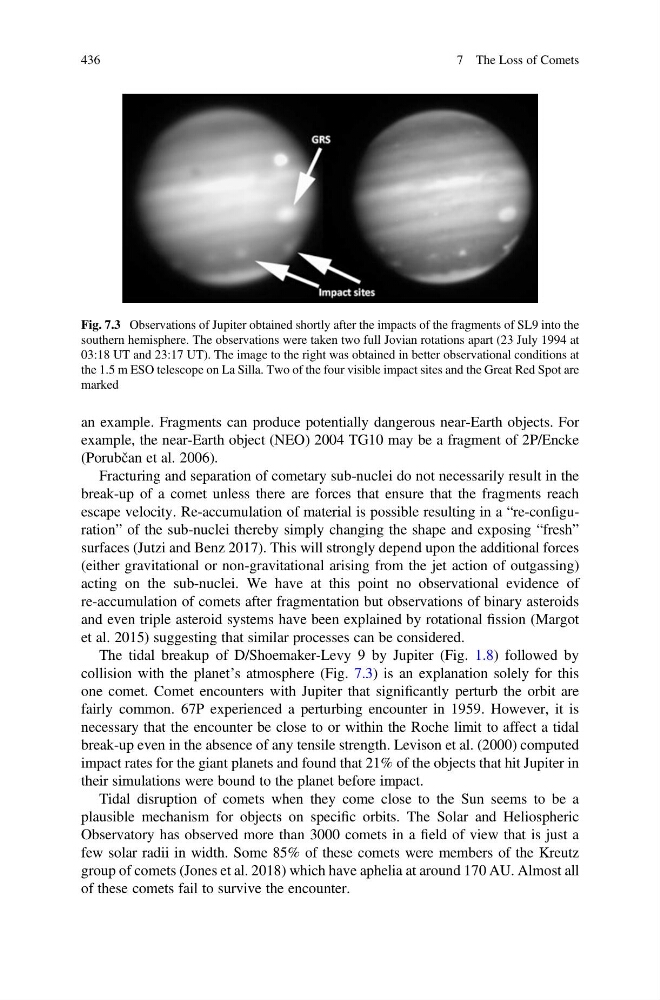
The tidal breakup of D/Shoemaker-Levy 9 by Jupiter (Fig. 1.8) followed by
collision with the planet’s atmosphere (Fig. 7.3) is an explanation solely for this
one comet. Comet encounters with Jupiter that significantly perturb the orbit are
fairly common. 67P experienced a perturbing encounter in 1959. However, it is
necessary that the encounter be close to or within the Roche limit to affect a tidal
break-up even in the absence of any tensile strength. Levison et al. (2000) computed
impact rates for the giant planets and found that 21% of the objects that hit Jupiter in
their simulations were bound to the planet before impact.
Tidal disruption of comets when they come close to the Sun seems to be a
plausible mechanism for objects on specific orbits. The Solar and Heliospheric
Observatory has observed more than 3000 comets in a field of view that is just a
few solar radii in width. Some 85% of these comets were members of the Kreutz
group of comets (Jones et al. 2018) which have aphelia at around 170 AU. Almost all
of these comets fail to survive the encounter.
Fig. 7.3 Observations of Jupiter obtained shortly after the impacts of the fragments of SL9 into the
southern hemisphere. The observations were taken two full Jovian rotations apart (23 July 1994 at
03:18 UT and 23:17 UT). The image to the right was obtained in better observational conditions at
the 1.5 m ESO telescope on La Silla. Two of the four visible impact sites and the Great Red Spot are
marked
436
7 The Loss of Comets
example, the near-Earth object (NEO) 2004 TG10 may be a fragment of 2P/Encke
(Porubčan et al. 2006).
Fracturing and separation of cometary sub-nuclei do not necessarily result in the
break-up of a comet unless there are forces that ensure that the fragments reach
escape velocity. Re-accumulation of material is possible resulting in a “re-configuration” of the sub-nuclei thereby simply changing the shape and exposing “fresh”
surfaces (Jutzi and Benz 2017). This will strongly depend upon the additional forces
(either gravitational or non-gravitational arising from the jet action of outgassing)
acting on the sub-nuclei. We have at this point no observational evidence of
re-accumulation of comets after fragmentation but observations of binary asteroids
and even triple asteroid systems have been explained by rotational fission (Margot
et al. 2015) suggesting that similar processes can be considered.
The tidal breakup of D/Shoemaker-Levy 9 by Jupiter (Fig. 1.8) followed by
collision with the planet’s atmosphere (Fig. 7.3) is an explanation solely for this
one comet. Comet encounters with Jupiter that significantly perturb the orbit are
fairly common. 67P experienced a perturbing encounter in 1959. However, it is
necessary that the encounter be close to or within the Roche limit to affect a tidal
break-up even in the absence of any tensile strength. Levison et al. (2000) computed
impact rates for the giant planets and found that 21% of the objects that hit Jupiter in
their simulations were bound to the planet before impact.
Tidal disruption of comets when they come close to the Sun seems to be a
plausible mechanism for objects on specific orbits. The Solar and Heliospheric
Observatory has observed more than 3000 comets in a field of view that is just a
few solar radii in width. Some 85% of these comets were members of the Kreutz
group of comets (Jones et al. 2018) which have aphelia at around 170 AU. Almost all
of these comets fail to survive the encounter.
Fig. 7.3 Observations of Jupiter obtained shortly after the impacts of the fragments of SL9 into the
southern hemisphere. The observations were taken two full Jovian rotations apart (23 July 1994 at
03:18 UT and 23:17 UT). The image to the right was obtained in better observational conditions at
the 1.5 m ESO telescope on La Silla. Two of the four visible impact sites and the Great Red Spot are
marked
436
7 The Loss of Comets